Ordering of Words in a Sentence
None
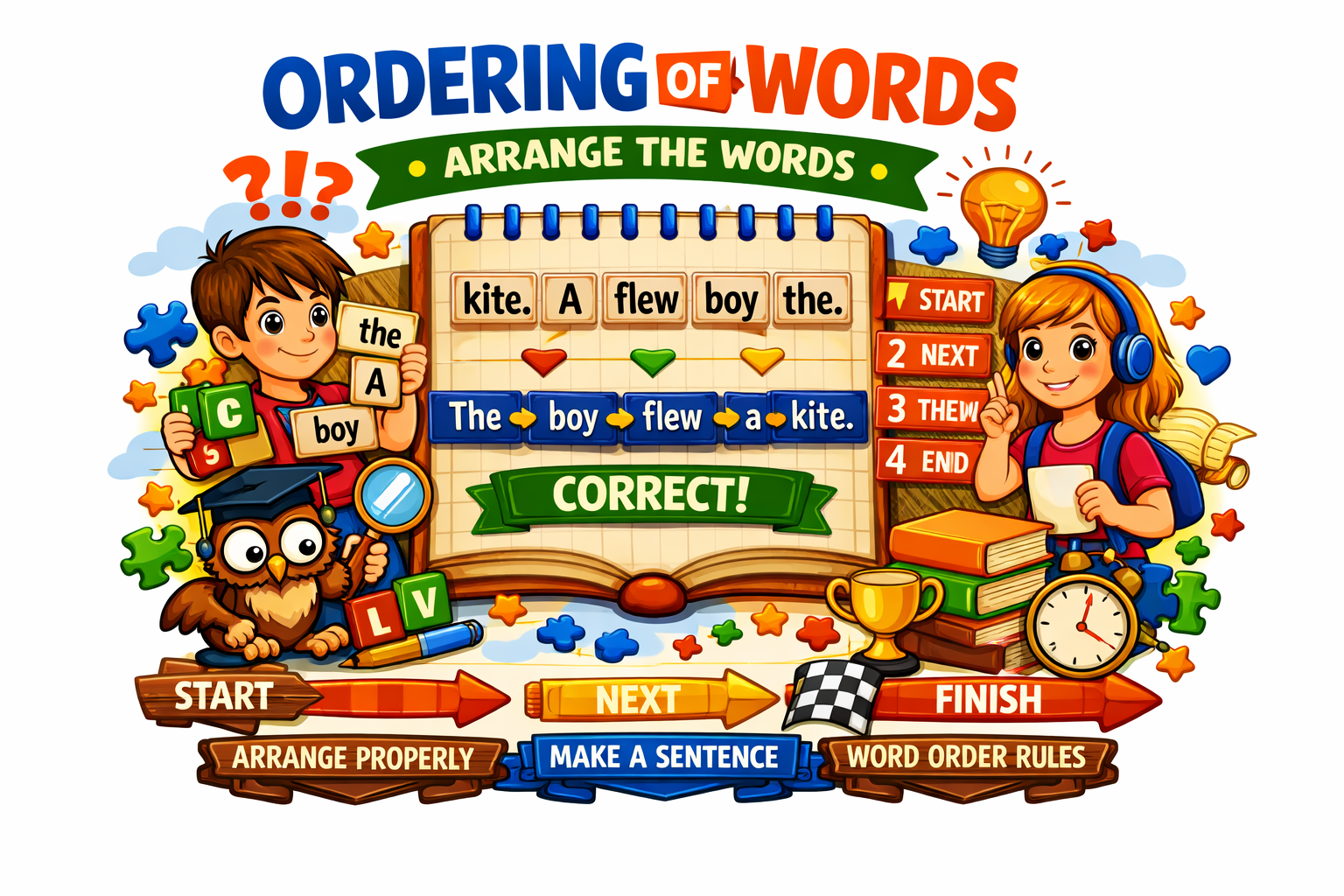
Ordering of Words in a Sentence questions test your ability to arrange jumbled words into a grammatically correct and meaningful sentence.
What is Ordering of Words in a Sentence?
In Ordering of Words, a set of words is given in a mixed order. You must arrange them correctly to form a complete and meaningful sentence.
A correct sentence usually follows a clear structure such as Subject + Verb + Object. Extra words like adjectives, adverbs, prepositions, and time expressions must be placed in the right position.
| Jumbled Words | Correct Sentence | Pattern |
|---|---|---|
| plays / cricket / Rohan | Rohan plays cricket. | Subject + Verb + Object |
| is / she / intelligent | She is intelligent. | Subject + Verb + Complement |
| school / goes / every day / to / he | He goes to school every day. | Subject + Verb + Place + Time |
| a / story / interesting / wrote / the boy | The boy wrote an interesting story. | Subject + Verb + Adjective + Object |
“A sentence becomes clear when words stand in their proper places.”
Grammar Tip
Key points
- Find the subject first.
- Identify the main verb.
- Place the object after the verb.
- Put adjectives before nouns.
- Check whether the final sentence sounds natural.
Common Word Order Patterns
Most sentence-ordering questions can be solved by identifying the sentence pattern.
Subject + Verb
The simplest sentence pattern.
- Birds fly.
- Children play.
- The baby sleeps.
Subject + Verb + Object
The object receives the action.
- She reads a book.
- He kicked the ball.
- They built a house.
Adjective + Noun
Adjectives usually come before nouns.
- a beautiful flower
- an honest man
- a difficult question
Place Before Time
Place often comes before time in simple sentences.
- He went to Mysuru yesterday.
- She studies at home every evening.
- They met in the park on Sunday.
Mini Word Ordering Strategy Bank
Tip: In jumbled word questions, punctuation and capital letters may give useful clues about the beginning and end.
Common Exam Examples
| Jumbled Words | Correct Sentence | Clue | Pattern |
|---|---|---|---|
| the / rises / east / sun / in | The sun rises in the east. | The sun = subject | Subject + Verb + Place |
| an / apple / every day / eats / she | She eats an apple every day. | She = subject; eats = verb | Subject + Verb + Object + Time |
| very / is / this / useful / book | This book is very useful. | This book = subject | Subject + Verb + Complement |
| quickly / the / ran / boy | The boy ran quickly. | Quickly describes ran | Subject + Verb + Adverb |
| in / lives / my / friend / Bengaluru | My friend lives in Bengaluru. | My friend = subject | Subject + Verb + Place |
| gave / teacher / homework / the / us | The teacher gave us homework. | The teacher = subject | Subject + Verb + Indirect Object + Object |
Note: In exams, do not simply arrange words by memory. Check grammar, meaning, and natural word order.
Practice
A) Multiple Choice: Choose the Correct Sentence
-
Arrange: plays / football / Ravi / every evening
Football plays Ravi every evening. Ravi plays football every evening. Every evening football Ravi plays. Plays Ravi football every evening.
-
Arrange: is / my / teacher / kind / very
My teacher is very kind. Very kind my teacher is. Teacher my is very kind. Is my teacher very kind.
-
Arrange: the / garden / flowers / beautiful / has
Beautiful the garden has flowers. The garden has beautiful flowers. Flowers has the garden beautiful. Has the garden beautiful flowers.
-
Arrange: early / wakes up / every day / she
Every day wakes up she early. She wakes up early every day. Early every day she wakes up. Wakes up she early every day.
B) Arrange the Words Manually
- reads / every night / a story / the child (Hint: Subject + Verb + Object + Time)
- are / students / the / in / classroom / the (Hint: Subject + Verb + Place)
- beautiful / a / painted / picture / she (Hint: adjective before noun)
- helps / exercise / us / healthy / stay (Hint: Subject + Verb + Object + Complement)
- on / table / the / book / is / the (Hint: Subject + Verb + Place)
C) Identify the Correct Word Order
| Incorrect / Awkward Sentence | Correct Sentence |
|---|---|
| Always she speaks politely. | She always speaks politely. |
| He to school goes daily. | He goes to school daily. |
| I bought red a bag. | I bought a red bag. |
| They in the park played yesterday. | They played in the park yesterday. |
| The teacher carefully the answer explained. | The teacher explained the answer carefully. |
Short Reading
Word order is important because it decides the meaning of a sentence. In English, the subject usually comes before the verb, and the object usually comes after the verb. Adjectives are placed before nouns, while time and place expressions are usually placed after the main sentence.
Task: Take five simple sentences and identify their subject, verb, object, place, and time words.
Show Suggested Answers
Multiple Choice
- Ravi plays football every evening.
- My teacher is very kind.
- The garden has beautiful flowers.
- She wakes up early every day.
Arrange Manually
- The child reads a story every night.
- The students are in the classroom.
- She painted a beautiful picture.
- Exercise helps us stay healthy.
- The book is on the table.
Correct Word Order
- Always she speaks politely. → She always speaks politely.
- He to school goes daily. → He goes to school daily.
- I bought red a bag. → I bought a red bag.
- They in the park played yesterday. → They played in the park yesterday.
- The teacher carefully the answer explained. → The teacher explained the answer carefully.
Clue Explanation
In most simple English sentences, the subject comes first, followed by the verb and object. Adjectives come before nouns, while place and time expressions usually come after the main idea.
Exam tips
- Identify the subject and verb first.
- Place adjectives before the nouns they describe.
- Keep object words close to the action verb.
- Place adverbs carefully: usually before the main verb or after the object.
- Read the final sentence to check whether it sounds natural.
Select a topic and chapter from the left menu.