Age, Time and Calendars
Practice MCQsNone
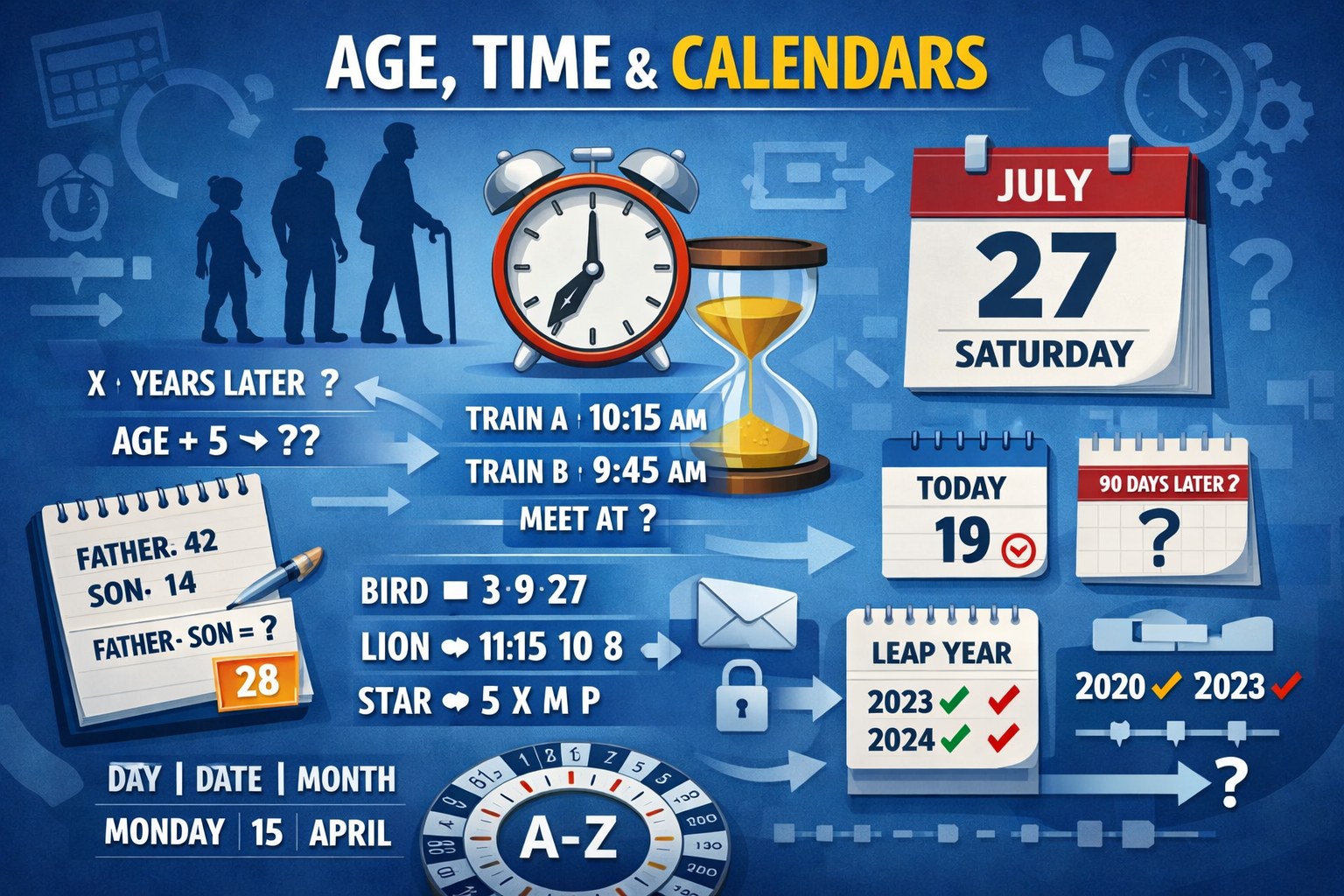
Age, Time and Calendars is an important reasoning ability topic that tests logical calculation, time-based comparison, age relations, clock movement, odd days, leap years, and weekday calculation.
What is Age, Time and Calendars in Reasoning?
In competitive exams, this topic is not limited to simple age addition or date counting. Questions often combine age ratios, past-present-future relations, time duration, clock angles, odd days, and calendar cycles.
The main skill is to convert a verbal statement into a mathematical relation. In age problems, the age difference between two persons remains constant. In clock problems, the hour hand and minute hand move at fixed angular speeds. In calendar problems, weekdays shift according to the number of extra days, called odd days.
| Sub-topic | Core Logic | Competitive Exam Focus |
|---|---|---|
| Ages | Past, present, and future ages are connected by equations. | Age ratio, age difference, father-son age, average age. |
| Time | Durations are compared after converting them into common units. | Before-after time, duration, schedules, time gaps. |
| Clock | Hour and minute hands move at different speeds. | Angle between hands, meeting time, opposite position. |
| Calendar | Days repeat after every 7 days; odd days decide weekday shift. | Leap year, odd days, same calendar, day/date problems. |
“Reasoning questions become easier when every statement is converted into a relation.”
Key points
- Age difference between two people remains constant.
- Past age = present age minus number of years.
- Future age = present age plus number of years.
- Minute hand moves 6° per minute.
- Hour hand moves 0.5° per minute.
- Normal year has 1 odd day.
- Leap year has 2 odd days.
Higher-Order Concepts for Competitive Exams
Competitive exam questions usually mix calculation with reasoning. The following concepts are repeatedly tested.
Age Ratio Problems
Ages are often given as ratios before or after some years.
- Present ratio: A : B = 3 : 5
- Use ages as 3x and 5x
- After 4 years: 3x + 4 and 5x + 4
- Age difference remains constant
Clock Angle Logic
Use relative motion of hour and minute hands.
- Minute hand = 6° per minute
- Hour hand = 0.5° per minute
- Relative speed = 5.5° per minute
- Angle at H:M = |30H - 5.5M|
Odd Days Method
Odd days are the remaining days after complete weeks are removed.
- Normal year = 365 days = 1 odd day
- Leap year = 366 days = 2 odd days
- 100 years = 5 odd days
- 400 years = 0 odd days
Same Calendar Years
Same calendar means same weekdays and same leap-year status.
- Normal year shifts by 1 day
- Leap year shifts by 2 days
- Total shift must become 0 mod 7
- Leap status must also match
Competitive Formula and Rule Bank
Age after n years = x + n
Age n years ago = x - n
Age difference is constant
If angle > 180°, use 360° - angle
Hands meet every 65 5/11 minutes
Leap year = 366 days = 2 odd days
400 years = 0 odd days
Century year must be divisible by 400
Example: 2000 is leap, 1900 is not leap
Tip: In reasoning exams, using the right shortcut is often more important than doing long calculation.
Odd Days Table for Calendar Questions
Odd days are the extra days left after dividing the total number of days by 7. They decide how many weekdays the calendar shifts.
| Period | Odd Days | Explanation |
|---|---|---|
| 1 normal year | 1 odd day | 365 days = 52 weeks + 1 day. |
| 1 leap year | 2 odd days | 366 days = 52 weeks + 2 days. |
| 100 years | 5 odd days | 76 normal years + 24 leap years = 76 + 48 = 124 odd days. 124 ÷ 7 leaves remainder 5. |
| 200 years | 3 odd days | 100 years + 100 years = 5 + 5 = 10 odd days. 10 ÷ 7 leaves remainder 3. |
| 300 years | 1 odd day | 5 + 5 + 5 = 15 odd days. 15 ÷ 7 leaves remainder 1. |
| 400 years | 0 odd days | 400-year calendar cycle has 0 odd days. |
Solved Examples for Competitive Exams
| Type | Question | Method | Answer |
|---|---|---|---|
| Age Ratio | The ratio of A and B is 3:5. After 6 years, the ratio becomes 2:3. Find A’s present age. |
Let ages be 3x and 5x. (3x + 6) / (5x + 6) = 2 / 3. 9x + 18 = 10x + 12, so x = 6. A = 3x = 18. |
18 years |
| Father-Son Age | A father is 4 times as old as his son. After 10 years, he will be twice as old as his son. Find son’s age. |
Let son = x, father = 4x. 4x + 10 = 2(x + 10). 4x + 10 = 2x + 20, so 2x = 10. |
5 years |
| Clock Angle | Find the angle between the clock hands at 3:20. |
Angle = |30H - 5.5M| = |30 × 3 - 5.5 × 20| = |90 - 110| = 20°. |
20° |
| Time Duration | A task starts at 9:45 AM and ends at 1:20 PM. Find the duration. |
9:45 to 12:45 = 3 hours. 12:45 to 1:20 = 35 minutes. |
3 hours 35 minutes |
| Day Calculation | If today is Monday, what day will it be after 100 days? |
100 ÷ 7 leaves remainder 2. Monday + 2 days. |
Wednesday |
| Leap Year | Which of these is a leap year: 1900, 2000, 2100? |
Century years must be divisible by 400. 1900 and 2100 are not divisible by 400. 2000 is divisible by 400. |
2000 only |
| Odd Days | How many odd days are there in 200 years? |
100 years = 5 odd days. 200 years = 5 + 5 = 10 odd days. 10 ÷ 7 leaves remainder 3. |
3 odd days |
| Calendar Cycle | A normal year starts on Monday. What day will the next year start? |
A normal year has 1 odd day. Monday + 1 day. |
Tuesday |
Note: In calendar problems, reducing the total number of days modulo 7 is usually the fastest method.
Common Traps and Shortcuts
Common Traps
- Using present age ratio directly for future age ratio without adding years.
- Forgetting that all people age by the same number of years.
- Treating every year divisible by 4 as a leap year, including century years.
- Using only 30° per hour in clock problems and ignoring minute adjustment.
- Forgetting to take the smaller angle when the clock angle exceeds 180°.
- Counting dates wrongly when the question says “after”, “before”, or “on”.
Useful Shortcuts
- Age difference remains constant in all years.
- For age ratios, use variables like 3x, 5x, etc.
- For day after n days, use n mod 7.
- Normal year shifts weekday by 1 day.
- Leap year shifts weekday by 2 days.
- Clock angle at H:M = |30H - 5.5M|.
Practice
A) Multiple Choice Questions
-
The present ages of A and B are in the ratio 4:7. After 6 years, the ratio becomes 5:8.
Find A’s present age.
18 24 30 36
-
A mother is three times as old as her daughter. After 12 years, she will be twice as old as her daughter.
Find the daughter’s present age.
10 12 14 16
-
What is the smaller angle between the hands of a clock at 4:30?
30° 35° 45° 60°
-
If today is Friday, what day will it be after 45 days?
Sunday Monday Tuesday Wednesday
-
Which of the following years is a leap year?
1800 1900 2000 2100
B) Solve the Higher-Order Problems
- The ratio of the ages of two persons is 5:8. After 10 years, the ratio becomes 2:3. Find their present ages. (Hint: Let present ages be 5x and 8x.)
- A person was 6 years older than his brother 5 years ago. What will be the age difference between them after 20 years? (Hint: Age difference remains constant.)
- Find the smaller angle between the hands of a clock at 7:20. (Hint: Use |30H - 5.5M|.)
- If 1st March is Wednesday, what day will 31st March be? (Hint: Difference in dates = 30 days.)
- How many odd days are there in 300 years? (Hint: 100 years = 5 odd days.)
C) Match the Concept with the Correct Rule
| Concept | Correct Rule / Meaning |
|---|---|
| Age difference | Remains constant over time |
| Minute hand speed | 6 degrees per minute |
| Hour hand speed | 0.5 degrees per minute |
| Normal year | 1 odd day |
| Leap year | 2 odd days |
| 400 years | 0 odd days |
Reasoning Reminder
In reasoning ability exams, age, time, and calendar questions are designed to test accuracy under time pressure. The best method is to identify the pattern quickly, form the correct relation, and avoid unnecessary long calculation. Mastering ratios, odd days, leap-year rules, and clock-angle formulas gives a strong advantage.
Task: Create five mixed questions using age ratio, clock angle, leap year, odd days, and weekday calculation.
Show Suggested Answers
Multiple Choice
-
24
Let ages be 4x and 7x.
(4x + 6) / (7x + 6) = 5 / 8.
32x + 48 = 35x + 30.
3x = 18, so x = 6.
A = 4x = 24. -
12
Let daughter = x and mother = 3x.
After 12 years: mother = 3x + 12, daughter = x + 12.
3x + 12 = 2(x + 12).
3x + 12 = 2x + 24, so x = 12. -
45°
Angle = |30H - 5.5M|
= |30 × 4 - 5.5 × 30|
= |120 - 165| = 45°. -
Monday
45 ÷ 7 leaves remainder 3.
Friday + 3 days = Monday. -
2000
Century years must be divisible by 400 to be leap years.
1800, 1900 and 2100 are not leap years. 2000 is a leap year.
Higher-Order Problems
-
Let ages be 5x and 8x.
(5x + 10) / (8x + 10) = 2 / 3.
15x + 30 = 16x + 20.
x = 10.
Present ages = 50 years and 80 years. - Age difference remains constant. Therefore, the difference after 20 years will also be 6 years.
-
Angle at 7:20 = |30 × 7 - 5.5 × 20|
= |210 - 110| = 100°. -
31st March is 30 days after 1st March.
30 ÷ 7 leaves remainder 2.
Wednesday + 2 days = Friday. -
100 years = 5 odd days.
300 years = 5 + 5 + 5 = 15 odd days.
15 ÷ 7 leaves remainder 1.
Answer = 1 odd day.
Concept Matching
- Age difference → Remains constant over time
- Minute hand speed → 6 degrees per minute
- Hour hand speed → 0.5 degrees per minute
- Normal year → 1 odd day
- Leap year → 2 odd days
- 400 years → 0 odd days
Clue Explanation
Age questions depend on equations and constant difference. Clock questions depend on angular speed. Calendar questions depend on odd days and leap-year rules. Reducing large day counts modulo 7 is the fastest method.
Exam tips
- For age ratios, use variables like 3x, 5x, etc.
- Always add or subtract years to all concerned persons.
- Use |30H - 5.5M| for clock angle questions.
- For weekday questions, divide days by 7 and use the remainder.
- For century leap years, check divisibility by 400.
- Do not ignore whether the question asks “after”, “before”, or “on”.