Alpha Numeric Sequence Puzzles
Practice MCQsNone
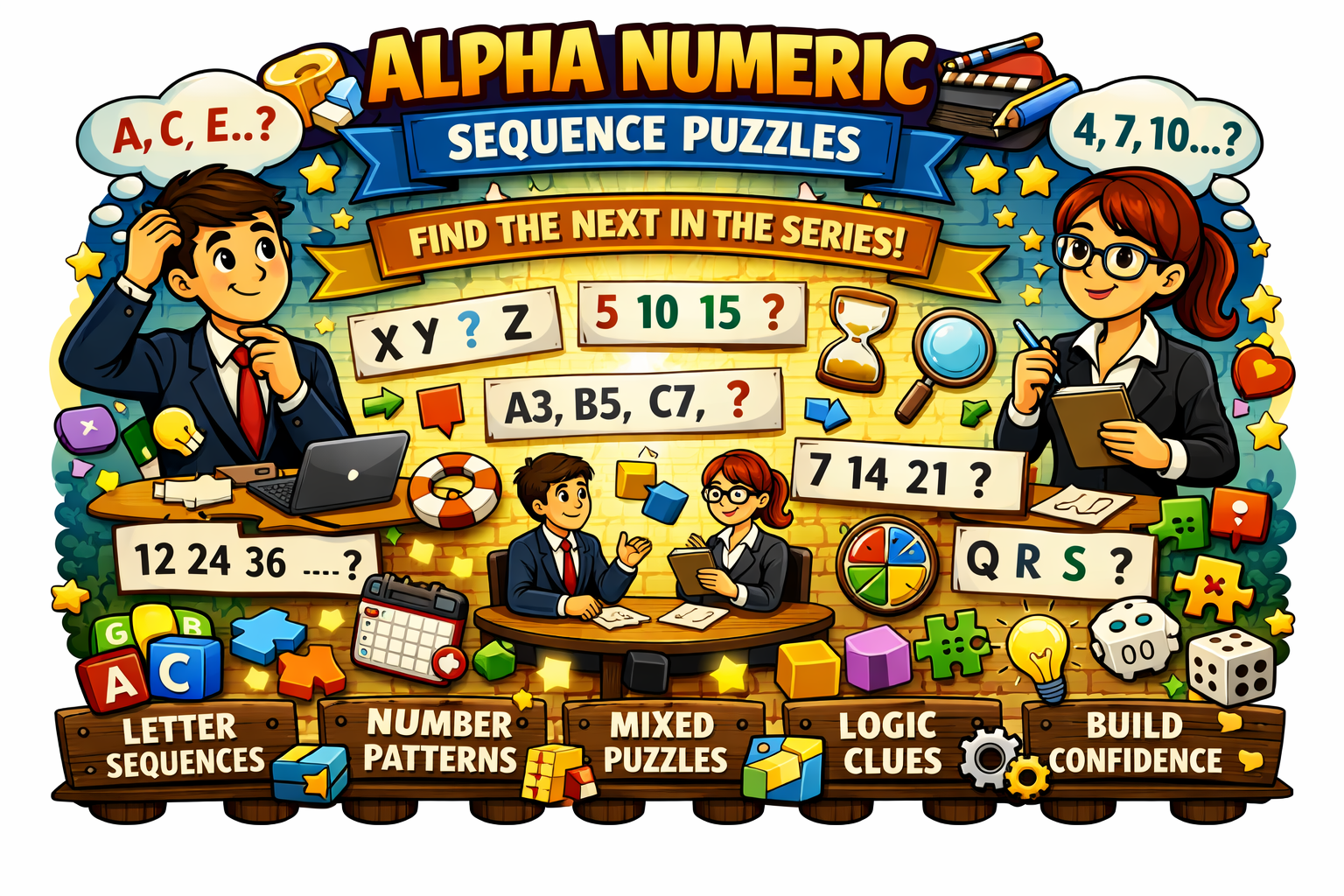
Alpha Numeric Sequence Puzzles are reasoning questions based on a mixed arrangement of alphabets, numbers, and sometimes symbols. These puzzles test observation, pattern recognition, position counting, logical sequencing, and speed.
What are Alpha Numeric Sequence Puzzles?
An alpha numeric sequence is a series that contains both alphabets and numbers. In some questions, symbols may also be included. You may be asked to find the missing term, next term, position of an element, number of elements between two terms, or the relationship between letters and numbers.
These questions usually require you to observe the arrangement carefully. Sometimes letters follow one pattern while numbers follow another pattern. In other cases, the number may be connected to the alphabet position of the letter.
| Sequence | Pattern | Next Term |
|---|---|---|
| A1, C3, E5, G7 | Letters move +2; numbers move +2 | I9 |
| B2, D4, F6, H8 | Letters move +2; numbers move +2 | J10 |
| D4, H8, L12, P16 | Letter position matches number | T20 |
| Z26, X24, V22, T20 | Letters and numbers move backward by 2 | R18 |
“In alpha numeric puzzles, the secret is to read the letters and numbers separately first.”
Key points
- Letters may follow alphabet order.
- Numbers may follow number series logic.
- Symbols may be used for position-based questions.
- Alphabet position is very important.
- Check forward and backward movement.
- Look for alternate or group-based patterns.
Alphabet Position Chart
Many alpha numeric puzzles use the position of letters. Therefore, remembering the alphabet position chart helps in solving questions quickly.
| A | B | C | D | E | F | G | H | I | J | K | L | M |
| 1 | 2 | 3 | 4 | 5 | 6 | 7 | 8 | 9 | 10 | 11 | 12 | 13 |
| N | O | P | Q | R | S | T | U | V | W | X | Y | Z |
| 14 | 15 | 16 | 17 | 18 | 19 | 20 | 21 | 22 | 23 | 24 | 25 | 26 |
Common Types of Alpha Numeric Sequence Questions
In competitive exams, alpha numeric sequence questions are asked in different forms. The following types are frequently seen.
Missing Term
One term is missing in the series.
- A1, C3, E5, ?
- Identify letter pattern
- Identify number pattern
- Combine both
Next Term
Find the next term after the given sequence.
- B2, D4, F6, H8, ?
- Letters move forward
- Numbers increase
- Answer: J10
Position Based
Find an element from left or right.
- Count carefully
- Use left/right position
- Do not skip symbols
- Mark groups if needed
Mixed Symbol Series
Letters, numbers, and symbols are mixed.
- A 5 # B 7 @ C 9
- Check position
- Check groups
- Check before/after elements
Pattern Bank
Letter and number both increase by 1
Letter and number both increase by 2
Letter and number both decrease by 2
Gaps are +2, +3, +4
Tip: When the letters and numbers both follow the same position value, the question becomes easier.
Step-by-Step Solving Method
| Step | Action | Example |
|---|---|---|
| Step 1 | Separate letters and numbers. | A1, C3, E5 becomes letters A, C, E and numbers 1, 3, 5. |
| Step 2 | Convert letters into alphabet positions. | A = 1, C = 3, E = 5. |
| Step 3 | Find the gap between letters. | A to C = +2, C to E = +2. |
| Step 4 | Find the number pattern. | 1, 3, 5 are increasing by 2. |
| Step 5 | Apply the same pattern to get the answer. | After E5, next is G7. |
Solved Examples
| Question | Method | Answer |
|---|---|---|
| Find the next term: A1, C3, E5, G7, ? |
Letters move +2: A, C, E, G, I. Numbers move +2: 1, 3, 5, 7, 9. |
I9 |
| Find the next term: B4, D8, F12, H16, ? |
Letters move +2: B, D, F, H, J. Numbers move +4: 4, 8, 12, 16, 20. |
J20 |
| Find the missing term: C3, F6, I9, L12, ? |
Letters move +3: C, F, I, L, O. Numbers move +3: 3, 6, 9, 12, 15. |
O15 |
| Find the next term: Z26, X24, V22, T20, ? |
Letters move backward by 2. Numbers decrease by 2. |
R18 |
| Find the next term: A1, D4, H8, M13, ? |
Letter positions: 1, 4, 8, 13. Differences are +3, +4, +5, so next is +6. 13 + 6 = 19, which is S. |
S19 |
| Find the next term: A2, C4, F7, J11, ? |
Letter positions: 1, 3, 6, 10. Differences are +2, +3, +4, so next is +5. 10 + 5 = 15, which is O. Numbers: 2, 4, 7, 11 follow +2, +3, +4, so next is 16. |
O16 |
| Find the next term: E25, G36, I49, K64, ? |
Letters move +2: E, G, I, K, M. Numbers are squares: 5², 6², 7², 8², so next is 9². |
M81 |
| Find the next term: A1, B4, C9, D16, ? |
Letters move +1: A, B, C, D, E. Numbers are squares: 1², 2², 3², 4², so next is 5². |
E25 |
Note: In higher-level questions, numbers may follow square, cube, prime number, or increasing-gap patterns.
Common Traps and Shortcuts
Common Traps
- Checking only letters and ignoring numbers.
- Assuming letters and numbers always have the same gap.
- Forgetting backward alphabet movement.
- Confusing alphabet position with term position.
- Not checking alternate terms separately.
- Skipping symbols while counting position-based questions.
Useful Shortcuts
- Convert letters into alphabet positions.
- Check letters and numbers separately.
- Use anchor values: A = 1, M = 13, Z = 26.
- Look for squares, cubes, primes, and odd/even numbers.
- Check whether odd-position and even-position terms follow different patterns.
- For long sequences, write only the required positions.
Practice
A) Multiple Choice Questions
-
Find the next term: A1, C3, E5, G7, ?
H8 I9 J10 K11
-
Find the missing term: B4, D8, F12, H16, ?
I18 J20 K22 L24
-
Find the next term: Z26, X24, V22, T20, ?
S19 R18 Q17 P16
-
Find the next term: A1, B4, C9, D16, ?
E20 E25 F25 F36
-
Find the next term: C3, F6, I9, L12, ?
M13 N14 O15 P16
B) Solve the Higher-Order Problems
- Find the next term: A2, C4, F7, J11, ? (Hint: Check increasing gaps in both letters and numbers.)
- Find the next term: E25, G36, I49, K64, ? (Hint: Letters move +2; numbers are squares.)
- Find the missing term: A1, D4, H8, M13, ? (Hint: Letter positions are also number values.)
- Find the next term: B3, D6, G10, K15, ? (Hint: Check differences +2, +3, +4, +5.)
- Find the next term: Z1, Y4, X9, W16, ? (Hint: Letters move backward; numbers are squares.)
C) Match the Pattern with the Correct Logic
| Pattern | Correct Logic / Meaning |
|---|---|
| A1, B2, C3 | Letters and numbers increase by 1 |
| A1, C3, E5 | Letters and numbers increase by 2 |
| Z26, X24, V22 | Letters and numbers decrease by 2 |
| A1, B4, C9 | Letters increase by 1; numbers are squares |
| A1, C3, F6, J10 | Increasing gap pattern |
| D4, H8, L12 | Letter position matches the number |
Reasoning Reminder
Alpha numeric sequence puzzles become easier when you split the sequence into separate parts: alphabets, numbers, and symbols. The most common patterns include alphabet position, fixed gaps, increasing gaps, backward movement, square numbers, and alternate sequences.
Task: Create five alpha numeric sequences using different patterns such as +2 movement, backward movement, square numbers, and increasing gaps.
Show Suggested Answers
Multiple Choice
-
I9
Letters move by +2: A, C, E, G, I.
Numbers move by +2: 1, 3, 5, 7, 9. -
J20
Letters move by +2: B, D, F, H, J.
Numbers increase by 4: 4, 8, 12, 16, 20. -
R18
Letters move backward by 2: Z, X, V, T, R.
Numbers decrease by 2: 26, 24, 22, 20, 18. -
E25
Letters move by +1: A, B, C, D, E.
Numbers are squares: 1, 4, 9, 16, 25. -
O15
Letters move by +3: C, F, I, L, O.
Numbers increase by 3: 3, 6, 9, 12, 15.
Higher-Order Problems
-
A2, C4, F7, J11, ?
Letter positions: 1, 3, 6, 10. Differences are +2, +3, +4, so next is +5.
10 + 5 = 15, which is O.
Numbers: 2, 4, 7, 11. Differences are +2, +3, +4, so next is 16.
Answer = O16. -
E25, G36, I49, K64, ?
Letters move by +2: E, G, I, K, M.
Numbers are squares: 5², 6², 7², 8², so next is 9² = 81.
Answer = M81. -
A1, D4, H8, M13, ?
Letter positions are 1, 4, 8, 13.
Differences are +3, +4, +5, so next difference is +6.
13 + 6 = 19, which is S.
Answer = S19. -
B3, D6, G10, K15, ?
Letter positions: 2, 4, 7, 11. Differences are +2, +3, +4, so next is +5.
11 + 5 = 16, which is P.
Numbers: 3, 6, 10, 15. Differences are +3, +4, +5, so next is +6.
15 + 6 = 21.
Answer = P21. -
Z1, Y4, X9, W16, ?
Letters move backward by 1: Z, Y, X, W, V.
Numbers are squares: 1, 4, 9, 16, 25.
Answer = V25.
Concept Matching
- A1, B2, C3 → Letters and numbers increase by 1
- A1, C3, E5 → Letters and numbers increase by 2
- Z26, X24, V22 → Letters and numbers decrease by 2
- A1, B4, C9 → Letters increase by 1; numbers are squares
- A1, C3, F6, J10 → Increasing gap pattern
- D4, H8, L12 → Letter position matches the number
Clue Explanation
Alpha numeric sequence questions usually combine alphabet movement with number series logic. Always convert letters into their positions, then compare the number pattern separately. This prevents mistakes in mixed and higher-order sequences.
Exam tips
- Separate letters and numbers first.
- Convert alphabets into positions.
- Check forward and backward movements.
- Look for square, cube, odd, even, and prime number patterns.
- Check alternate terms separately in longer sequences.
- For symbol-based questions, count every element carefully.