Blood and Family Relations
Practice MCQsBlood and Family Relations is an important reasoning ability topic that tests your understanding of family relationships, generations, gender clues, and relation mapping.
Blood and Family Relations is an important reasoning ability topic that tests your understanding of family relationships, generations, gender clues, and relation mapping. These questions are commonly asked in competitive exams to check logical interpretation and diagram-based reasoning.
What are Blood and Family Relations?
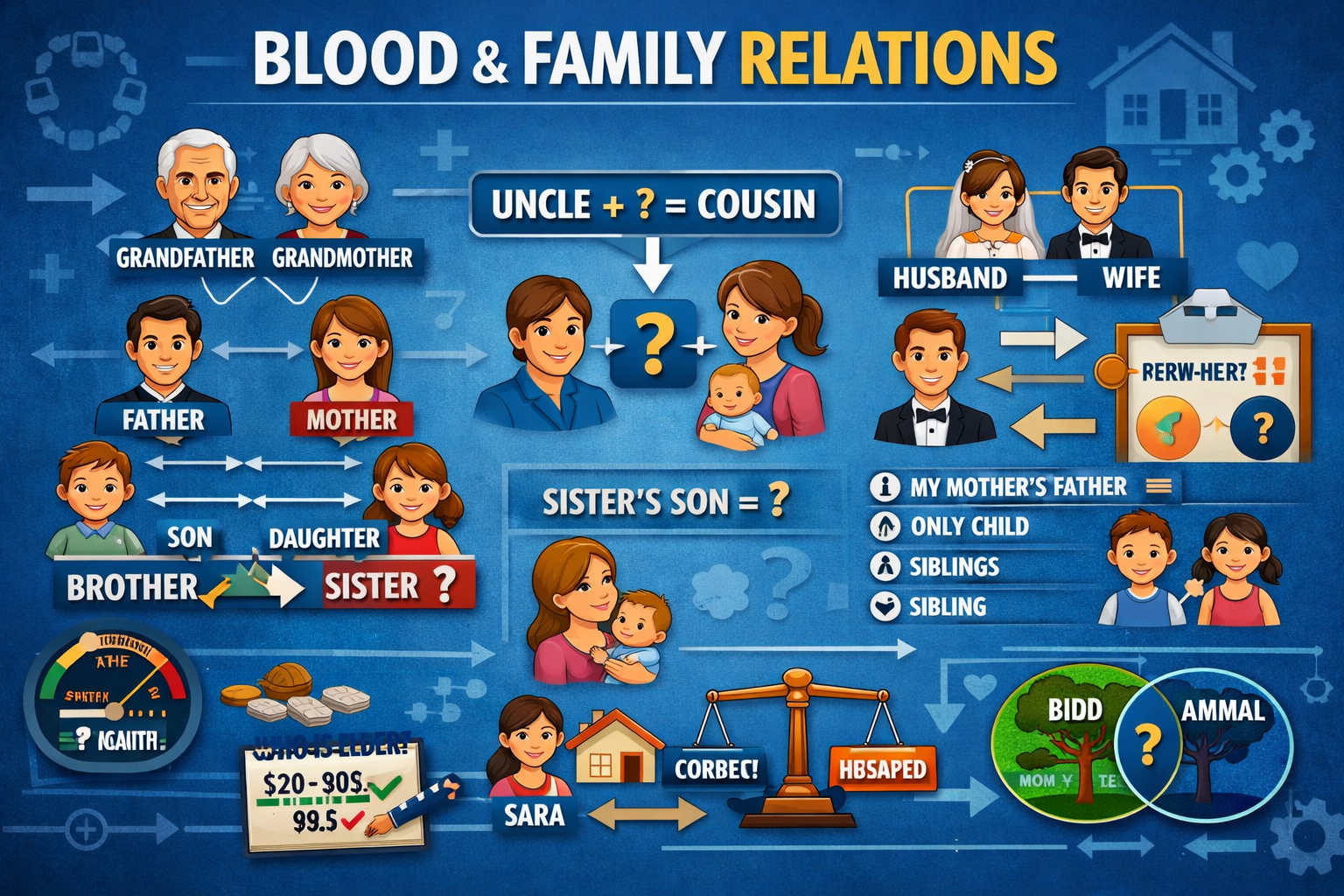
Blood and Family Relations questions are based on relationships among family members such as father, mother, brother, sister, son, daughter, uncle, aunt, grandfather, grandmother, cousin, husband, and wife.
In these questions, information is given in words, and you must identify the correct relationship between two people. The best method is to convert the statement into a simple family tree or generation chart.
| Relation | Meaning | Generation Level |
|---|---|---|
| Father / Mother | Parent of a person | One generation above |
| Son / Daughter | Child of a person | One generation below |
| Brother / Sister | Sibling of a person | Same generation |
| Grandfather / Grandmother | Parent of parent | Two generations above |
| Grandson / Granddaughter | Child of child | Two generations below |
“Family relation questions become easy when every person is placed at the correct generation level.”
Key points
- Identify gender clues carefully.
- Mark male and female symbols if needed.
- Place parents one level above children.
- Place siblings on the same level.
- Read the question from the last person if confused.
- Draw a small family tree for complex questions.
Common Family Relation Terms
Understanding common relation terms is the foundation of solving blood relation questions.
| Term | Meaning | Example |
|---|---|---|
| Paternal | Related to father’s side | Father’s father = paternal grandfather |
| Maternal | Related to mother’s side | Mother’s mother = maternal grandmother |
| Uncle | Brother of father or mother | Father’s brother or mother’s brother |
| Aunt | Sister of father or mother | Father’s sister or mother’s sister |
| Cousin | Child of uncle or aunt | Uncle’s son or aunt’s daughter |
| Nephew | Brother’s or sister’s son | My sister’s son is my nephew |
| Niece | Brother’s or sister’s daughter | My brother’s daughter is my niece |
| Sibling | Brother or sister | Two children of the same parents |
Common Types of Blood Relation Questions
Competitive exams ask blood relation questions in different styles. The following types are common.
Direct Relation
Simple relation between two people.
- A is B’s father
- B is C’s sister
- Find A’s relation to C
- Use direct mapping
Pointing Type
Relation is described while pointing to a person.
- Pointing to a photo
- “He is my father’s son”
- Identify speaker first
- Then identify photo person
Coded Relation
Symbols represent relations.
- A + B means A is father of B
- A - B means A is sister of B
- Decode symbols
- Draw relation chain
Family Tree
Several family members are connected.
- Multiple persons
- Generations involved
- Use diagram
- Track gender and marriage
Relation Pattern Bank
Mother’s mother → grandmother
Parent’s sibling → uncle/aunt
Daughter’s daughter → granddaughter
Child’s child → grandchild
Sister’s daughter → niece
Sibling’s child → nephew/niece
Wife’s father → father-in-law
Spouse’s sibling → brother/sister-in-law
Tip: Always move step by step. Do not jump directly from the first person to the last person.
Step-by-Step Solving Method
| Step | Action | Example |
|---|---|---|
| Step 1 | Identify all people mentioned in the question. | A, B, C, speaker, photo person |
| Step 2 | Mark gender wherever given. | Male = father, son, brother; Female = mother, daughter, sister |
| Step 3 | Place people at correct generation levels. | Parents above, children below, siblings same level |
| Step 4 | Connect the relation step by step. | Father’s son = brother or self depending on speaker |
| Step 5 | Answer exactly what is asked. | How is A related to B? Do not reverse the relation. |
Solved Examples
| Question | Method | Answer |
|---|---|---|
| A is the father of B. B is the sister of C. How is A related to C? |
A is father of B. B and C are siblings. Therefore, A is also father of C. |
Father |
| Pointing to a man, Ravi said, “He is the son of my father.” Who is the man? |
“My father’s son” means Ravi himself or Ravi’s brother. Since Ravi is pointing to another man, he is Ravi’s brother. |
Brother |
| A woman says, “This girl is the daughter of my only son.” How is the girl related to the woman? |
Woman’s only son has a daughter. Son’s daughter is granddaughter. |
Granddaughter |
| A is the brother of B. B is the mother of C. How is A related to C? |
B is mother of C. A is brother of B. Mother’s brother is maternal uncle. |
Uncle |
| P is the sister of Q. Q is the father of R. How is P related to R? |
Q is father of R. P is sister of Q. Father’s sister is aunt. |
Aunt |
| A is the son of B. B is the daughter of C. How is C related to A? |
B is daughter of C, so C is parent of B. A is son of B. Parent’s parent is grandparent. |
Grandparent |
| Pointing to a photo, Meena said, “He is the father of my mother.” Who is he? | Mother’s father is maternal grandfather. | Grandfather |
| A is the husband of B. B is the sister of C. How is A related to C? |
B is sister of C. A is husband of B. Sister’s husband is brother-in-law. |
Brother-in-law |
Note: In pointing questions, identify the speaker first and then decode the relation.
Common Traps and Shortcuts
Common Traps
- Reversing the relation asked in the question.
- Assuming gender from name without clear clue.
- Confusing father’s side and mother’s side.
- Forgetting that “father’s son” may mean self or brother.
- Not identifying the speaker in pointing questions.
- Mixing uncle, aunt, cousin, nephew, and niece.
Useful Shortcuts
- Use M for male and F for female while drawing.
- Put parents above and children below.
- Place siblings on the same line.
- Use a horizontal line for marriage relation.
- Read the question from the last relation if it is confusing.
- Answer exactly in the direction asked.
Practice
A) Multiple Choice Questions
-
A is the father of B. B is the brother of C. How is A related to C?
Brother Father Uncle Grandfather
-
Pointing to a girl, Raj said, “She is the daughter of my mother.” Who is the girl?
Mother Sister Daughter Aunt
-
A is the mother of B. B is the father of C. How is A related to C?
Mother Grandmother Sister Aunt
-
P is the brother of Q. Q is the mother of R. How is P related to R?
Father Uncle Brother Grandfather
-
A is the daughter of B. B is the son of C. How is C related to A?
Parent Grandparent Sibling Cousin
B) Solve the Higher-Order Problems
- Pointing to a man, Sita said, “His mother is the only daughter of my mother.” How is the man related to Sita? (Hint: My mother’s only daughter = Sita herself.)
- A is the sister of B. B is the father of C. C is the brother of D. How is A related to D? (Hint: Father’s sister relation.)
- P is the husband of Q. Q is the mother of R. R is the sister of S. How is P related to S? (Hint: Husband of mother = father.)
- X is the son of Y. Y is the brother of Z. Z is the mother of W. How is X related to W? (Hint: Children of siblings are cousins.)
- A is the father of B. B is the daughter of C. C is the mother of D. How is A related to D? (Hint: Identify relation between A and C first.)
C) Match the Relation with the Correct Meaning
| Relation | Correct Meaning |
|---|---|
| Father’s father | Grandfather |
| Mother’s brother | Uncle |
| Sister’s son | Nephew |
| Brother’s daughter | Niece |
| Uncle’s child | Cousin |
| Son’s daughter | Granddaughter |
Reasoning Reminder
Blood and family relation questions require careful reading and correct mapping of persons. The main points are gender, generation level, speaker identity, and relation direction. Drawing a simple family tree helps avoid mistakes in complex questions.
Task: Create five family relation questions using father, mother, brother, sister, uncle, aunt, cousin, and grandparent relationships.
Show Suggested Answers
Multiple Choice
-
Father
A is father of B. B and C are siblings. Therefore, A is also father of C. -
Sister
“Daughter of my mother” means Raj’s sister, assuming the girl is not Raj himself. -
Grandmother
A is mother of B. B is father of C. Therefore, A is grandmother of C. -
Uncle
Q is mother of R. P is brother of Q. Therefore, P is R’s uncle. -
Grandparent
A is daughter of B. B is son of C. Therefore, C is grandparent of A.
Higher-Order Problems
-
“My mother’s only daughter” means Sita herself.
The man’s mother is Sita.
Therefore, the man is Sita’s son. -
A is sister of B. B is father of C. C and D are siblings.
So B is father of D also.
A is father’s sister of D.
Answer = Aunt. -
P is husband of Q. Q is mother of R. R and S are siblings.
Therefore, Q is also mother of S.
P is father of S.
Answer = Father. -
X is son of Y. Y is brother of Z. Z is mother of W.
Y and Z are siblings. Their children X and W are cousins.
Answer = Cousin. -
A is father of B. B is daughter of C. C is mother of D.
Since B is daughter of both A and C, A is husband of C.
D is also child of C. Therefore, A is father of D.
Answer = Father.
Concept Matching
- Father’s father → Grandfather
- Mother’s brother → Uncle
- Sister’s son → Nephew
- Brother’s daughter → Niece
- Uncle’s child → Cousin
- Son’s daughter → Granddaughter
Clue Explanation
Family relation questions should be solved step by step. Identify the speaker, gender, generation level, and final relation direction. A small family tree avoids most mistakes.
Exam tips
- Identify the speaker first in pointing questions.
- Do not assume gender unless clearly given.
- Use generation levels while drawing.
- Read the final question carefully: A to B or B to A.
- Use symbols for male, female, marriage, and siblings.
- Verify the final relation before selecting the answer.