Arithmetical Reasoning
Practice MCQsArithmetical Reasoning develops the skill of converting word statements into mathematical operations and logical answers.
Arithmetical Reasoning is an important reasoning ability topic that tests your ability to understand numerical statements, convert them into mathematical operations, and solve them logically. It combines basic arithmetic with reasoning-based interpretation.
What is Arithmetical Reasoning?
Arithmetical Reasoning refers to word-based numerical problems where the question must be understood carefully before applying arithmetic operations. These questions may involve age, ratio, percentage, profit and loss, average, time and work, speed, distance, money, or simple number logic.
Unlike direct calculation questions, arithmetical reasoning questions require you to identify what is given, what is asked, and which operation or formula is suitable. The main skill is to convert a sentence into a mathematical relation.
| Question Type | Core Logic | Example Focus |
|---|---|---|
| Number Problems | Use equations or arithmetic operations. | Find a number from clues. |
| Age Problems | Past, present, and future ages are connected. | Age ratio, age difference. |
| Percentage | Convert percentage into fraction or decimal. | Increase, decrease, marks, discount. |
| Average | Total value divided by number of items. | Average marks, age, speed, salary. |
“Arithmetical reasoning is not only calculation; it is understanding what calculation is needed.”
Key points
- Read the question carefully.
- Identify given and required values.
- Convert statements into equations.
- Use correct arithmetic operation.
- Check units such as rupees, years, km, hours.
- Verify the answer with the question condition.
Common Types of Arithmetical Reasoning Questions
Competitive exams ask arithmetical reasoning questions in different forms. The following types are commonly seen.
Number-Based Problems
Find a number using given clues.
- Twice a number
- Sum or difference
- Product or quotient
- Equation method
Age Problems
Compare ages in past, present, or future.
- Present age
- Age after years
- Age before years
- Age ratio
Percentage Problems
Use percentage to compare values.
- Marks percentage
- Increase/decrease
- Discount
- Profit/loss percent
Average Problems
Use total and number of values.
- Average marks
- Average age
- Average salary
- Missing value
Formula and Method Bank
Total = Average × Number of items
Part = Percentage × Whole / 100
Loss = CP - SP
Profit % = Profit / CP × 100
Distance = Speed × Time
Time = Distance / Speed
Tip: Most arithmetical reasoning questions become simple after writing the correct relation.
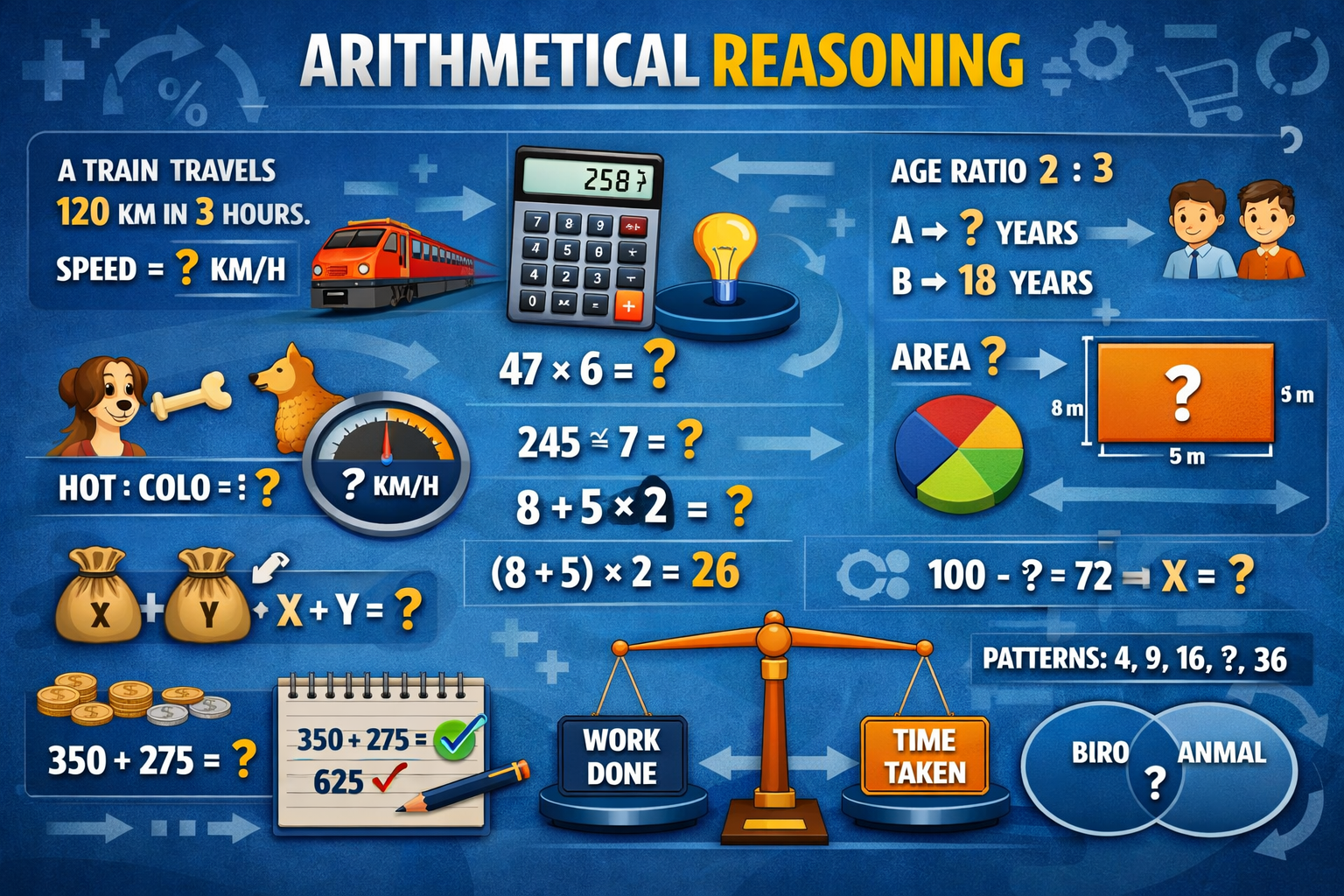
Step-by-Step Solving Method
| Step | Action | Example |
|---|---|---|
| Step 1 | Read the question and identify what is asked. | Find a number, age, percentage, average, or time. |
| Step 2 | List the given values. | Example: total = 250, percentage = 20%. |
| Step 3 | Choose the correct formula or operation. | 20% of 250 = 20 × 250 / 100. |
| Step 4 | Calculate carefully with correct units. | 20 × 250 / 100 = 50. |
| Step 5 | Check whether the answer satisfies the question. | 20% of 250 is 50, so answer is correct. |
Solved Examples
| Question | Method | Answer |
|---|---|---|
| A number is increased by 12 and becomes 35. Find the number. |
Let the number be x. x + 12 = 35. x = 35 - 12. |
23 |
| Twice a number is 48. Find the number. |
Let the number be x. 2x = 48. x = 48 / 2. |
24 |
| The average of 5 numbers is 18. Find their total. |
Total = Average × Number of items. Total = 18 × 5. |
90 |
| Find 25% of 240. |
25% of 240 = 25 × 240 / 100. Or 25% = 1/4, so 240 / 4. |
60 |
| A shopkeeper buys an item for ₹500 and sells it for ₹650. Find the profit. |
Profit = Selling Price - Cost Price. Profit = 650 - 500. |
₹150 |
| A person travels 120 km in 3 hours. Find the speed. |
Speed = Distance / Time. Speed = 120 / 3. |
40 km/h |
| A father is 4 times as old as his son. If the son is 8 years old, find the father’s age. |
Father’s age = 4 × son’s age. Father’s age = 4 × 8. |
32 years |
| A student scored 72 marks out of 90. Find the percentage. |
Percentage = Marks obtained / Total marks × 100. Percentage = 72 / 90 × 100. |
80% |
Note: Always check whether the question asks for value, percentage, total, average, profit, speed, or age.
Common Traps and Shortcuts
Common Traps
- Starting calculation without understanding the question.
- Using the wrong formula for average or percentage.
- Confusing cost price and selling price.
- Forgetting units such as km/h, rupees, years, or marks.
- Not converting percentage into proper fraction or decimal.
- Ignoring words like more than, less than, twice, half, and difference.
Useful Shortcuts
- Write unknown quantity as x.
- Convert word statements into equations.
- Use 25% = 1/4, 50% = 1/2, 75% = 3/4.
- For average, remember total = average × number of items.
- For speed problems, keep units consistent.
- Verify the final answer with the original question.
Practice
A) Multiple Choice Questions
-
A number is increased by 15 and becomes 50. Find the number.
25 30 35 40
-
The average of 6 numbers is 20. Find their total.
100 110 120 130
-
Find 20% of 350.
60 70 80 90
-
An item is bought for ₹800 and sold for ₹950. Find the profit.
₹100 ₹120 ₹150 ₹180
-
A vehicle travels 180 km in 3 hours. Find the speed.
50 km/h 55 km/h 60 km/h 65 km/h
B) Solve the Higher-Order Problems
- The sum of two numbers is 75. One number is 25. Find the other number. (Hint: Other number = total sum - given number.)
- A student scored 84 marks out of 120. Find the percentage. (Hint: Percentage = obtained marks / total marks × 100.)
- The average age of 4 persons is 30 years. Find their total age. (Hint: Total = average × number of persons.)
- A man spends ₹450 out of ₹900. What percentage of money did he spend? (Hint: Spent percentage = spent amount / total amount × 100.)
- A train covers 240 km in 4 hours. Find its speed. (Hint: Speed = distance / time.)
C) Match the Concept with the Correct Rule
| Concept | Correct Rule / Meaning |
|---|---|
| Average | Total divided by number of items |
| Percentage | Part divided by whole multiplied by 100 |
| Profit | Selling price minus cost price |
| Loss | Cost price minus selling price |
| Speed | Distance divided by time |
| Equation Method | Using x to represent an unknown value |
Reasoning Reminder
Arithmetical reasoning questions are solved by understanding the statement and selecting the correct arithmetic operation. The most common question areas are number relations, average, percentage, profit and loss, age, and speed-time-distance.
Task: Create five arithmetical reasoning questions using percentage, average, number relation, profit/loss, and speed-time-distance.
Show Suggested Answers
Multiple Choice
-
35
Let the number be x.
x + 15 = 50, so x = 50 - 15 = 35. -
120
Total = Average × Number of values.
Total = 20 × 6 = 120. -
70
20% of 350 = 20 × 350 / 100 = 70. -
₹150
Profit = Selling Price - Cost Price.
Profit = 950 - 800 = ₹150. -
60 km/h
Speed = Distance / Time.
Speed = 180 / 3 = 60 km/h.
Higher-Order Problems
-
Sum of two numbers = 75.
One number = 25.
Other number = 75 - 25 = 50. -
Percentage = 84 / 120 × 100.
= 70%.
Answer = 70%. -
Total age = Average age × Number of persons.
Total age = 30 × 4 = 120 years. -
Spent percentage = 450 / 900 × 100.
= 50%.
Answer = 50%. -
Speed = Distance / Time.
Speed = 240 / 4 = 60 km/h.
Concept Matching
- Average → Total divided by number of items
- Percentage → Part divided by whole multiplied by 100
- Profit → Selling price minus cost price
- Loss → Cost price minus selling price
- Speed → Distance divided by time
- Equation Method → Using x to represent an unknown value
Clue Explanation
Arithmetical reasoning depends on converting statements into mathematical relations. Once the relation is clear, the calculation usually becomes simple and direct.
Exam tips
- Underline numbers and keywords.
- Identify what is asked before solving.
- Use x for unknown values.
- Convert percentage into fraction where possible.
- Keep units consistent in speed and time questions.
- Check the answer with the original statement.