Classification
Practice MCQsClassification questions test your ability to group similar items and identify the one that does not belong.
Classification is an important reasoning ability topic where you are asked to identify the item that does not belong to a given group. These questions test your ability to observe similarities, compare features, and find the odd one out.
What is Classification?
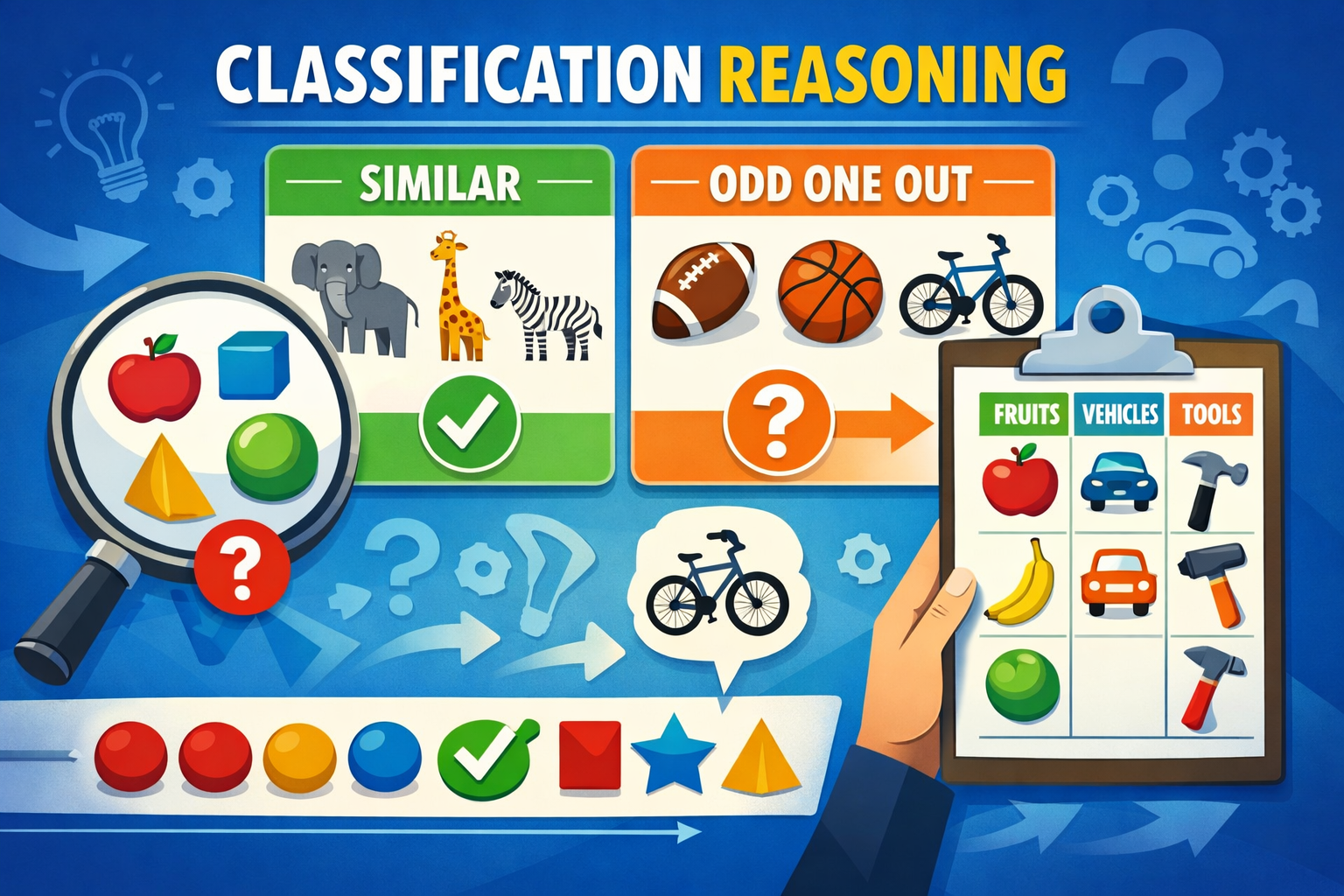
Classification means grouping items based on a common property. In reasoning questions, four or five options are given, and most of them share a common feature. One option does not follow the same rule. That option is called the odd one out.
The items may be words, letters, numbers, objects, animals, places, professions, or mixed patterns. Your task is to identify the common relationship among the majority of items and then eliminate the one that is different.
| Group | Common Feature | Odd One Out |
|---|---|---|
| Apple, Mango, Banana, Carrot | First three are fruits | Carrot |
| Dog, Cat, Lion, Sparrow | First three are mammals | Sparrow |
| 2, 4, 6, 9 | First three are even numbers | 9 |
| A, E, I, B | First three are vowels | B |
“Classification questions are solved by finding the rule that connects most of the options.”
Key points
- Find the common feature first.
- Compare all options carefully.
- Do not select based on appearance alone.
- Check category, use, property, spelling, or number pattern.
- One option usually breaks the common rule.
- Sometimes more than one feature may be possible.
Common Types of Classification Questions
Classification questions can be based on words, numbers, letters, meanings, categories, or general knowledge. The following types are commonly asked in competitive exams.
Word Classification
Find the word that does not belong to the group.
- Rose, Lotus, Lily, Mango
- First three are flowers
- Mango is fruit
- Odd one: Mango
Number Classification
Find the number that differs from others.
- 4, 9, 16, 20
- 4, 9, 16 are squares
- 20 is not a square
- Odd one: 20
Letter Classification
Find the letter or group that breaks the pattern.
- A, E, I, K
- A, E, I are vowels
- K is consonant
- Odd one: K
Pair Classification
Find the pair that has a different relationship.
- Pen-Write
- Knife-Cut
- Key-Open
- Book-Table
Classification Pattern Bank
Rose, Lily, Lotus → Flowers
Cow, Goat, Dog → Animals
Odd numbers
Prime numbers
Square numbers
Knife → Cut
Key → Open
Brush → Paint
Alphabet position
Forward/backward movement
Fixed gap pattern
Tip: Always ask: “What property do most options share?” The answer to this question reveals the odd one out.
Step-by-Step Solving Method
| Step | Action | Example |
|---|---|---|
| Step 1 | Read all options carefully. | Apple, Mango, Banana, Carrot |
| Step 2 | Find a common feature among most options. | Apple, Mango, and Banana are fruits. |
| Step 3 | Check which option does not share the common feature. | Carrot is not a fruit; it is a vegetable. |
| Step 4 | Verify the rule with all options. | Only Carrot breaks the fruit category rule. |
| Step 5 | Select the odd one out. | Answer: Carrot |
Solved Examples
| Question | Method | Answer |
|---|---|---|
| Find the odd one out: Rose, Lotus, Lily, Apple |
Rose, Lotus, and Lily are flowers. Apple is a fruit. |
Apple |
| Find the odd one out: Dog, Cat, Cow, Crow |
Dog, Cat, and Cow are mammals. Crow is a bird. |
Crow |
| Find the odd one out: 4, 9, 16, 20 |
4 = 2², 9 = 3², 16 = 4². 20 is not a perfect square. |
20 |
| Find the odd one out: 2, 3, 5, 9 |
2, 3, and 5 are prime numbers. 9 is not a prime number. |
9 |
| Find the odd one out: A, E, I, P |
A, E, and I are vowels. P is a consonant. |
P |
| Find the odd one out: AB, CD, EF, GH, IJ, KL, MN, OP, QR, ST, VX |
Most pairs are consecutive letters. V and X are not consecutive because W comes between them. |
VX |
| Find the odd one out: Pen-Write, Knife-Cut, Key-Open, Book-Read |
Each pair shows object and function. All follow the same relationship. |
No odd one |
| Find the odd one out: Triangle, Square, Rectangle, Circle |
Triangle, square, and rectangle have straight sides. Circle has no straight side. |
Circle |
Note: In some questions, the odd one may be based on meaning, spelling, shape, number property, or relationship between pairs.
Common Traps and Shortcuts
Common Traps
- Selecting an option without finding the common rule.
- Choosing based only on word familiarity.
- Ignoring number properties such as prime, square, or cube.
- Confusing category and function-based classification.
- Not checking spelling or alphabet position patterns.
- Missing hidden relationship in pair classification.
Useful Shortcuts
- Find the rule that applies to most options.
- Check category, property, function, and relationship.
- For numbers, test even, odd, prime, square, cube, and divisibility.
- For letters, check vowels, consonants, positions, and gaps.
- For words, check meaning, usage, group, and spelling.
- Verify that only one option breaks the rule.
Practice
A) Multiple Choice Questions
-
Find the odd one out: Apple, Mango, Banana, Potato
Apple Mango Banana Potato
-
Find the odd one out: 3, 5, 7, 9
3 5 7 9
-
Find the odd one out: A, E, I, R
A E I R
-
Find the odd one out: 8, 27, 64, 100
8 27 64 100
-
Find the odd one out: Pen-Write, Knife-Cut, Key-Open, Chair-Sit
Pen-Write Knife-Cut Key-Open Chair-Sit
B) Solve the Higher-Order Problems
- Find the odd one out: 16, 25, 36, 49, 60 (Hint: Check perfect squares.)
- Find the odd one out: AB, CD, EF, GH, IK (Hint: Check consecutive letters.)
- Find the odd one out: Doctor-Hospital, Teacher-School, Farmer-Field, Pen-Write (Hint: Check person and workplace relationship.)
- Find the odd one out: January, March, May, June (Hint: Check number of days in the month.)
- Find the odd one out: Triangle, Square, Rectangle, Cube (Hint: Check 2D and 3D shapes.)
C) Match the Group with the Correct Classification Rule
| Group | Correct Rule / Meaning |
|---|---|
| Apple, Mango, Banana | Fruits |
| Rose, Lotus, Lily | Flowers |
| 2, 3, 5, 7 | Prime numbers |
| A, E, I, O, U | Vowels |
| 4, 9, 16, 25 | Perfect squares |
| Pen-Write, Knife-Cut, Key-Open | Object and function relation |
Reasoning Reminder
Classification questions are solved by identifying the common feature among most options and selecting the item that does not follow the same rule. The common feature may be based on category, meaning, function, number property, letter pattern, shape, or general knowledge.
Task: Create five classification questions using word groups, number properties, letter patterns, object-function pairs, and shape-based groups.
Show Suggested Answers
Multiple Choice
-
Potato
Apple, Mango, and Banana are fruits. Potato is a vegetable. -
9
3, 5, and 7 are prime numbers. 9 is not a prime number. -
R
A, E, and I are vowels. R is a consonant. -
100
8 = 2³, 27 = 3³, 64 = 4³. 100 is not a perfect cube. -
Chair-Sit
Pen-Write, Knife-Cut, and Key-Open show object and direct function. Chair-Sit is different because a chair is used for sitting, but “sit” is not an action performed by the chair itself.
Higher-Order Problems
-
16, 25, 36, 49 are perfect squares.
60 is not a perfect square.
Answer = 60. -
AB, CD, EF, GH are consecutive letter pairs.
IK is not consecutive because J comes between I and K.
Answer = IK. -
Doctor-Hospital, Teacher-School, and Farmer-Field show person and workplace.
Pen-Write shows object and function.
Answer = Pen-Write. -
January, March, and May have 31 days.
June has 30 days.
Answer = June. -
Triangle, Square, and Rectangle are 2D shapes.
Cube is a 3D shape.
Answer = Cube.
Concept Matching
- Apple, Mango, Banana → Fruits
- Rose, Lotus, Lily → Flowers
- 2, 3, 5, 7 → Prime numbers
- A, E, I, O, U → Vowels
- 4, 9, 16, 25 → Perfect squares
- Pen-Write, Knife-Cut, Key-Open → Object and function relation
Clue Explanation
Classification questions depend on finding the strongest common rule. Once the common rule is clear, the odd one out can be identified quickly and accurately.
Exam tips
- Find the common rule before selecting the answer.
- Check meaning, category, function, and property.
- For numbers, test prime, square, cube, odd, and even.
- For letters, check vowels, consonants, and alphabet gaps.
- For pairs, identify the relationship between the two words.
- Verify that only one option breaks the rule.