Alphabet Series
Practice MCQsNone
Alphabet Series is an important reasoning ability topic based on the arrangement of letters according to a fixed pattern. These questions test alphabet position knowledge, observation, logical sequence recognition, and speed.
What is an Alphabet Series?
An alphabet series is a sequence of letters arranged according to a particular rule. The rule may be based on forward movement, backward movement, fixed gaps, increasing gaps, alternate patterns, or alphabet positions.
In competitive exams, you may be asked to find the missing letter, next letter, wrong term, or correct continuation of a given letter series. To solve these questions quickly, it is important to know the alphabet positions from A to Z.
| Series | Pattern | Next Letter |
|---|---|---|
| A, C, E, G | Letters move forward by 2 positions | I |
| B, E, H, K | Letters move forward by 3 positions | N |
| Z, X, V, T | Letters move backward by 2 positions | R |
| A, C, F, J, O | Gaps increase as +2, +3, +4, +5 | U |
“Alphabet series questions become simple when letters are converted into numbers.”
Key points
- Alphabet position is the base of this topic.
- Letters may move forward or backward.
- Gaps may be fixed or increasing.
- Odd and even positions may follow separate patterns.
- Reverse alphabet order is often used.
- Wrong-term questions need careful checking.
Alphabet Position Chart
The position of each alphabet is very useful for solving alphabet series questions quickly.
| A | B | C | D | E | F | G | H | I | J | K | L | M |
| 1 | 2 | 3 | 4 | 5 | 6 | 7 | 8 | 9 | 10 | 11 | 12 | 13 |
| N | O | P | Q | R | S | T | U | V | W | X | Y | Z |
| 14 | 15 | 16 | 17 | 18 | 19 | 20 | 21 | 22 | 23 | 24 | 25 | 26 |
Common Types of Alphabet Series Questions
Alphabet series questions may look simple, but exam questions often test different pattern types.
Missing Letter
A letter is missing in the series.
- A, C, E, ?
- Check the gap
- Apply the same rule
- Answer: G
Next Letter
Find the letter that continues the pattern.
- B, D, F, H, ?
- Letters move +2
- Next letter is J
- Use alphabet positions
Reverse Series
Letters move backward in the alphabet.
- Z, X, V, T, ?
- Move backward by 2
- Answer: R
- Useful in exam traps
Alternate Pattern
Odd and even positions follow different rules.
- A, Z, C, X, E, V
- A, C, E move forward
- Z, X, V move backward
- Check separately
Pattern Bank
Letters move forward by 1
Letters move forward by 2
Letters move backward by 2
Gaps are +2, +3, +4, +5
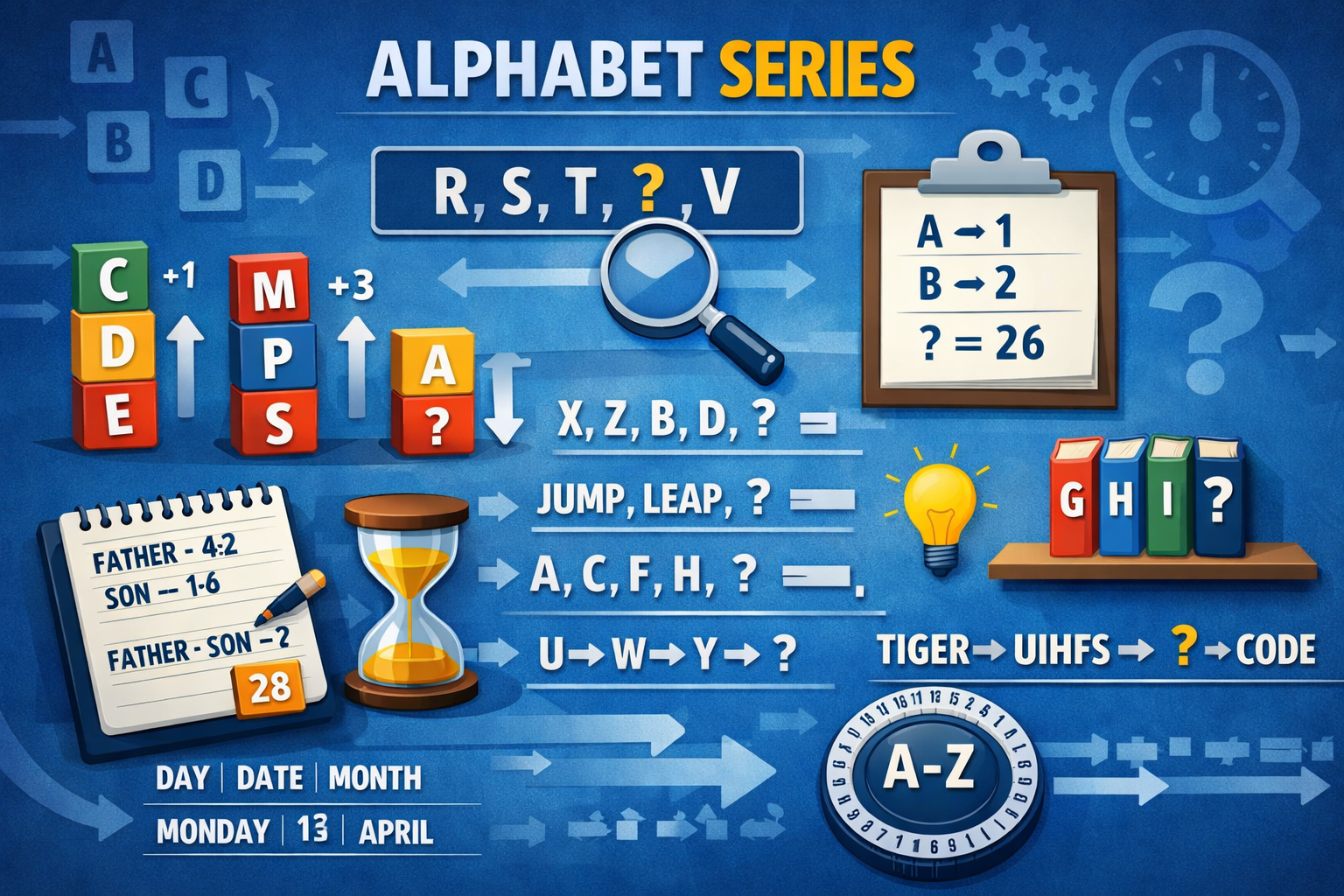
Tip: Most questions can be solved quickly by writing the alphabet position numbers above the letters.
Step-by-Step Solving Method
| Step | Action | Example |
|---|---|---|
| Step 1 | Write the alphabet position of each letter. | A = 1, C = 3, F = 6, J = 10. |
| Step 2 | Check whether the series moves forward or backward. | A, C, F, J moves forward. |
| Step 3 | Find the difference between positions. | 1 to 3 = +2, 3 to 6 = +3, 6 to 10 = +4. |
| Step 4 | Identify whether the difference is fixed or increasing. | Here, the difference increases by 1. |
| Step 5 | Apply the same pattern to get the next letter. | Next gap is +5, so 10 + 5 = 15 = O. |
Solved Examples
| Question | Method | Answer |
|---|---|---|
| Find the next letter: A, C, E, G, ? |
Alphabet positions: 1, 3, 5, 7. Difference is +2 each time. |
I |
| Find the next letter: B, E, H, K, ? |
Alphabet positions: 2, 5, 8, 11. Difference is +3 each time. |
N |
| Find the next letter: Z, X, V, T, ? |
Letters move backward by 2 positions. Z, X, V, T, R. |
R |
| Find the next letter: A, C, F, J, O, ? |
Positions: 1, 3, 6, 10, 15. Differences are +2, +3, +4, +5. Next difference is +6. |
U |
| Find the next letter: A, B, D, G, K, ? |
Positions: 1, 2, 4, 7, 11. Differences are +1, +2, +3, +4. Next difference is +5. |
P |
| Find the missing letter: C, F, J, O, ? |
Positions: 3, 6, 10, 15. Differences are +3, +4, +5. Next difference is +6. |
U |
| Find the next letter: A, Z, C, X, E, V, ? |
Odd positions: A, C, E move forward by 2. Even positions: Z, X, V move backward by 2. Next odd-position letter is G. |
G |
| Find the wrong term: A, D, G, J, N |
Pattern should be +3 each time: A, D, G, J, M. Therefore N is wrong. |
N |
Note: In wrong-term questions, first identify the correct pattern and then compare each term.
Common Traps and Shortcuts
Common Traps
- Assuming every series has a fixed gap.
- Forgetting to check backward movement.
- Ignoring alternate patterns.
- Confusing letter position with sequence position.
- Not checking increasing or decreasing gaps.
- Making mistakes near the end of the alphabet.
Useful Shortcuts
- Memorize alphabet positions from A to Z.
- Use anchor letters like A, E, J, O, T, and Z.
- Check forward and backward movement.
- For long series, check odd and even terms separately.
- Write position numbers above difficult letters.
- For wrong-term questions, verify all gaps.
Practice
A) Multiple Choice Questions
-
Find the next letter: A, C, E, G, ?
H I J K
-
Find the next letter: B, E, H, K, ?
L M N O
-
Find the next letter: Z, X, V, T, ?
S R Q P
-
Find the next letter: A, B, D, G, K, ?
M N O P
-
Find the missing letter: A, Z, C, X, E, V, ?
F G H I
B) Solve the Higher-Order Problems
- Find the next letter: A, C, F, J, O, ? (Hint: Check increasing gaps.)
- Find the next letter: C, F, J, O, ? (Hint: Differences are increasing.)
- Find the next letter: Y, V, R, M, ? (Hint: Backward gaps are increasing.)
- Find the next letter: A, D, I, P, ? (Hint: Check gaps +3, +5, +7.)
- Find the wrong term: B, D, G, K, Q, V (Hint: Check increasing differences.)
C) Match the Series with the Correct Pattern
| Series | Correct Pattern / Meaning |
|---|---|
| A, B, C, D | Consecutive letters |
| A, C, E, G | Letters move forward by 2 |
| Z, X, V, T | Letters move backward by 2 |
| A, C, F, J | Increasing gap pattern |
| A, Z, C, X, E | Alternate forward and backward pattern |
| A, D, G, J | Letters move forward by 3 |
Reasoning Reminder
Alphabet series questions require careful observation of letter movement. Most questions are based on fixed gaps, reverse order, increasing gaps, alternate patterns, or wrong-term detection. The fastest method is to convert letters into numbers and compare the differences.
Task: Create five alphabet series using fixed gaps, reverse order, increasing gaps, and alternate patterns.
Show Suggested Answers
Multiple Choice
-
I
A, C, E, G move forward by 2 positions. Therefore, the next letter is I. -
N
B, E, H, K move forward by 3 positions. Therefore, the next letter is N. -
R
Z, X, V, T move backward by 2 positions. Therefore, the next letter is R. -
P
Alphabet positions are 1, 2, 4, 7, 11.
Differences are +1, +2, +3, +4. Next difference is +5.
11 + 5 = 16, which is P. -
G
Odd-position letters: A, C, E, G move forward by 2.
Even-position letters: Z, X, V move backward by 2.
Higher-Order Problems
-
A, C, F, J, O, ?
Positions: 1, 3, 6, 10, 15.
Differences are +2, +3, +4, +5, so next difference is +6.
15 + 6 = 21, which is U. -
C, F, J, O, ?
Positions: 3, 6, 10, 15.
Differences are +3, +4, +5, so next difference is +6.
15 + 6 = 21, which is U. -
Y, V, R, M, ?
Positions: 25, 22, 18, 13.
Differences are -3, -4, -5, so next difference is -6.
13 - 6 = 7, which is G. -
A, D, I, P, ?
Positions: 1, 4, 9, 16.
Differences are +3, +5, +7. Next difference is +9.
16 + 9 = 25, which is Y. -
B, D, G, K, Q, V
Correct pattern should be +2, +3, +4, +5, +6.
B = 2, D = 4, G = 7, K = 11.
Next should be 11 + 5 = 16, which is P, not Q.
Correct series should be B, D, G, K, P, V.
Wrong term = Q.
Concept Matching
- A, B, C, D → Consecutive letters
- A, C, E, G → Letters move forward by 2
- Z, X, V, T → Letters move backward by 2
- A, C, F, J → Increasing gap pattern
- A, Z, C, X, E → Alternate forward and backward pattern
- A, D, G, J → Letters move forward by 3
Clue Explanation
Alphabet series questions are solved by converting letters into positions and finding the difference between them. If a single pattern does not work, check odd-position and even-position letters separately.
Exam tips
- Memorize alphabet positions from A to Z.
- Use anchor values like A = 1, M = 13, Z = 26.
- Check whether letters move forward or backward.
- Look for fixed and increasing gaps.
- Check alternate terms separately in long series.
- For wrong-term questions, verify every gap carefully.