Logical Sequence of Words
Practice MCQsLogical Sequence of Words questions test your ability to arrange words in a meaningful and natural order.
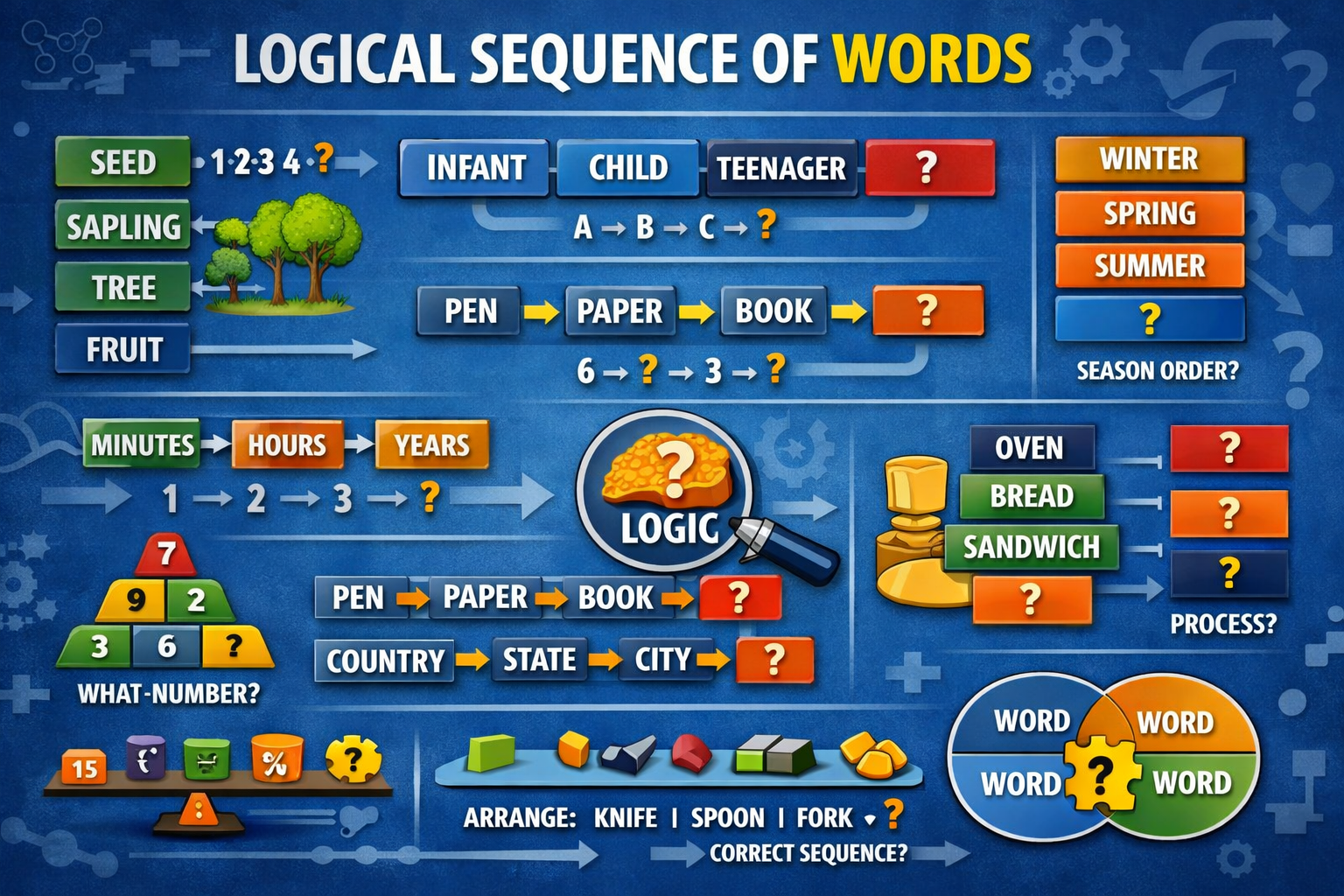
Logical Sequence of Words is an important reasoning ability topic where a group of words is given in a jumbled order, and you must arrange them in a meaningful, logical, chronological, procedural, or natural sequence.
What is Logical Sequence of Words?
In Logical Sequence of Words questions, a set of words is given and you are asked to arrange them in the correct order. The order may be based on time, size, age, process, cause and effect, hierarchy, natural growth, or dictionary-like progression.
These questions test your ability to understand relationships among words and arrange them according to a logical flow. The sequence should make sense from beginning to end.
| Jumbled Words | Logic | Correct Sequence |
|---|---|---|
| Seed, Tree, Plant, Fruit | Natural growth order | Seed → Plant → Tree → Fruit |
| Infant, Adult, Child, Teenager | Age order | Infant → Child → Teenager → Adult |
| District, Country, Village, State | Administrative hierarchy | Village → District → State → Country |
| Interview, Application, Selection, Joining | Job process order | Application → Interview → Selection → Joining |
“Logical sequence questions are solved by finding the natural order hidden among the words.”
Key points
- Identify the basis of arrangement first.
- Check whether the words follow time or process order.
- Look for natural growth or life-cycle order.
- Check small-to-large or low-to-high hierarchy.
- Do not arrange words alphabetically unless asked.
- Verify that the final sequence has a meaningful flow.
Common Types of Logical Sequence Questions
Logical sequence questions are usually based on a familiar order. The following types are commonly asked in competitive exams.
Time Sequence
Words are arranged according to time order.
- Morning, Afternoon, Evening, Night
- Past to future
- Earlier to later
- Chronological order
Process Sequence
Words are arranged as steps of a process.
- Apply → Interview → Select → Join
- First step to last step
- Procedure-based
- Action flow
Size or Hierarchy
Words are arranged from small to large or low to high.
- Village → District → State
- Word → Sentence → Paragraph
- Part to whole
- Rank order
Life Cycle
Words are arranged according to growth or development.
- Seed → Plant → Tree → Fruit
- Egg → Larva → Pupa → Butterfly
- Birth to maturity
- Natural order
Sequence Pattern Bank
Egg → Chick → Hen
Infant → Child → Adult
Purchase → Payment → Delivery
Read → Understand → Answer
Ward → City → State
Local to national
School → College → University
Simple to complex
Tip: Try placing the first and last word first. The remaining words often become easier to arrange.
Step-by-Step Solving Method
| Step | Action | Example |
|---|---|---|
| Step 1 | Read all given words carefully. | Seed, Fruit, Plant, Tree |
| Step 2 | Identify the basis of sequence. | This is a natural growth sequence. |
| Step 3 | Find the first and last stage. | First: Seed, Last: Fruit |
| Step 4 | Arrange the middle stages logically. | Seed → Plant → Tree → Fruit |
| Step 5 | Verify whether the order makes sense. | A seed becomes a plant, then a tree, then gives fruit. |
Solved Examples
| Question | Method | Correct Sequence |
|---|---|---|
| Arrange: Seed, Tree, Plant, Fruit |
This is natural growth order. A seed grows into a plant, then tree, then fruit appears. |
Seed → Plant → Tree → Fruit |
| Arrange: Adult, Infant, Teenager, Child | This is age order from youngest to oldest. | Infant → Child → Teenager → Adult |
| Arrange: State, Village, Country, District | This is administrative order from smaller to larger unit. | Village → District → State → Country |
| Arrange: Sentence, Letter, Paragraph, Word | This is language structure from smallest to largest. | Letter → Word → Sentence → Paragraph |
| Arrange: Interview, Joining, Application, Selection | This is job recruitment process order. | Application → Interview → Selection → Joining |
| Arrange: Payment, Order, Delivery, Selection | This is online purchase process. | Selection → Order → Payment → Delivery |
| Arrange: Rain, Cloud, River, Evaporation |
This is water cycle logic. Evaporation forms clouds, clouds cause rain, rainwater flows into rivers. |
Evaporation → Cloud → Rain → River |
| Arrange: Book, Chapter, Page, Word | This is from larger unit to smaller unit. | Book → Chapter → Page → Word |
Note: Always decide whether the sequence should be from small to large, large to small, first to last, or cause to result.
Common Traps and Shortcuts
Common Traps
- Arranging words alphabetically instead of logically.
- Ignoring whether the sequence is small-to-large or large-to-small.
- Missing the first or final stage of a process.
- Confusing cause and effect order.
- Not identifying the common category of the words.
- Choosing a sequence only because it sounds familiar.
Useful Shortcuts
- Identify whether the order is time, size, process, or hierarchy.
- Find the first and last word first.
- Use natural life cycle or process logic where applicable.
- For administrative units, arrange from smaller to larger.
- For language units, arrange letter, word, sentence, paragraph.
- Verify the final sequence by reading it as a story.
Practice
A) Multiple Choice Questions
-
Arrange logically: Seed, Fruit, Plant, Tree
Seed → Plant → Tree → Fruit Fruit → Seed → Tree → Plant Plant → Seed → Fruit → Tree Tree → Plant → Seed → Fruit
-
Arrange logically: Child, Infant, Adult, Teenager
Child → Infant → Adult → Teenager Infant → Child → Teenager → Adult Adult → Teenager → Child → Infant Teenager → Child → Infant → Adult
-
Arrange logically: District, Village, Country, State
Country → State → Village → District Village → District → State → Country State → Country → Village → District District → Village → State → Country
-
Arrange logically: Sentence, Letter, Paragraph, Word
Word → Letter → Sentence → Paragraph Letter → Word → Sentence → Paragraph Paragraph → Sentence → Letter → Word Sentence → Word → Letter → Paragraph
-
Arrange logically: Application, Selection, Joining, Interview
Application → Interview → Selection → Joining Interview → Application → Joining → Selection Selection → Application → Interview → Joining Joining → Selection → Interview → Application
B) Solve the Higher-Order Problems
- Arrange logically: Purchase, Selection, Payment, Delivery (Hint: Think of online shopping order.)
- Arrange logically: Egg, Butterfly, Pupa, Larva (Hint: Life cycle of a butterfly.)
- Arrange logically: Paragraph, Letter, Sentence, Word (Hint: Arrange from smallest to largest language unit.)
- Arrange logically: Cloud, Evaporation, Rain, River (Hint: Water cycle sequence.)
- Arrange logically: Interview, Appointment Letter, Application, Joining (Hint: Job process sequence.)
C) Match the Words with the Correct Sequence Type
| Word Group | Correct Sequence Type |
|---|---|
| Seed, Plant, Tree, Fruit | Natural growth sequence |
| Infant, Child, Teenager, Adult | Age sequence |
| Village, District, State, Country | Administrative hierarchy |
| Letter, Word, Sentence, Paragraph | Language structure sequence |
| Application, Interview, Selection, Joining | Job process sequence |
| Evaporation, Cloud, Rain, River | Water cycle / cause-effect sequence |
Reasoning Reminder
Logical sequence of words questions require arranging words according to a meaningful order. The sequence may be based on time, process, hierarchy, growth, cause-effect, size, or language structure. The best method is to identify the first and last step, then arrange the remaining words.
Task: Create five logical sequence questions using growth order, process order, hierarchy, life cycle, and cause-effect sequence.
Show Suggested Answers
Multiple Choice
-
Seed → Plant → Tree → Fruit
A seed grows into a plant, the plant becomes a tree, and the tree gives fruit. -
Infant → Child → Teenager → Adult
This is the age order from youngest to oldest. -
Village → District → State → Country
This is administrative order from smaller to larger unit. -
Letter → Word → Sentence → Paragraph
Letters make words, words make sentences, and sentences make paragraphs. -
Application → Interview → Selection → Joining
This is the usual job recruitment sequence.
Higher-Order Problems
-
Purchase, Selection, Payment, Delivery
Correct order = Selection → Purchase → Payment → Delivery. -
Egg, Butterfly, Pupa, Larva
Correct order = Egg → Larva → Pupa → Butterfly. -
Paragraph, Letter, Sentence, Word
Correct order = Letter → Word → Sentence → Paragraph. -
Cloud, Evaporation, Rain, River
Correct order = Evaporation → Cloud → Rain → River. -
Interview, Appointment Letter, Application, Joining
Correct order = Application → Interview → Appointment Letter → Joining.
Concept Matching
- Seed, Plant, Tree, Fruit → Natural growth sequence
- Infant, Child, Teenager, Adult → Age sequence
- Village, District, State, Country → Administrative hierarchy
- Letter, Word, Sentence, Paragraph → Language structure sequence
- Application, Interview, Selection, Joining → Job process sequence
- Evaporation, Cloud, Rain, River → Water cycle / cause-effect sequence
Clue Explanation
Logical sequence questions should be solved by identifying the basis of order. Once the basis is clear, arrange the words from beginning to end, small to large, cause to effect, or first step to final step.
Exam tips
- Identify the type of order first.
- Find the first and last word.
- Use natural process or life-cycle logic.
- Check whether order is small-to-large or large-to-small.
- Do not arrange alphabetically unless asked.
- Read the final sequence as a meaningful flow.