Coding and Decoding
Practice MCQsCoding and Decoding questions test your ability to identify a hidden rule and apply the same rule to a new word, number, or message.
Coding and Decoding is an important reasoning ability topic where words, letters, numbers, or symbols are written in a coded form. Your task is to identify the hidden rule and decode the correct answer.
What is Coding and Decoding?
Coding means converting a word, number, or message into another form using a particular rule. Decoding means identifying the rule and converting the coded message back into its original or required form.
In competitive exams, coding and decoding questions may use alphabet positions, reverse alphabet order, letter shifting, number values, symbols, word substitution, or mixed patterns. The key is to find the rule used in the given example and apply the same rule to the question.
| Original | Code | Rule |
|---|---|---|
| CAT | DBU | Each letter is moved one step forward. |
| DOG | CNF | Each letter is moved one step backward. |
| BAD | 214 | Letters are replaced by alphabet positions. |
| TOP | KLM | Letters are replaced by reverse alphabet positions. |
“Coding and decoding questions are solved by finding the hidden rule, not by guessing the code.”
Key points
- Compare given word and code carefully.
- Use alphabet position values.
- Check forward and backward letter shifts.
- Look for reverse alphabet coding.
- Check whether letters are rearranged.
- Apply the same rule to the new word.
Alphabet Position Chart
Alphabet positions are very important in coding and decoding questions. Many codes are formed by adding, subtracting, or reversing alphabet positions.
| A | B | C | D | E | F | G | H | I | J | K | L | M |
| 1 | 2 | 3 | 4 | 5 | 6 | 7 | 8 | 9 | 10 | 11 | 12 | 13 |
| N | O | P | Q | R | S | T | U | V | W | X | Y | Z |
| 14 | 15 | 16 | 17 | 18 | 19 | 20 | 21 | 22 | 23 | 24 | 25 | 26 |
Common Types of Coding and Decoding Questions
Coding and decoding questions may be based on letters, numbers, symbols, word replacement, or mixed logic. The following types are commonly asked in competitive exams.
Letter Shifting
Each letter is moved forward or backward.
- CAT → DBU
- C + 1 = D
- A + 1 = B
- T + 1 = U
Number Coding
Letters are replaced by numbers.
- A = 1
- B = 2
- CODE = 3 15 4 5
- Use alphabet positions
Reverse Alphabet Coding
Letters are replaced by opposite letters.
- A ↔ Z
- B ↔ Y
- C ↔ X
- CAT → XZG
Substitution Coding
Words are replaced by code words.
- “sky is blue” → “pa la ma”
- Compare statements
- Find common words
- Decode meaning
Coding Pattern Bank
CAT → DBU
Each letter moves +1
DOG → CNF
Each letter moves -1
BAD → 2 1 4
CODE → 3 15 4 5
DOG → WLT
Use opposite alphabet
Tip: Compare the first and last letters also. Many questions use shifting from both sides.
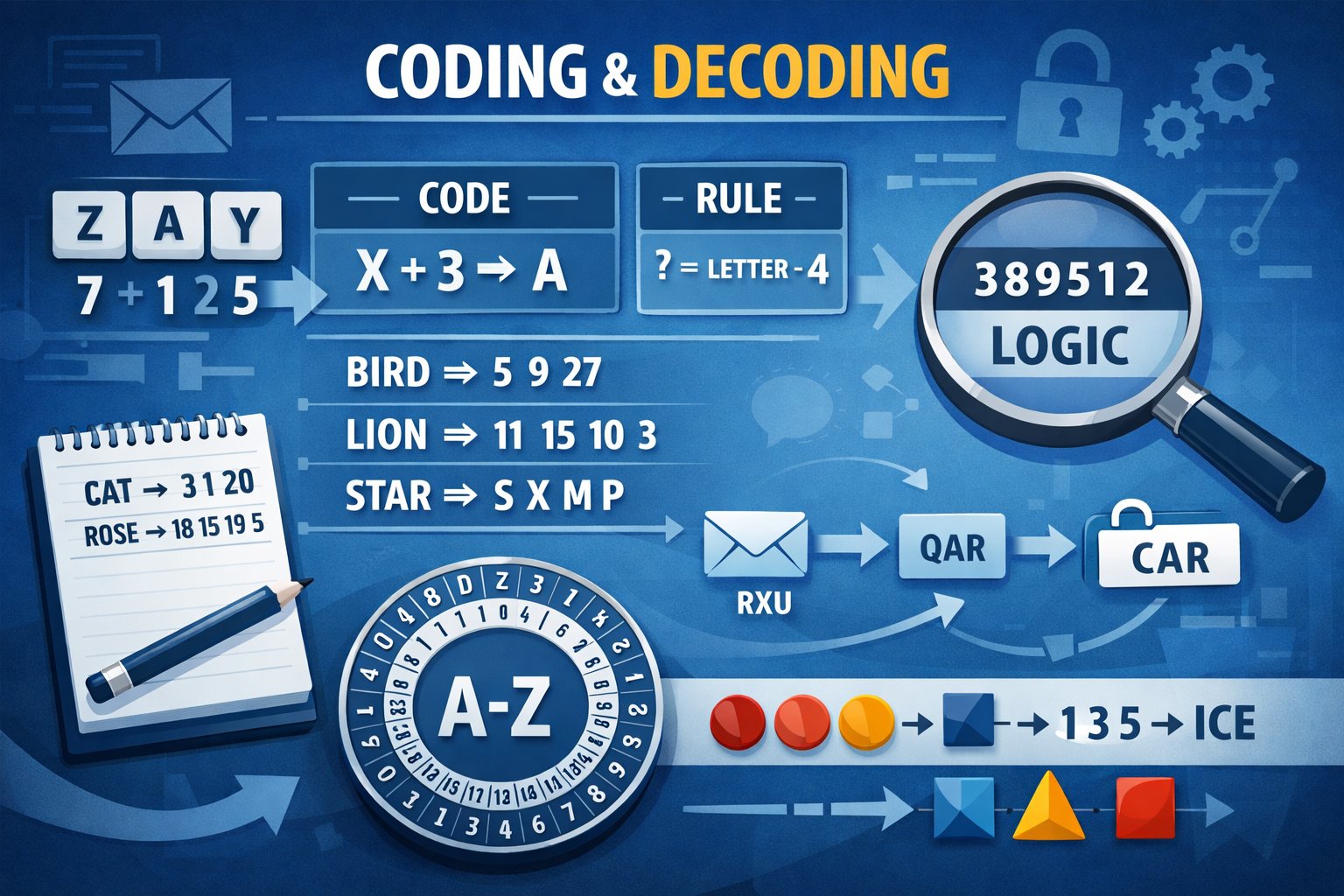
Step-by-Step Solving Method
| Step | Action | Example |
|---|---|---|
| Step 1 | Write the original word and coded word clearly. | CAT → DBU |
| Step 2 | Compare each corresponding letter. | C → D, A → B, T → U |
| Step 3 | Find the movement or rule. | Each letter moves +1. |
| Step 4 | Check whether the rule applies to all letters. | C + 1 = D, A + 1 = B, T + 1 = U. |
| Step 5 | Apply the same rule to the new word. | DOG → EPH. |
Solved Examples
| Question | Method | Answer |
|---|---|---|
| If CAT is coded as DBU, how is DOG coded? |
CAT → DBU means each letter moves +1. D + 1 = E, O + 1 = P, G + 1 = H. |
EPH |
| If DOG is coded as CNF, how is CAT coded? |
DOG → CNF means each letter moves -1. C - 1 = B, A - 1 = Z, T - 1 = S. |
BZS |
| If BAD is coded as 214, how is CAB coded? |
BAD → 214 means alphabet positions are used. C = 3, A = 1, B = 2. |
312 |
| If A is coded as Z and B is coded as Y, how is CAT coded? |
Use reverse alphabet coding. C → X, A → Z, T → G. |
XZG |
| If ROAD is coded as URDG, how is LAMP coded? |
R → U, O → R, A → D, D → G. Each letter moves +3. L → O, A → D, M → P, P → S. |
ODPS |
| If MANGO is coded as NZOHP, how is APPLE coded? |
Each letter moves +1. A → B, P → Q, P → Q, L → M, E → F. |
BQQMF |
| If DELHI is coded as CDKGH, how is PATNA coded? |
Each letter moves -1. P → O, A → Z, T → S, N → M, A → Z. |
OZSMZ |
| If BOOK is coded as 2151511, how is PEN coded? |
Use alphabet positions. B = 2, O = 15, O = 15, K = 11. P = 16, E = 5, N = 14. |
16514 |
Note: In number coding, single-digit and double-digit alphabet positions may be written together. Read carefully before decoding.
Common Traps and Shortcuts
Common Traps
- Assuming every code uses +1 letter movement.
- Ignoring backward letter movement.
- Forgetting reverse alphabet coding.
- Not checking whether letters are rearranged.
- Confusing alphabet position with term position.
- Reading number codes incorrectly when digits are joined together.
Useful Shortcuts
- Write alphabet positions above the letters.
- Compare first letter with first coded letter.
- Check whether all letters follow the same shift.
- Use reverse pair memory: A-Z, B-Y, C-X, D-W.
- For long words, check first, middle, and last letters.
- Verify the final code by applying the rule again.
Practice
A) Multiple Choice Questions
-
If CAT is coded as DBU, how is DOG coded?
EPH CNG FQI DOH
-
If BAD is coded as 214, how is CAB coded?
312 321 231 213
-
If A is coded as Z, B as Y, then CAT is coded as:
XZG YAG WZF XAG
-
If ROAD is coded as URDG, how is LAMP coded?
MBNQ ODPS KZLO NCOR
-
If DELHI is coded as CDKGH, how is PATNA coded?
QBUOB OZSMZ PZSMB OASNZ
B) Solve the Higher-Order Problems
- If MANGO is coded as NZOHP, how is APPLE coded? (Hint: Check forward letter shift.)
- If SCHOOL is coded as RBGNNK, how is TABLE coded? (Hint: Check backward letter shift.)
- If KING is coded as PRMT using reverse alphabet coding, how is QUEEN coded? (Hint: Use A-Z, B-Y, C-X reverse pairs.)
- If BOOK is coded as 2151511, how is PEN coded? (Hint: Use alphabet positions.)
- If TRAIN is coded as WUDLQ, how is BUS coded? (Hint: Check each letter shift in TRAIN.)
C) Match the Coding Type with the Correct Rule
| Coding Type | Correct Rule / Meaning |
|---|---|
| Forward Shift | Each letter moves ahead in alphabet order |
| Backward Shift | Each letter moves backward in alphabet order |
| Alphabet Position Coding | Letters are replaced by their position numbers |
| Reverse Alphabet Coding | A becomes Z, B becomes Y, C becomes X |
| Substitution Coding | Words or symbols are replaced by fixed codes |
| Mixed Coding | More than one rule is used together |
Reasoning Reminder
Coding and decoding questions are solved by identifying the hidden rule used to transform the original word or message into code. The rule may involve alphabet movement, number position, reverse alphabet, symbol substitution, word substitution, or mixed operations.
Task: Create five coding and decoding questions using forward shift, backward shift, alphabet position, reverse alphabet, and mixed coding patterns.
Show Suggested Answers
Multiple Choice
-
EPH
CAT → DBU means each letter moves +1.
D → E, O → P, G → H. -
312
BAD → 214 uses alphabet positions.
C = 3, A = 1, B = 2. -
XZG
Reverse alphabet coding: C → X, A → Z, T → G. -
ODPS
ROAD → URDG means each letter moves +3.
L → O, A → D, M → P, P → S. -
OZSMZ
DELHI → CDKGH means each letter moves -1.
P → O, A → Z, T → S, N → M, A → Z.
Higher-Order Problems
-
MANGO → NZOHP uses +1 shift.
APPLE → BQQMF.
Answer = BQQMF. -
SCHOOL → RBGNNK uses -1 shift.
TABLE → SZAKD.
Answer = SZAKD. -
Reverse alphabet coding:
Q → J, U → F, E → V, E → V, N → M.
QUEEN → JFVVM. -
BOOK → 2151511 uses alphabet positions.
P = 16, E = 5, N = 14.
PEN → 16514. -
TRAIN → WUDLQ uses +3 shift for each letter.
B → E, U → X, S → V.
BUS → EXV.
Concept Matching
- Forward Shift → Each letter moves ahead in alphabet order
- Backward Shift → Each letter moves backward in alphabet order
- Alphabet Position Coding → Letters are replaced by their position numbers
- Reverse Alphabet Coding → A becomes Z, B becomes Y, C becomes X
- Substitution Coding → Words or symbols are replaced by fixed codes
- Mixed Coding → More than one rule is used together
Clue Explanation
Coding and decoding questions should be solved by comparing the original and coded forms. Once the transformation rule is identified, apply the same rule carefully to the new word.
Exam tips
- Compare original and coded words letter by letter.
- Check forward and backward shifts.
- Use alphabet position chart for number codes.
- Remember reverse pairs: A-Z, B-Y, C-X.
- Check whether letters are rearranged.
- Verify the rule before selecting the answer.