Analogy
Practice MCQsAnalogy is an important reasoning ability topic that tests your ability to identify the relationship between two items and apply the same relationship to another pair.
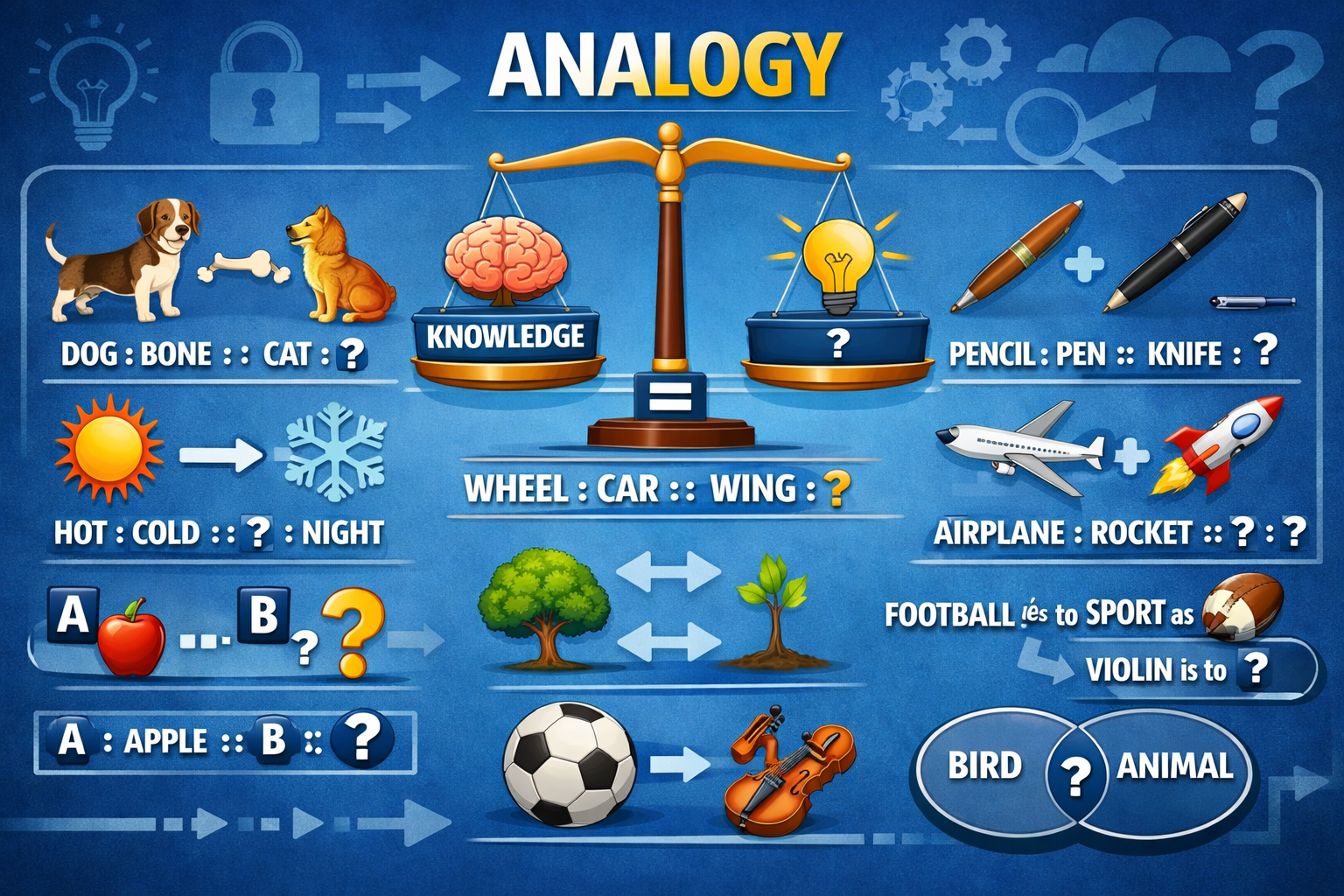
Analogy is an important reasoning ability topic that tests your ability to identify the relationship between two items and apply the same relationship to another pair. It is commonly asked in competitive exams to check logical thinking, comparison skills, vocabulary, classification, and pattern recognition.
What is Analogy?
An analogy is a comparison between two pairs of words, numbers, letters, or objects. The first pair has a relationship, and you must identify the same relationship in the second pair.
For example, Bird : Fly :: Fish : Swim. Here, a bird moves by flying and a fish moves by swimming. The relationship is based on mode of movement.
| Analogy | Relationship | Explanation |
|---|---|---|
| Doctor : Hospital | Person and workplace | A doctor works in a hospital. |
| Pen : Write | Tool and function | A pen is used to write. |
| Bird : Nest | Animal and home | A bird lives in a nest. |
| Hot : Cold | Opposite meaning | Hot and cold are antonyms. |
“In analogy questions, the answer depends on the relationship, not only on the words.”
Key points
- Identify the relationship in the first pair.
- Apply the same relationship to the second pair.
- Do not select based on word familiarity alone.
- Check direction of relationship carefully.
- Analogy can be verbal, numerical, or letter-based.
- Many options may look close, but only one fits exactly.
Common Types of Analogy Questions
Analogy questions can be formed using words, letters, numbers, objects, actions, and categories. The following types are frequently asked in competitive exams.
Word Analogy
Relationship between two words.
- Teacher : School
- Doctor : Hospital
- Tool and use
- Person and place
Number Analogy
Relationship between numbers.
- 4 : 16 :: 5 : 25
- Square relation
- Cube relation
- Arithmetic pattern
Letter Analogy
Relationship based on alphabet positions.
- A : C :: D : F
- Letters move +2
- Use alphabet position
- Check forward/backward
Classification Analogy
Relationship based on group or category.
- Apple : Fruit
- Rose : Flower
- Animal and class
- Object and category
Analogy Pattern Bank
Teacher : School
Farmer : Field
Knife : Cut
Key : Open
Lion : Den
Bee : Hive
Day : Night
Success : Failure
Tip: Read the pair as a sentence. Example: “A pen is used to write.” Then apply the same sentence logic.
Alphabet Position Chart for Letter Analogy
Letter analogy questions often use alphabet position. This chart helps in solving such questions quickly.
| A | B | C | D | E | F | G | H | I | J | K | L | M |
| 1 | 2 | 3 | 4 | 5 | 6 | 7 | 8 | 9 | 10 | 11 | 12 | 13 |
| N | O | P | Q | R | S | T | U | V | W | X | Y | Z |
| 14 | 15 | 16 | 17 | 18 | 19 | 20 | 21 | 22 | 23 | 24 | 25 | 26 |
Step-by-Step Solving Method
| Step | Action | Example |
|---|---|---|
| Step 1 | Read the first pair carefully. | Pen : Write |
| Step 2 | Identify the relationship. | A pen is used to write. |
| Step 3 | Apply the same relationship to the second pair. | Knife is used to cut. |
| Step 4 | Check the direction of relation. | Tool → function, not function → tool. |
| Step 5 | Choose the option with the exact same logic. | Pen : Write :: Knife : Cut |
Solved Examples
| Question | Method | Answer |
|---|---|---|
| Doctor : Hospital :: Teacher : ? |
A doctor works in a hospital. A teacher works in a school. |
School |
| Pen : Write :: Knife : ? |
A pen is used to write. A knife is used to cut. |
Cut |
| Bird : Nest :: Lion : ? |
A bird lives in a nest. A lion lives in a den. |
Den |
| Hot : Cold :: Day : ? |
Hot and cold are opposites. Day and night are opposites. |
Night |
| 4 : 16 :: 5 : ? |
4² = 16. So, 5² = 25. |
25 |
| A : C :: D : ? |
A to C means +2 letters. D + 2 = F. |
F |
| Eye : See :: Ear : ? |
Eye is used to see. Ear is used to hear. |
Hear |
| Car : Road :: Train : ? |
A car moves on a road. A train moves on a track. |
Track |
Note: Always express the relationship as a simple sentence before choosing the answer.
Common Traps and Shortcuts
Common Traps
- Selecting an option only because it is related to one word.
- Ignoring the direction of the relationship.
- Confusing category relation with example relation.
- Mixing synonym, antonym, and function-based relationships.
- Not checking number operations in number analogy.
- Forgetting alphabet position in letter analogy.
Useful Shortcuts
- Convert the first pair into a sentence.
- Check whether relation is person-place, tool-use, object-category, or opposite.
- For number analogy, test square, cube, addition, subtraction, multiplication, and division.
- For letter analogy, convert letters into positions.
- Check whether the order of relation is same in both pairs.
- Eliminate options that match only one word but not the full relation.
Practice
A) Multiple Choice Questions
-
Doctor : Hospital :: Teacher : ?
Court School Market Bank
-
Pen : Write :: Knife : ?
Draw Cut Eat Open
-
Bird : Nest :: Bee : ?
Den Hive Stable Kennel
-
6 : 36 :: 7 : ?
42 49 56 63
-
A : D :: E : ?
F G H I
B) Solve the Higher-Order Problems
- Book : Read :: Food : ? (Hint: Object and action performed with it.)
- 3 : 27 :: 4 : ? (Hint: Check cube relation.)
- C : F :: H : ? (Hint: Check alphabet movement.)
- Eye : See :: Tongue : ? (Hint: Sense organ and function.)
- Mango : Fruit :: Carrot : ? (Hint: Object and category.)
C) Match the Analogy with the Correct Relationship
| Analogy | Correct Relationship / Meaning |
|---|---|
| Doctor : Hospital | Person and workplace |
| Pen : Write | Tool and function |
| Hot : Cold | Opposite words |
| Apple : Fruit | Object and category |
| 4 : 16 | Square relation |
| A : C | Letter movement by +2 |
Reasoning Reminder
Analogy questions are solved by identifying the exact relationship in the first pair and applying it to the second pair. The relationship may be based on function, place, category, synonym, antonym, numerical operation, or alphabet movement.
Task: Create five analogy questions using person-place, tool-function, animal-home, number-square, and letter-movement patterns.
Show Suggested Answers
Multiple Choice
-
School
A doctor works in a hospital. Similarly, a teacher works in a school. -
Cut
A pen is used to write. Similarly, a knife is used to cut. -
Hive
A bird lives in a nest. Similarly, a bee lives in a hive. -
49
6² = 36. Similarly, 7² = 49. -
H
A to D is +3 letters. Similarly, E + 3 = H.
Higher-Order Problems
-
Book : Read :: Food : ?
A book is read. Food is eaten.
Answer = Eat. -
3 : 27 :: 4 : ?
3³ = 27. Therefore, 4³ = 64.
Answer = 64. -
C : F :: H : ?
C to F is +3 letters.
H + 3 = K.
Answer = K. -
Eye : See :: Tongue : ?
Eye is used to see. Tongue is used to taste.
Answer = Taste. -
Mango : Fruit :: Carrot : ?
Mango is a fruit. Carrot is a vegetable.
Answer = Vegetable.
Concept Matching
- Doctor : Hospital → Person and workplace
- Pen : Write → Tool and function
- Hot : Cold → Opposite words
- Apple : Fruit → Object and category
- 4 : 16 → Square relation
- A : C → Letter movement by +2
Clue Explanation
In analogy questions, the correct answer is the option that follows the same relationship as the given pair. Always test the relationship as a short sentence before choosing the answer.
Exam tips
- Read the first pair carefully.
- Convert the relationship into a sentence.
- Check the direction of the pair.
- For number analogy, test common operations.
- For letter analogy, use alphabet positions.
- Eliminate options that only partially match the relationship.