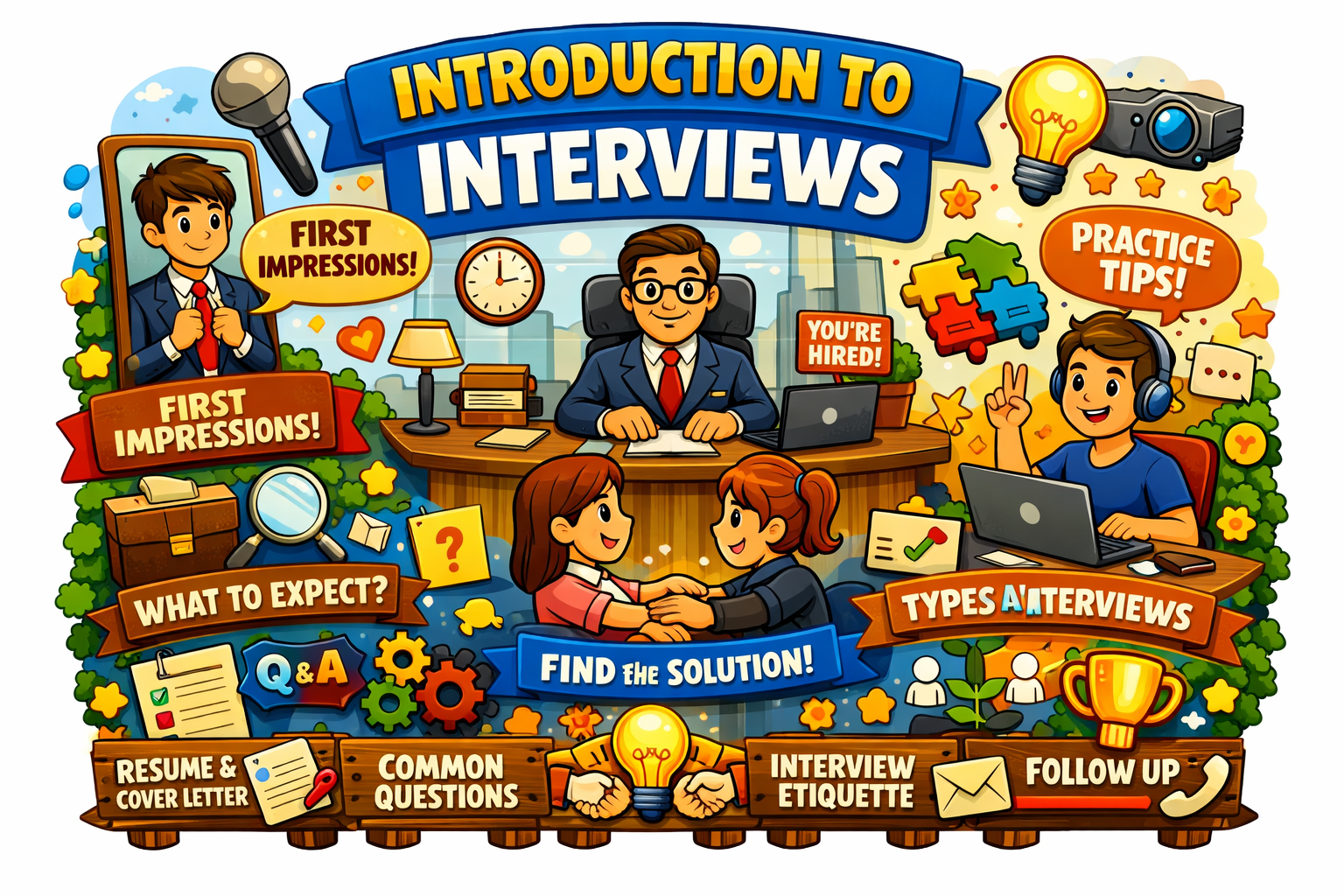
Introduction to Interviews
None
Interviews are formal or semi-formal conversations used to assess a candidate’s knowledge, skills, attitude, communication ability, confidence, and suitability for a role, course, project, scholarship, or opportunity.
What is an Interview?
An interview is a structured conversation between an interviewer and a candidate. The interviewer asks questions to understand the candidate’s background, abilities, behaviour, problem-solving approach, communication style, and overall fit for the opportunity.
Interviews are commonly used for jobs, internships, college admissions, scholarships, promotions, project selection, campus placement, and professional assessments. A good interview is not only about giving correct answers; it is also about presenting yourself clearly, honestly, confidently, and respectfully.
| Interview Area | What the Interviewer Checks | Candidate’s Focus |
|---|---|---|
| Knowledge | Subject understanding, technical ability, practical awareness. | Explain concepts clearly with examples. |
| Skills | Communication, problem solving, teamwork, leadership, tools. | Show skills through real experiences. |
| Attitude | Confidence, honesty, learning mindset, discipline, responsibility. | Be positive, respectful, and sincere. |
| Suitability | Whether the candidate fits the role, institution, or opportunity. | Connect your strengths with the requirement. |
“An interview is your opportunity to show who you are, what you know, and how you can contribute.”
Career Readiness Tip
Key points
- Understand the purpose of the interview.
- Prepare your self-introduction.
- Know your resume or profile clearly.
- Research the organisation or opportunity.
- Communicate clearly and honestly.
- Maintain professional body language.
- Ask thoughtful questions when appropriate.
Why are Interviews Important?
Interviews help organisations and institutions assess whether a candidate has the required knowledge, skills, attitude, communication ability, and seriousness for the opportunity.
Shows Personality
An interview helps present qualities beyond marks or resume points.
- Confidence
- Clarity
- Attitude
- Professional behaviour
Tests Communication
The interviewer observes how clearly you express ideas.
- Listening
- Answer structure
- Vocabulary
- Confidence in speech
Assesses Readiness
Interviews check whether you are prepared for the role or opportunity.
- Subject preparation
- Career clarity
- Role understanding
- Practical thinking
Creates Opportunity
A good interview can open doors to jobs, internships, admissions, and growth.
- Selection
- Networking
- Career growth
- Professional exposure
Common Types of Interviews
Different interviews are used for different purposes. Understanding the type helps you prepare better.
| Interview Type | Meaning | Preparation Focus |
|---|---|---|
| Personal Interview | One or more interviewers ask questions about you, your background, and your suitability. | Self-introduction, resume, strengths, goals, achievements. |
| Technical Interview | Checks subject knowledge, technical concepts, tools, or practical ability. | Core concepts, projects, problem solving, practical examples. |
| HR Interview | Assesses attitude, communication, behaviour, fit, and expectations. | Career goals, strengths, weaknesses, teamwork, salary or joining questions. |
| Panel Interview | Multiple interviewers assess the candidate together. | Confidence, eye contact with all panel members, structured answers. |
| Group Interview | Multiple candidates are assessed together. | Communication, teamwork, leadership, listening, respectful participation. |
| Online Interview | Interview conducted through video call or online platform. | Internet, camera, microphone, lighting, background, digital etiquette. |
| Behavioural Interview | Uses past experience to predict future behaviour. | Prepare examples using the STAR method. |
Mini Interview Preparation Strategy Bank
Tip: The best interview answers are clear, honest, relevant, and supported by examples.
Stages of an Interview
Most interviews follow a simple flow from greeting to closing. Knowing the stages helps you stay calm.
| Stage | What Happens | Candidate’s Approach |
|---|---|---|
| 1. Greeting | The interviewer welcomes the candidate and starts the conversation. | Greet politely, smile naturally, and maintain calm body language. |
| 2. Introduction | The candidate may be asked to introduce themselves. | Give a short, structured self-introduction relevant to the opportunity. |
| 3. Background Questions | Questions about education, experience, resume, projects, or interests. | Know your profile and explain experiences clearly. |
| 4. Skill / Subject Questions | The interviewer checks knowledge, ability, and practical thinking. | Answer logically and admit honestly if you do not know something. |
| 5. Behavioural Questions | Questions about teamwork, leadership, conflict, mistakes, or challenges. | Use real examples and explain what you learned. |
| 6. Candidate Questions | The interviewer may ask if you have any questions. | Ask thoughtful questions about the role, learning, team, or expectations. |
| 7. Closing | The interview ends with final remarks. | Thank the interviewer politely and leave professionally. |
STAR Method for Behavioural Interview Answers
The STAR method helps answer behavioural questions in a structured way. It is useful for questions like “Tell me about a time when you solved a problem.”
| STAR Element | Meaning | Example Prompt |
|---|---|---|
| S - Situation | Explain the background or context. | During my final-year project... |
| T - Task | Explain your responsibility or challenge. | I was responsible for coordinating the report... |
| A - Action | Explain what you did. | I divided the work, tracked progress, and helped two members... |
| R - Result | Explain the outcome and learning. | We submitted on time, and I learned the value of planning... |
Common Interview Questions and Answer Focus
| Question | What the Interviewer Wants to Know | Answer Focus |
|---|---|---|
| Tell me about yourself. | Background, communication, confidence, relevance. | Education, skills, experience/project, strengths, goal. |
| Why should we select you? | Your suitability for the role or opportunity. | Match your skills and attitude with the requirement. |
| What are your strengths? | Self-awareness and useful qualities. | Choose strengths relevant to the role and give examples. |
| What is your weakness? | Honesty, self-awareness, improvement mindset. | Share a real but manageable weakness and improvement action. |
| Tell me about a challenge you faced. | Problem-solving ability and resilience. | Use STAR method: situation, task, action, result. |
| Where do you see yourself in five years? | Career clarity and seriousness. | Show realistic growth, learning, and contribution. |
| Do you have any questions for us? | Interest, preparation, and maturity. | Ask about role expectations, learning, team, or next steps. |
Note: Avoid memorising long answers. Prepare key points and speak naturally.
Interview Etiquette and Professional Behaviour
| Area | Good Practice | Avoid |
|---|---|---|
| Punctuality | Reach early or join online a few minutes before time. | Arriving late without valid reason. |
| Appearance | Dress neatly and appropriately for the interview context. | Untidy or overly casual appearance. |
| Body Language | Sit upright, maintain natural eye contact, and listen actively. | Fidgeting, slouching, checking phone, or looking distracted. |
| Communication | Answer clearly, politely, and to the point. | Speaking too fast, interrupting, or giving unrelated answers. |
| Honesty | Be truthful about skills, experience, and knowledge. | Exaggerating or claiming false experience. |
| Closing | Thank the interviewer and show interest politely. | Leaving abruptly or asking careless questions. |
Common Interview Mistakes and Better Approaches
| Common Mistake | Possible Impact | Better Approach |
|---|---|---|
| Not knowing your resume | Creates doubt about honesty or preparation. | Review every point in your resume before the interview. |
| Giving very long answers | May sound unclear or unfocused. | Answer directly, then add a short example if needed. |
| Speaking negatively about others | Shows poor attitude and professionalism. | Discuss challenges respectfully and focus on learning. |
| Claiming skills without examples | Weakens credibility. | Support claims with projects, tasks, or real experiences. |
| Poor body language | May suggest nervousness, disinterest, or lack of confidence. | Sit upright, listen actively, and maintain natural eye contact. |
| Not asking any question | May show low interest or preparation. | Ask a thoughtful question about the role, learning, or next steps. |
Note: Interview mistakes can be reduced through preparation, practice, mock interviews, and honest self-review.
Step-by-Step Interview Preparation Process
Interview preparation becomes easier when it follows a clear process.
| Step | Action | Question to Ask |
|---|---|---|
| 1. Understand the Opportunity | Read the role, course, institution, or opportunity details. | What are they looking for? |
| 2. Review Your Profile | Study your resume, education, skills, projects, and achievements. | Can I explain every point clearly? |
| 3. Prepare Self-Introduction | Create a short and relevant introduction. | What should I say in the first minute? |
| 4. Practise Common Questions | Prepare answers for common HR, technical, and behavioural questions. | Can I answer clearly without memorising? |
| 5. Prepare Examples | Collect examples of teamwork, leadership, problem solving, and learning. | What real examples prove my skills? |
| 6. Practise Body Language | Practise posture, eye contact, voice, and listening. | Do I look attentive and confident? |
| 7. Arrange Essentials | Keep resume, documents, portfolio, internet setup, or interview link ready. | Is everything ready before the interview? |
| 8. Review and Improve | Take mock interviews and improve weak areas. | What feedback should I work on? |
Practice
A) Multiple Choice Questions
-
An interview is mainly used to assess:
only handwriting knowledge, skills, attitude, and suitability only physical height only hobbies
-
A good self-introduction should be:
very long and unrelated short, clear, and relevant full of false claims only jokes
-
The STAR method is useful for:
behavioural interview answers random guessing avoiding questions writing only addresses
-
If you do not know an answer, you should:
make a false answer confidently honestly say you do not know and show willingness to learn blame the interviewer remain rude
-
Professional interview body language includes:
slouching and fidgeting upright posture and natural eye contact checking phone repeatedly interrupting frequently
B) Situation-Based Practice
- You are asked, “Tell me about yourself.” How should you answer? (Hint: education, skills, experience/project, strength, goal.)
- The interviewer asks about a project mentioned in your resume. What should you explain? (Hint: purpose, your role, tools/method, result, learning.)
- You are asked about a weakness. How should you answer professionally? (Hint: be honest, choose a manageable weakness, show improvement action.)
- You do not know the answer to a technical question. What should you do? (Hint: be honest and show willingness to learn.)
- At the end, the interviewer asks if you have questions. What can you ask? (Hint: role expectations, learning opportunities, team, next steps.)
C) Match the Interview Concept with Its Use
| Interview Concept | Use |
|---|---|
| Self-introduction | Creates the first structured impression |
| Resume review | Helps explain your background confidently |
| STAR method | Structures behavioural answers clearly |
| Mock interview | Improves confidence through practice |
| Professional etiquette | Shows respect, seriousness, and maturity |
Interview Readiness Reminder
Interviews are important career and academic opportunities. A successful candidate prepares well, understands the role, knows their own profile, communicates clearly, behaves professionally, listens carefully, and gives honest answers supported by examples.
Task: Prepare a one-minute self-introduction and practise it aloud three times.
Show Suggested Answers
Multiple Choice
- knowledge, skills, attitude, and suitability
- short, clear, and relevant
- behavioural interview answers
- honestly say you do not know and show willingness to learn
- upright posture and natural eye contact
Situation-Based Practice: Sample Answers
- Give a short introduction covering your name, education, key skills, relevant project or experience, strength, and career interest.
- Explain the project purpose, your specific role, tools or methods used, challenges faced, result achieved, and learning gained.
- Mention a real but manageable weakness and explain what you are doing to improve it.
- Say honestly, “I am not fully sure about this, but I am willing to learn and understand it.”
- You may ask, “What are the key expectations from this role?” or “What learning opportunities are available for selected candidates?”
Concept Matching
- Self-introduction → Creates the first structured impression
- Resume review → Helps explain your background confidently
- STAR method → Structures behavioural answers clearly
- Mock interview → Improves confidence through practice
- Professional etiquette → Shows respect, seriousness, and maturity
Clue Explanation
Interview preparation includes understanding the opportunity, knowing your profile, preparing examples, practising communication, maintaining professional behaviour, and answering honestly with clarity.
Practical tips
- Prepare a short self-introduction.
- Know every point in your resume.
- Research the role or organisation.
- Prepare examples for your skills.
- Practise common interview questions.
- Use the STAR method for behavioural answers.
- Dress neatly and be punctual.
- Answer honestly and professionally.
Select a topic and chapter from the left menu.