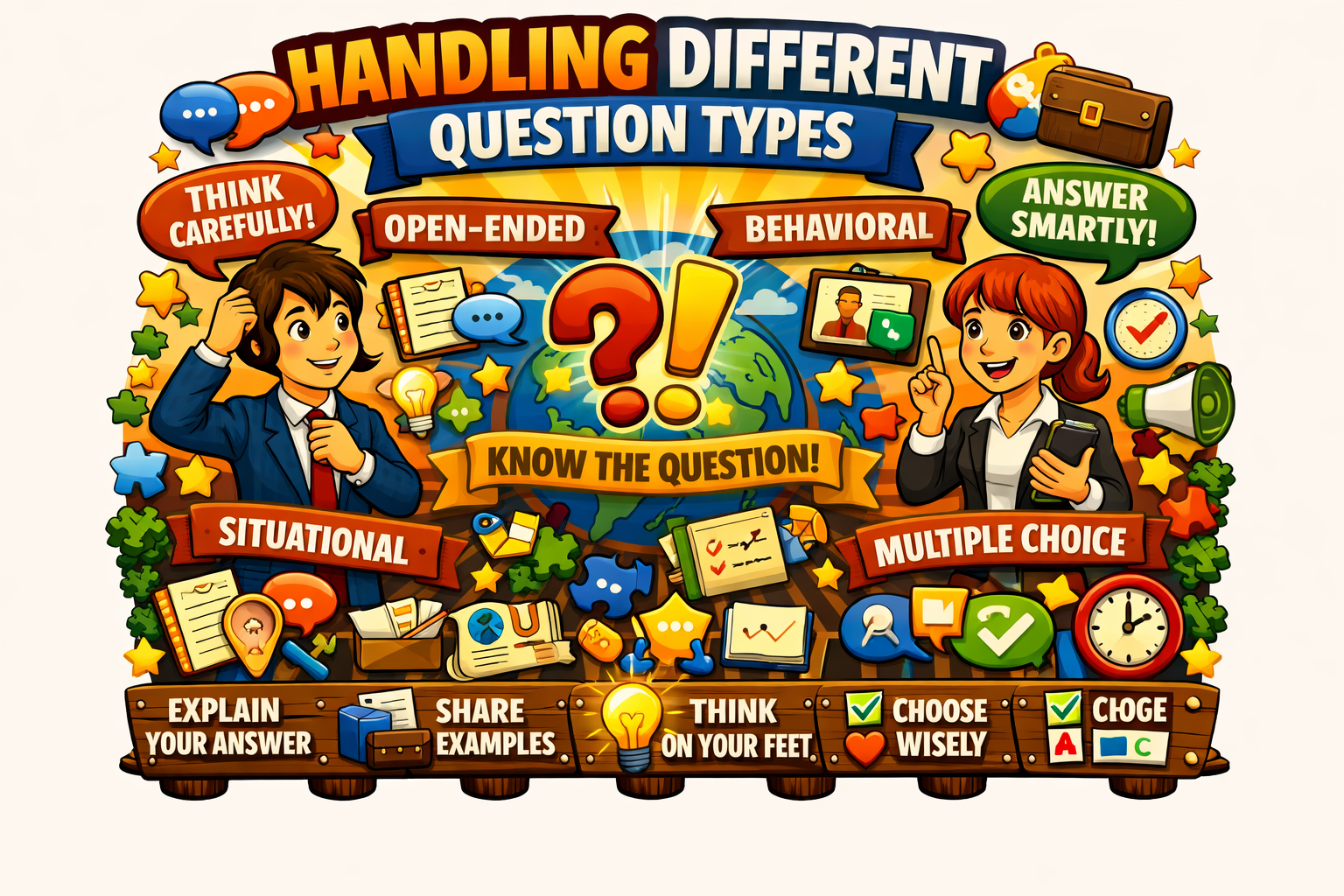
Handling Different Question Types
Handling Different Question Types means understanding why an interviewer is asking a particular question and answering it with the right structure, examples, honesty, and confidence.
What Does Handling Different Question Types Mean?
In an interview, all questions are not the same. Some questions test your knowledge, some test your communication, some check your attitude, and some observe how you think under pressure.
A good candidate does not answer every question in the same style. They first understand the type of question, identify what the interviewer wants to know, and then give a clear, relevant, and well-structured answer.
| Question Type | What It Tests | Best Answer Style |
|---|---|---|
| Introductory Questions | Confidence, background, communication, relevance. | Short, structured, and role-focused. |
| Technical Questions | Subject knowledge, practical understanding, clarity. | Concept + example + application. |
| Behavioural Questions | Past behaviour, teamwork, leadership, problem solving. | Use STAR method. |
| Situational Questions | Judgement, decision making, maturity. | Explain practical action step by step. |
| Stress Questions | Calmness, confidence, emotional control. | Stay composed and answer respectfully. |
“A strong interview answer is clear, relevant, honest, and supported by examples.”
Interview Technique Tip
Key points
- Listen carefully before answering.
- Identify the type of question.
- Understand what is being tested.
- Use a suitable answer structure.
- Support answers with examples.
- Be honest if you do not know something.
- Stay calm during difficult questions.
Why is It Important to Handle Question Types Properly?
Interviewers ask different types of questions to understand different qualities of a candidate. When you answer according to the question type, your response becomes clearer, more relevant, and more professional.
Improves Relevance
You answer what is actually being asked.
- Avoids unrelated answers
- Focuses on interviewer’s intent
- Improves clarity
- Saves time
Shows Preparation
Structured answers show that you are serious and prepared.
- Resume clarity
- Role awareness
- Prepared examples
- Professional approach
Builds Confidence
Knowing answer patterns reduces nervousness.
- Better fluency
- Less hesitation
- Calm response
- Improved self-belief
Creates Strong Impression
Good answers show maturity, clarity, and suitability.
- Clear thinking
- Good judgement
- Communication skill
- Role fit
Major Types of Interview Questions
Interview questions can be grouped into different categories. Each category needs a slightly different answering technique.
| Question Type | Purpose | Example Question | Answer Technique |
|---|---|---|---|
| Introductory | To know your background and communication style. | Tell me about yourself. | Use present-past-future or education-skills-goal structure. |
| Resume-Based | To verify and explore your profile. | Explain this project mentioned in your resume. | Explain purpose, your role, tools, result, and learning. |
| Technical / Subject | To test knowledge and practical understanding. | What is database normalization? | Define, explain, give example, and mention application. |
| Behavioural | To understand how you acted in past situations. | Tell me about a time you worked in a team. | Use STAR: Situation, Task, Action, Result. |
| Situational | To check judgement in imaginary or future situations. | What will you do if your team misses a deadline? | Explain a practical step-by-step response. |
| Strengths and Weaknesses | To check self-awareness and maturity. | What are your strengths and weaknesses? | Give honest, relevant answer with improvement action. |
| Motivation / Fit | To check interest and suitability. | Why do you want this role? | Connect your skills, goals, and values with the opportunity. |
| Stress / Pressure | To observe calmness and emotional control. | Why should we hire you when others have better marks? | Stay respectful, confident, and evidence-based. |
| Closing Questions | To assess interest and professionalism. | Do you have any questions for us? | Ask thoughtful questions about role, learning, or expectations. |
Mini Answering Strategy Bank
Tip: A short structured answer is usually stronger than a long unfocused answer.
1. Introductory and Resume-Based Questions
These questions create the first impression. They check whether you know yourself and whether you can present your background clearly.
| Question | What to Include | Avoid |
|---|---|---|
| Tell me about yourself. | Education, skills, project/experience, strengths, career interest. | Very long personal history or unrelated details. |
| Walk me through your resume. | Key academic/work milestones and relevant achievements. | Reading every line mechanically. |
| Explain your project. | Problem, your role, tools, method, result, and learning. | Claiming team work as your own without clarity. |
| Why did you choose this course/field? | Interest, skill fit, learning journey, and future goal. | “Because my friend chose it” or vague answers. |
2. Technical or Subject-Based Questions
Technical questions test your subject understanding, practical application, and ability to explain concepts clearly.
| Question Pattern | Answer Structure | Example Approach |
|---|---|---|
| What is...? | Definition + simple explanation + example. | “Database normalization is... For example...” |
| How does it work? | Step-by-step process + practical use. | “First..., then..., finally...” |
| Difference between A and B? | Compare by purpose, use, advantage, and example. | “A is used when..., whereas B is used when...” |
| Explain your technical project. | Problem + tools + your role + result + learning. | “The project solved..., I worked on..., we used...” |
| What if you do not know? | Be honest + show learning attitude. | “I am not fully sure, but I would like to learn it.” |
3. Behavioural Questions
Behavioural questions ask about past experiences. Interviewers use them to understand how you may behave in similar situations in the future.
| Question | What It Tests | Best Method |
|---|---|---|
| Tell me about a time you worked in a team. | Teamwork, cooperation, responsibility. | Use STAR method. |
| Tell me about a challenge you faced. | Problem solving, resilience, learning. | Use STAR method. |
| Describe a time you made a mistake. | Honesty, accountability, improvement mindset. | Accept mistake + correction + learning. |
| Tell me about a time you showed leadership. | Initiative, coordination, responsibility. | Situation + action + result. |
| STAR Element | Meaning | Example Cue |
|---|---|---|
| S - Situation | Give the background. | During our final-year project... |
| T - Task | Explain your responsibility. | I was responsible for coordinating the report... |
| A - Action | Explain what you did. | I divided the work and followed up daily... |
| R - Result | Explain outcome and learning. | We submitted on time and I learned... |
4. Situational Questions
Situational questions ask what you would do in a possible future situation. They test judgement, maturity, ethics, and practical thinking.
| Question | What to Show | Suggested Answer Direction |
|---|---|---|
| What would you do if your team misses a deadline? | Responsibility and problem solving. | Identify cause, reassign tasks, inform stakeholders, recover timeline. |
| What would you do if you disagree with your senior? | Respect and communication maturity. | Understand first, share your view respectfully, accept final decision professionally. |
| What would you do if you make a mistake? | Accountability and honesty. | Accept, inform, correct, and prevent repetition. |
| What would you do if you do not know how to complete a task? | Learning attitude and initiative. | Try to understand, research, ask for guidance, and complete responsibly. |
5. Strengths, Weaknesses and Motivation Questions
These questions test self-awareness, honesty, seriousness, and whether you understand your own suitability.
| Question | Good Answer Focus | Avoid |
|---|---|---|
| What are your strengths? | Mention role-relevant strength with example. | Generic claims without evidence. |
| What is your weakness? | Real but manageable weakness + improvement action. | Fake weakness like “I am too perfect.” |
| Why do you want this role? | Connect role, skills, interest, and career goal. | Only salary, pressure from others, or vague interest. |
| Why should we select you? | Skill match + attitude + learning ability + contribution. | Overconfidence or comparing negatively with others. |
| Where do you see yourself in five years? | Realistic growth, learning, and contribution. | Unrealistic claims or no clarity at all. |
6. Stress, Tricky and Unexpected Questions
Some interview questions may feel difficult, uncomfortable, or unexpected. The interviewer may be testing your calmness, honesty, confidence, and ability to think clearly.
| Question | What It Tests | Better Response Style |
|---|---|---|
| Why are your marks low? | Honesty and improvement mindset. | Accept, explain briefly, focus on improvement and current strengths. |
| Why should we hire you over others? | Confidence without arrogance. | Speak about your fit, skills, learning attitude, and contribution. |
| You do not seem experienced enough. | Composure and self-belief. | Acknowledge, highlight learning ability, projects, and willingness to work hard. |
| What if you fail in this role? | Resilience and problem solving. | Explain how you would seek feedback, improve, and take corrective action. |
| Can you answer a question you do not know? | Honesty under pressure. | Say honestly that you do not know and explain how you would learn it. |
7. Closing Questions and Candidate Questions
Closing questions allow you to show interest, professionalism, and seriousness about the opportunity.
| Question | Best Approach | Example Response |
|---|---|---|
| Do you have any questions for us? | Ask thoughtful questions about role or learning. | What are the key expectations from this role in the first few months? |
| Are you comfortable with this role? | Show interest and realistic understanding. | Yes, based on my understanding, this role matches my skills and learning goals. |
| When can you join? | Answer clearly and honestly. | I can join from this date, subject to completing formalities. |
| Any final comments? | Summarise interest and thank the interviewer. | Thank you for the opportunity. I am interested in contributing and learning in this role. |
Note: Avoid asking only about salary, leave, or benefits as your first question unless the interviewer opens that topic.
Common Mistakes While Answering Interview Questions
| Mistake | Impact | Better Approach |
|---|---|---|
| Answering without listening fully | Answer may not match the question. | Listen fully and pause briefly before answering. |
| Giving very long answers | Interviewer may lose focus. | Keep answers structured and concise. |
| Making false claims | Damages trust and credibility. | Be honest about skills and experience. |
| No examples | Answers sound weak or generic. | Use real examples from study, project, work, or activities. |
| Speaking negatively about others | Shows poor attitude. | Discuss challenges respectfully and focus on learning. |
| Getting defensive | Shows low emotional control. | Stay calm and answer with maturity. |
Note: Interview answers should show clarity, confidence, honesty, maturity, and learning attitude.
Step-by-Step Method to Handle Any Interview Question
Use this method when you face any interview question, especially when you are unsure how to begin.
| Step | Action | Question to Ask Yourself |
|---|---|---|
| 1. Listen | Listen to the full question carefully. | What exactly is being asked? |
| 2. Identify | Recognise the question type. | Is this technical, behavioural, situational, or personal? |
| 3. Pause | Take a short pause to organise your thoughts. | What is my main answer? |
| 4. Structure | Choose a suitable answering method. | Should I use STAR, definition-example, or step-by-step? |
| 5. Answer | Give a clear and relevant response. | Am I answering the actual question? |
| 6. Support | Add example, evidence, or result if needed. | Can I support this with a real example? |
| 7. Close | End with result, learning, or positive point. | Does my answer end professionally? |
Practice
A) Multiple Choice Questions
-
The first step before answering any interview question is to:
interrupt immediately listen carefully guess randomly avoid eye contact
-
The STAR method is best used for:
behavioural questions only salary questions random guessing avoiding answers
-
For technical questions, a good answer should include:
definition, explanation, and example false confidence only silence unrelated story
-
If you do not know an answer, you should:
make a false answer be honest and show willingness to learn argue with the interviewer blame the question
-
A good closing question to ask the interviewer is:
What are the key expectations from this role? Can I leave now? Why is this interview so long? Do I have to work?
B) Situation-Based Practice
- You are asked, “Tell me about yourself.” How will you structure your answer? (Hint: education, skills, project/experience, strength, goal.)
- You are asked about a team challenge. Which method will you use? (Hint: STAR method.)
- You are asked a technical question but you know only part of the answer. What should you do? (Hint: answer what you know honestly and show willingness to learn.)
- The interviewer asks, “Why should we hire you?” What should your answer focus on? (Hint: skills, attitude, role fit, and contribution.)
- You are asked a pressure question about low marks. How should you respond? (Hint: accept, explain briefly, focus on improvement.)
C) Match the Question Type with the Best Answer Method
| Question Type | Best Answer Method |
|---|---|
| Behavioural question | Use STAR method |
| Technical question | Define, explain, and give example |
| Situational question | Explain practical step-by-step action |
| Weakness question | Be honest and show improvement action |
| Closing question | Ask thoughtful question about role or learning |
Interview Answering Reminder
Different interview questions need different answering techniques. Introductory answers should be short and structured, technical answers should show understanding, behavioural answers should use examples, situational answers should show judgement, and pressure questions should be handled calmly.
Task: Prepare one answer each for self-introduction, project explanation, strength, weakness, teamwork, challenge, and “why should we select you?”
Show Suggested Answers
Multiple Choice
- listen carefully
- behavioural questions
- definition, explanation, and example
- be honest and show willingness to learn
- What are the key expectations from this role?
Situation-Based Practice: Sample Answers
- Structure it with education, key skills, relevant project or experience, one strength, and career interest related to the role.
- Use the STAR method: explain the situation, your task, the action you took, and the result or learning.
- Explain the part you know clearly and honestly say that you would like to learn the remaining part.
- Focus on your relevant skills, sincere attitude, ability to learn, and how you can contribute to the role.
- Accept the low marks honestly, briefly explain the reason if appropriate, and focus on what you improved later.
Question Type Matching
- Behavioural question → Use STAR method
- Technical question → Define, explain, and give example
- Situational question → Explain practical step-by-step action
- Weakness question → Be honest and show improvement action
- Closing question → Ask thoughtful question about role or learning
Clue Explanation
Handling question types well requires listening, identifying the question purpose, choosing a suitable answer structure, supporting with examples, staying honest, and closing answers positively.
Practical tips
- Listen fully before answering.
- Pause briefly to organise your thoughts.
- Use STAR for behavioural questions.
- Use definition and example for technical questions.
- Use step-by-step logic for situational questions.
- Be honest if you do not know something.
- Do not give very long or unrelated answers.
- End answers with learning, result, or positive attitude.
Select a topic and chapter from the left menu.