Communication Skills
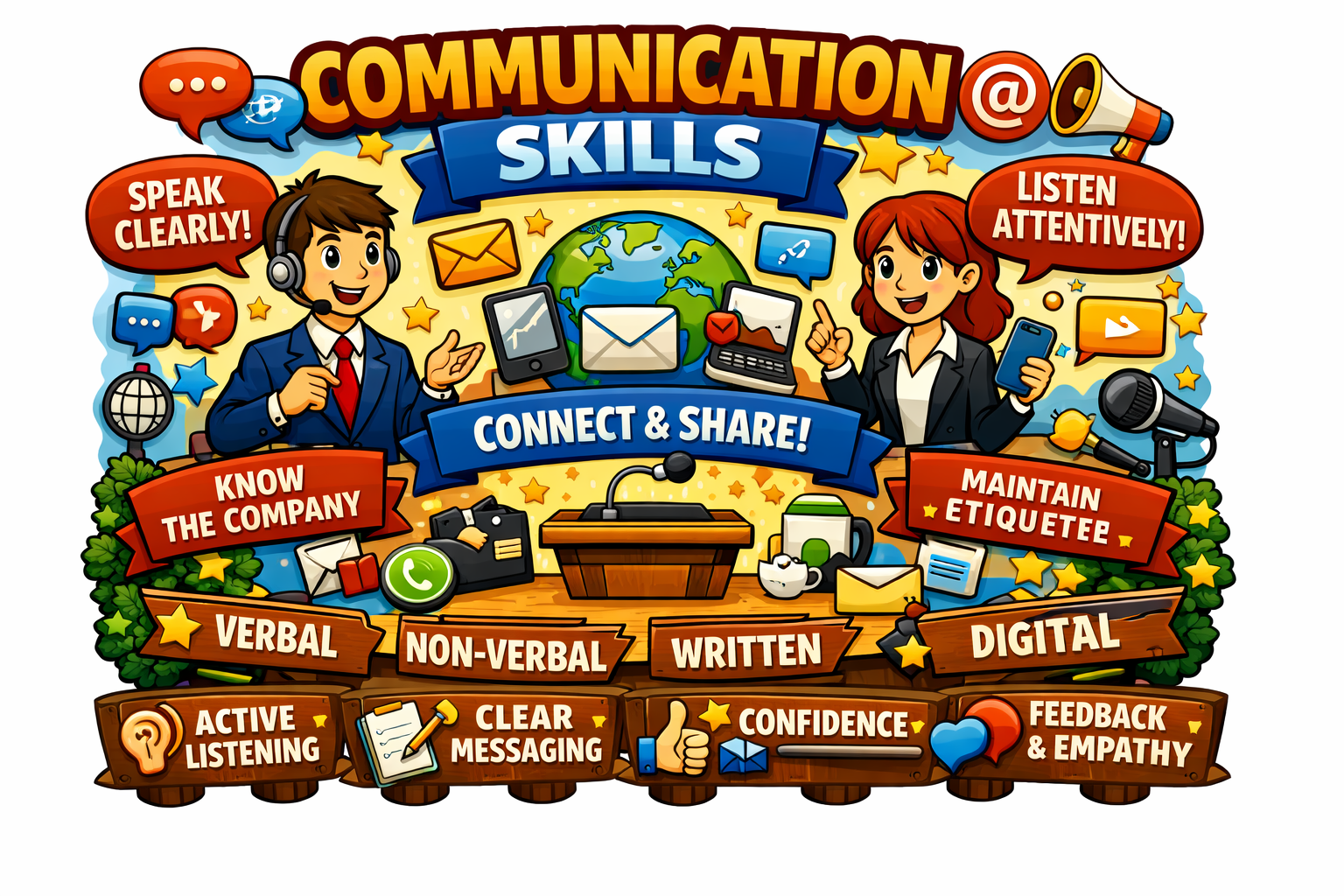
Communication Skills are the abilities used to express thoughts, ideas, information, feelings, and instructions clearly, respectfully, and effectively through speaking, writing, listening, body language, and digital interaction.
What are Communication Skills?
Communication is the process of sharing information between people. It is not only about speaking. It also includes listening carefully, understanding the message, using suitable words, observing body language, responding appropriately, and ensuring that the other person has understood the message correctly.
Good communication skills are useful in classrooms, interviews, group discussions, presentations, workplaces, customer interactions, leadership roles, teamwork, and daily life.
| Situation | Poor Communication | Effective Communication |
|---|---|---|
| Giving instructions | Explaining vaguely without checking understanding. | Giving clear steps and confirming that the listener understood. |
| Listening to others | Interrupting or thinking of your reply while the other person speaks. | Listening fully, asking questions, and responding thoughtfully. |
| Interview answer | Speaking too long without structure. | Answering clearly with relevant points and examples. |
| Team discussion | Dominating or ignoring others’ views. | Sharing views respectfully and allowing others to speak. |
“Good communication is not only speaking well; it is understanding well.”
Communication Tip
Key points
- Speak clearly and respectfully.
- Listen actively before responding.
- Use simple and appropriate words.
- Maintain positive body language.
- Ask questions when something is unclear.
- Give and receive feedback politely.
- Match communication style to the situation.
Why are Communication Skills Important?
Communication skills help people express ideas, build relationships, work in teams, solve problems, perform well in interviews, and succeed in academic and professional life.
Better Understanding
Clear communication reduces confusion and misunderstanding.
- Clear message
- Correct interpretation
- Better instructions
- Fewer mistakes
Stronger Relationships
Respectful communication builds trust and cooperation.
- Active listening
- Empathy
- Polite disagreement
- Emotional maturity
Career Success
Employers value people who can express ideas clearly.
- Interviews
- Presentations
- Meetings
- Customer handling
Leadership Ability
Leaders use communication to guide, motivate, and coordinate people.
- Clear direction
- Team motivation
- Feedback
- Conflict handling
Types of Communication
Communication happens in different forms. A skilled communicator knows which form is suitable for each situation.
| Type | Meaning | Example | Good Practice |
|---|---|---|---|
| Verbal Communication | Communication through spoken words. | Conversation, interview, speech, discussion. | Speak clearly, politely, and with purpose. |
| Non-Verbal Communication | Communication through body language and expressions. | Eye contact, posture, gestures, facial expression. | Use body language that supports your message. |
| Written Communication | Communication through written words. | Email, report, application, message, notice. | Write clearly, correctly, and professionally. |
| Visual Communication | Communication through images, charts, signs, or diagrams. | Presentation slides, charts, posters, infographics. | Use visuals to simplify and support information. |
| Digital Communication | Communication through digital platforms. | Email, chat, video meeting, online discussion. | Use proper etiquette, clarity, and timely response. |
Mini Communication Strategy Bank
Tip: In formal communication, clarity is more important than speed.
Communication Process
Communication becomes effective when the sender, message, medium, receiver, and feedback work properly.
| Element | Meaning | Example | Possible Problem |
|---|---|---|---|
| Sender | The person who sends the message. | Teacher giving instructions. | Sender may be unclear or unprepared. |
| Message | The information, idea, or instruction being shared. | Assignment deadline and format. | Message may be incomplete or confusing. |
| Medium | The method used to send the message. | Speech, email, phone call, notice. | Wrong medium may reduce effectiveness. |
| Receiver | The person who receives the message. | Student listening to instruction. | Receiver may be distracted or may misunderstand. |
| Feedback | The response that confirms understanding. | Student asking a clarification question. | No feedback may hide misunderstanding. |
| Noise / Barrier | Anything that disturbs communication. | Loud noise, poor internet, unclear words. | Message may be distorted or missed. |
7 Cs of Effective Communication
The 7 Cs are useful principles for making communication professional and effective.
| C | Meaning | Good Example | Poor Example |
|---|---|---|---|
| Clear | The message should be easy to understand. | Please submit the report by Friday, 5 PM. | Submit it soon. |
| Concise | The message should be brief and focused. | The meeting starts at 10 AM. | Regarding the meeting, actually, it may begin sometime... |
| Complete | The message should include all necessary details. | Bring ID card, resume, and certificates. | Bring documents. |
| Correct | The message should be accurate and grammatically correct. | The interview is on Monday. | The interview are on Monday. |
| Concrete | The message should be specific and factual. | Sales increased by 15% this month. | Sales improved a lot. |
| Courteous | The message should be polite and respectful. | Could you please share the update? | Send update now. |
| Coherent | The message should be logical and well-organised. | First explain the problem, then solution, then result. | Jumping randomly between points. |
Verbal, Non-Verbal and Listening Skills
| Skill Area | Effective Behaviour | Poor Behaviour | Impact |
|---|---|---|---|
| Speaking | Clear voice, correct pace, simple words, logical points. | Mumbling, speaking too fast, using confusing words. | Improves or reduces understanding. |
| Listening | Paying full attention, not interrupting, asking questions. | Checking phone, interrupting, assuming meaning. | Builds trust or causes misunderstanding. |
| Body Language | Natural eye contact, upright posture, calm expression. | Slouching, avoiding eye contact, restless movement. | Shows confidence or nervousness. |
| Tone | Respectful, calm, and suitable for the situation. | Harsh, sarcastic, careless, or aggressive tone. | Creates cooperation or conflict. |
| Questioning | Asking relevant questions for clarity. | Not asking and then misunderstanding. | Improves accuracy and involvement. |
| Feedback | Giving specific, polite, and useful feedback. | Criticising personally or vaguely. | Encourages improvement or defensiveness. |
Note: Communication improves when words, tone, body language, and listening all support the same message.
Barriers to Effective Communication
Communication barriers are anything that prevent the message from being understood correctly.
| Barrier | How it Affects Communication | Better Approach |
|---|---|---|
| Unclear Language | Listener may not understand the message. | Use simple, specific, and familiar words. |
| Poor Listening | Important details may be missed. | Listen fully before responding. |
| Emotional Reaction | Anger or fear may distort the message. | Pause, calm down, and respond thoughtfully. |
| Assumptions | People may misunderstand without checking facts. | Ask clarifying questions. |
| Noise or Distraction | Message may not be received properly. | Choose a suitable place or medium. |
| Wrong Tone | Message may sound rude even if words are correct. | Use respectful and calm tone. |
| Cultural Differences | Words or gestures may be interpreted differently. | Be respectful and sensitive to differences. |
Communication in Professional Situations
| Situation | Recommended Communication | Avoid |
|---|---|---|
| Interview | Answer clearly, briefly, and honestly with examples. | Long unrelated answers or false claims. |
| Presentation | Use structure, examples, voice control, and audience connection. | Reading every slide word by word. |
| Group Discussion | Share views respectfully and listen to others. | Interrupting, dominating, or mocking others. |
| Use subject, greeting, clear purpose, details, and closing. | Blank subject, unclear message, careless tone. | |
| Team Meeting | Give updates, mention issues, and suggest next steps. | Speaking without facts or hiding delays. |
| Customer Interaction | Listen patiently and respond politely with solution focus. | Arguing, blaming, or dismissing the concern. |
Note: Professional communication should be respectful, factual, and action-oriented.
Step-by-Step Communication Skills Development Process
Communication skills can be improved through awareness, practice, feedback, and consistent correction.
| Step | Action | Question to Ask Yourself |
|---|---|---|
| 1. Observe | Notice how you speak, listen, write, and respond. | Do people understand me clearly? |
| 2. Identify | Find one weak area such as clarity, listening, tone, or confidence. | Which communication habit should I improve first? |
| 3. Practise | Practise speaking, writing, listening, and asking questions. | Can I express this message more clearly? |
| 4. Record or Review | Record your speech or review your written messages. | Is my message clear, brief, and respectful? |
| 5. Seek Feedback | Ask teachers, mentors, friends, or colleagues for feedback. | How do others experience my communication? |
| 6. Improve | Apply feedback and practise again. | What specific change should I make next? |
| 7. Apply | Use improved communication in real situations. | Am I communicating better in daily life? |
Practice
A) Multiple Choice Questions
-
Communication skills are used to:
hide information express and understand messages effectively avoid listening create confusion
-
Active listening means:
interrupting frequently listening fully to understand checking phone while someone speaks ignoring the speaker
-
Which is one of the 7 Cs of communication?
Confusing Clear Careless Casual always
-
Which is a communication barrier?
clear message active listening unclear language polite tone
-
Professional communication should be:
clear, respectful, and purposeful rude and unclear full of false claims careless and delayed
B) Situation-Based Practice
- You have to explain a task to a team member. How will you communicate clearly? (Hint: explain steps, deadline, expected result, and confirm understanding.)
- Someone is speaking, but you disagree with them. What should you do? (Hint: listen fully, acknowledge, then disagree respectfully.)
- You need to write a formal email requesting information. What should it include? (Hint: subject, greeting, purpose, details, request, closing.)
- During a presentation, the audience looks confused. What can you do? (Hint: pause, simplify, give example, ask if clarification is needed.)
- You received unclear instructions. What is the best response? (Hint: ask clarifying questions before starting.)
C) Match the Communication Concept with Its Use
| Communication Concept | Use |
|---|---|
| Active listening | Understanding the speaker before responding |
| Feedback | Confirms whether the message was understood |
| Non-verbal communication | Uses body language, facial expression, and gestures |
| Written communication | Shares information through emails, reports, and messages |
| 7 Cs | Principles for making communication effective |
Communication Reminder
Communication skills are essential for academic success, interviews, teamwork, leadership, relationships, and workplace readiness. A good communicator speaks clearly, listens actively, writes properly, uses suitable body language, respects others, and checks understanding.
Task: Practise a one-minute self-introduction and then write the same introduction in five clear sentences.
Show Suggested Answers
Multiple Choice
- express and understand messages effectively
- listening fully to understand
- Clear
- unclear language
- clear, respectful, and purposeful
Situation-Based Practice: Sample Answers
- Explain the task step by step, mention the deadline and expected result, and ask the person to confirm their understanding.
- Listen fully without interrupting, acknowledge the point, and then say, “I understand your view, but I see it differently.”
- Use a clear subject line, polite greeting, purpose of the email, required details, specific request, and respectful closing.
- Pause, simplify the explanation, give a practical example, and ask whether the point is clear.
- Ask specific clarifying questions before starting the task, such as deadline, format, expected output, and priority.
Concept Matching
- Active listening → Understanding the speaker before responding
- Feedback → Confirms whether the message was understood
- Non-verbal communication → Uses body language, facial expression, and gestures
- Written communication → Shares information through emails, reports, and messages
- 7 Cs → Principles for making communication effective
Clue Explanation
Effective communication combines clear speaking, active listening, suitable body language, correct writing, respectful tone, feedback, and awareness of the audience and situation.
Practical tips
- Think before you speak.
- Use simple and clear language.
- Listen fully before replying.
- Ask questions when instructions are unclear.
- Use respectful tone in all situations.
- Maintain positive body language.
- Write emails and messages with proper structure.
- Seek feedback and practise regularly.
Select a topic and chapter from the left menu.