Managing Stress & Difficult Situations
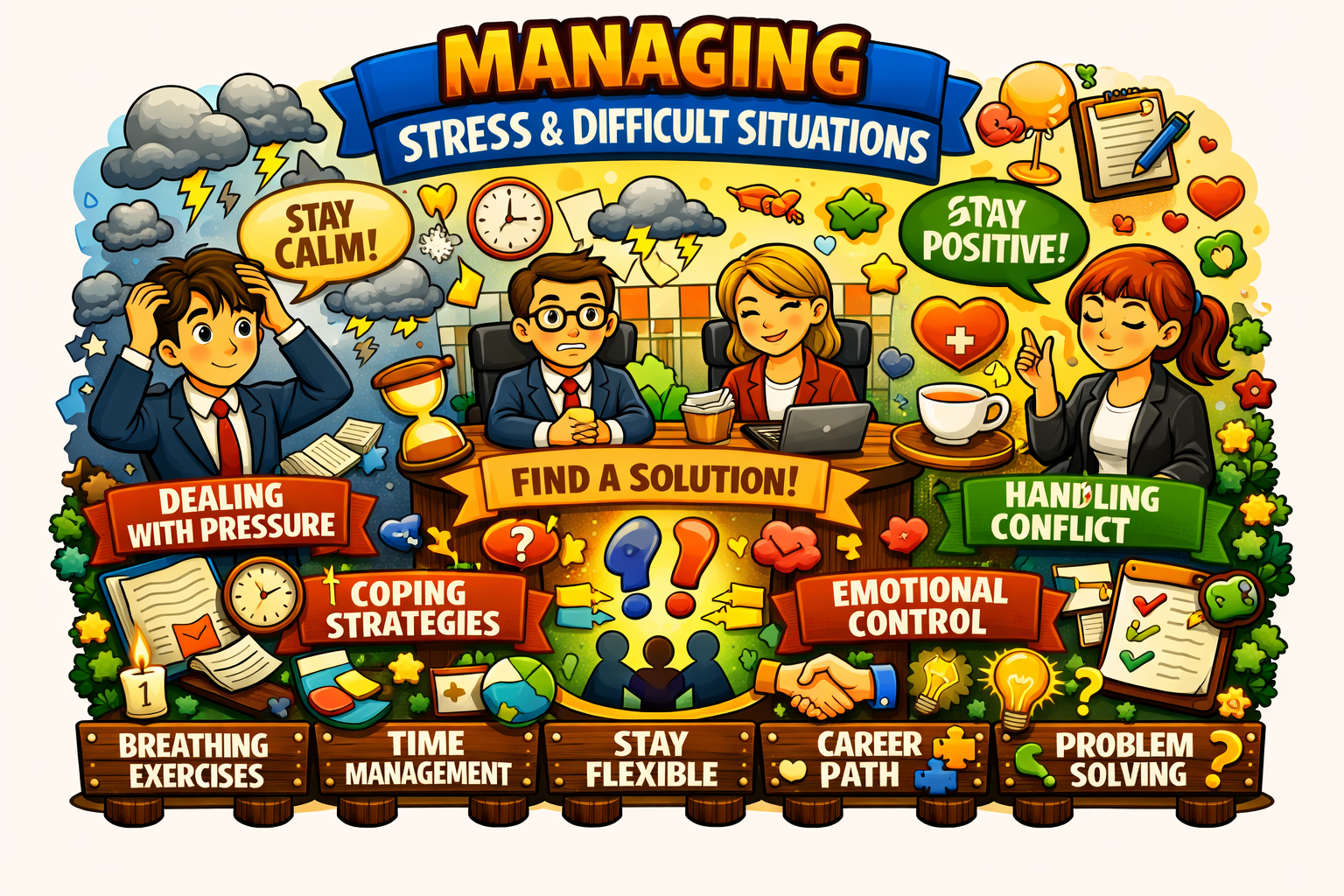
Managing Stress & Difficult Situations means staying calm, thinking clearly, responding professionally, and taking practical action when facing pressure, uncertainty, criticism, difficult questions, conflict, rejection, or unexpected problems.
What Does Managing Stress & Difficult Situations Mean?
In interviews, academics, workplaces, and daily life, difficult situations are common. A candidate may face nervousness, tough questions, criticism, silence, disagreement, technical failure, rejection, or time pressure.
Managing stress does not mean avoiding pressure completely. It means controlling your reaction, understanding the situation, choosing a suitable response, and continuing with confidence and maturity.
| Difficult Situation | Poor Response | Better Response |
|---|---|---|
| Tough interview question | Panicking or giving a false answer. | Pause, think, answer honestly, and show willingness to learn. |
| Low marks question | Making excuses or blaming others. | Accept honestly, explain briefly, and focus on improvement. |
| Disagreement | Arguing emotionally or becoming defensive. | Listen, acknowledge, and respond respectfully with reason. |
| Technical issue in online interview | Getting confused and remaining silent. | Inform politely, fix quickly, and continue professionally. |
“Calmness under pressure is one of the strongest signs of professionalism.”
Interview Readiness Tip
Key points
- Accept that pressure is normal.
- Pause before reacting.
- Breathe slowly and maintain posture.
- Listen carefully to the question or issue.
- Respond honestly and respectfully.
- Focus on solution, learning, and improvement.
- Do not let one difficult moment affect the whole performance.
Why is Stress Management Important?
Stress management helps candidates and professionals stay clear, confident, and respectful even when situations become challenging. It improves performance, decision making, communication, and self-control.
Improves Thinking
Calmness helps the mind think clearly under pressure.
- Better judgement
- Clear answers
- Less confusion
- Better memory recall
Builds Confidence
Handling pressure well improves self-belief.
- Reduced nervousness
- Improved composure
- Positive attitude
- Greater self-control
Shows Professionalism
Mature responses create a strong impression.
- Respectful tone
- Honest answers
- Responsible behaviour
- Emotional control
Supports Recovery
A difficult moment does not have to spoil the whole interview or task.
- Quick correction
- Learning mindset
- Continued focus
- Better resilience
Common Stressful Situations in Interviews
Interview stress usually comes from uncertainty, fear of judgement, difficult questions, or unexpected events. Knowing these situations in advance helps you prepare better.
| Situation | Why It Feels Difficult | Professional Response |
|---|---|---|
| Not knowing an answer | Fear of appearing weak. | Be honest, explain what you know, and show willingness to learn. |
| Question about low marks | Fear of negative judgement. | Accept, give brief context, and explain improvement steps. |
| Long silence from interviewer | Creates anxiety or overthinking. | Remain composed and wait respectfully. |
| Repeated questioning | May feel like pressure or doubt. | Stay consistent, calm, and factual. |
| Critical feedback | May feel personal or discouraging. | Listen calmly, thank them, and show improvement mindset. |
| Online technical problem | Disturbs flow and confidence. | Inform politely, troubleshoot quickly, and continue. |
| Unexpected question | No prepared answer available. | Pause, think logically, and give a structured response. |
Mini Stress Management Strategy Bank
Tip: Confidence is not the absence of nervousness. Confidence is continuing calmly even when nervous.
Managing Stress Before the Interview
Stress before an interview is normal. Proper preparation and routine can reduce unnecessary anxiety.
| Stress Source | Better Preparation | Benefit |
|---|---|---|
| Fear of questions | Prepare common questions and practise aloud. | Improves fluency and confidence. |
| Resume doubts | Review every point in your resume. | Prevents hesitation during profile questions. |
| Technical fear | Revise core concepts and project details. | Improves subject clarity. |
| Last-minute rush | Keep documents, dress, route, and online setup ready early. | Reduces panic before interview time. |
| Low confidence | Take mock interviews and record your answers. | Builds familiarity with interview setting. |
| Negative thoughts | Replace “I will fail” with “I will answer honestly and calmly.” | Improves mental readiness. |
Managing Stress During the Interview
The interview itself may create nervousness. Use simple techniques to stay composed and professional.
| Moment | What to Do | Professional Phrase / Action |
|---|---|---|
| You need time to think | Pause briefly and organise your answer. | “Let me think about that for a moment.” |
| You did not understand the question | Ask politely for clarification. | “Could you please clarify the question?” |
| You know only part of the answer | Answer what you know and be honest about the rest. | “I understand this part clearly, but I need to learn more about…” |
| You made a mistake while answering | Correct yourself calmly. | “Let me correct that point…” |
| You feel nervous | Slow down your speech and breathe gently. | Pause, sit upright, and continue clearly. |
| The interviewer challenges your answer | Stay respectful and support your view with reason. | “I understand your point. My reasoning was…” |
Handling Tough or Stress Questions
Stress questions may be asked to check honesty, confidence, and emotional maturity. The correct approach is to stay calm and answer without defensiveness.
| Tough Question | What It Tests | Better Answer Direction |
|---|---|---|
| Why are your marks low? | Honesty and improvement mindset. | Accept briefly, mention improvement actions, and highlight current readiness. |
| Why should we select you over others? | Confidence without arrogance. | Focus on your skills, learning attitude, sincerity, and role fit. |
| You do not seem experienced enough. | Composure and self-belief. | Acknowledge, then show project exposure, learning speed, and willingness to work hard. |
| What if you fail in this role? | Resilience and accountability. | Explain that you would seek feedback, identify gaps, and improve quickly. |
| Why did you make this mistake in your project? | Ownership and learning. | Accept responsibility, explain correction, and mention prevention. |
| Can you work under pressure? | Stress tolerance and planning. | Give an example of prioritising tasks and completing work under deadline. |
Managing Difficult Workplace Situations
Interviewers may ask how you would handle workplace challenges. Your answer should show maturity, communication, responsibility, and solution-focused thinking.
| Situation | Professional Response | Skill Demonstrated |
|---|---|---|
| Conflict with teammate | Listen, clarify issue, discuss respectfully, and focus on team goal. | Conflict management and teamwork. |
| Missed deadline | Inform early, explain status, propose recovery plan, and prevent repetition. | Accountability and planning. |
| Heavy workload | Prioritise tasks, communicate constraints, and complete urgent work first. | Time management and judgement. |
| Critical feedback | Listen calmly, ask for specifics, and improve based on feedback. | Learning attitude and emotional maturity. |
| Unclear instruction | Ask clarifying questions before starting work. | Communication and accuracy. |
| Mistake in work | Accept, correct, inform concerned person, and document prevention steps. | Integrity and responsibility. |
Note: In difficult workplace situations, avoid emotional reactions. Show problem solving, respect, communication, and ownership.
Managing Stress After the Interview
Stress may continue after the interview while waiting for results. A professional candidate uses this time for reflection and improvement instead of overthinking.
| After-Interview Situation | Better Response | Why It Helps |
|---|---|---|
| You feel you made a mistake | Write down the question and prepare a better answer for next time. | Turns mistake into learning. |
| You are waiting for result | Continue preparation and apply for other suitable opportunities. | Reduces overdependence on one result. |
| You are rejected | Review performance, improve weak areas, and try again. | Builds resilience. |
| You performed well | Note what worked and keep improving. | Builds repeatable success. |
| You receive feedback | Accept it calmly and use it constructively. | Improves future performance. |
Common Mistakes Under Stress and Better Approaches
| Mistake | Possible Impact | Better Approach |
|---|---|---|
| Speaking too fast | Answer becomes unclear. | Slow down and use short pauses. |
| Giving false answers | Damages trust and credibility. | Be honest and show learning attitude. |
| Becoming defensive | Shows low emotional control. | Listen calmly and respond with maturity. |
| Over-apologising | May reduce confidence impression. | Correct calmly and continue. |
| Thinking about previous mistake | Affects next answers. | Mentally reset and focus on the current question. |
| Blaming others | Shows poor accountability. | Take ownership and focus on improvement. |
Note: Stress becomes manageable when you slow down, breathe, think, and respond with structure.
Step-by-Step Method to Handle Difficult Situations
Use this method whenever you face stress, pressure, criticism, uncertainty, or a difficult question.
| Step | Action | Question to Ask Yourself |
|---|---|---|
| 1. Pause | Do not react immediately. | Can I take a moment before responding? |
| 2. Breathe | Take one or two slow breaths. | Am I calming my body first? |
| 3. Understand | Identify the real issue or question. | What is actually being asked or expected? |
| 4. Choose Response | Select a respectful and practical answer. | What is the most professional response? |
| 5. Answer Clearly | Speak briefly, honestly, and logically. | Is my answer clear and relevant? |
| 6. Focus on Solution | Move towards correction, learning, or next action. | What can be done now? |
| 7. Continue | Do not stay mentally stuck on the difficulty. | Can I focus on the next question or task? |
Practice
A) Multiple Choice Questions
-
Managing stress means:
avoiding all difficult situations staying calm and responding thoughtfully panicking immediately blaming others always
-
If you do not know an interview answer, you should:
give a false answer be honest and show willingness to learn argue with interviewer leave immediately
-
When you feel nervous during an interview, you should:
speak faster pause, breathe, and slow down stop listening look distracted
-
A professional response to criticism is to:
become defensive listen calmly and learn from it reject everything immediately argue loudly
-
After a rejected interview, the best action is:
give up completely review performance and improve blame everyone avoid future opportunities
B) Situation-Based Practice
- You are asked a question you do not know. What should you do? (Hint: be honest, answer what you know, show willingness to learn.)
- The interviewer asks about your low marks. How should you respond? (Hint: accept, explain briefly, focus on improvement.)
- You become nervous and start speaking too fast. What should you do? (Hint: pause, breathe, slow down, continue clearly.)
- A teammate criticises your work in a meeting. How should you handle it? (Hint: listen calmly, ask specifics, improve where needed.)
- You are rejected after an interview. What should be your next step? (Hint: reflect, improve weak areas, continue applying.)
C) Match the Difficult Situation with the Best Response
| Difficult Situation | Best Response |
|---|---|
| Unknown question | Be honest and show willingness to learn |
| Nervousness | Pause, breathe, and slow down |
| Criticism | Listen calmly and use feedback constructively |
| Technical issue | Inform politely and fix quickly |
| Rejection | Review performance and improve for next opportunity |
Stress Management Reminder
Difficult situations are a part of interviews and professional life. A mature candidate does not panic, blame, or give false answers. They pause, breathe, understand the situation, respond honestly, focus on solutions, and continue with confidence. Managing stress is a skill that improves with preparation, practice, and reflection.
Task: Write three stressful interview situations you fear most and prepare a calm, honest response for each.
Show Suggested Answers
Multiple Choice
- staying calm and responding thoughtfully
- be honest and show willingness to learn
- pause, breathe, and slow down
- listen calmly and learn from it
- review performance and improve
Situation-Based Practice: Sample Answers
- Say honestly that you are not fully sure, explain the part you know if any, and mention that you are willing to learn it.
- Accept the marks honestly, explain briefly if needed, and focus on the steps you took to improve your skills or performance later.
- Pause briefly, take a slow breath, reduce your speed, and continue answering clearly.
- Listen without reacting emotionally, ask for specific improvement points, and apply useful feedback professionally.
- Review what went well and what did not, improve weak areas, and continue preparing for future opportunities.
Situation Matching
- Unknown question → Be honest and show willingness to learn
- Nervousness → Pause, breathe, and slow down
- Criticism → Listen calmly and use feedback constructively
- Technical issue → Inform politely and fix quickly
- Rejection → Review performance and improve for next opportunity
Clue Explanation
Managing stress and difficult situations requires calmness, honest communication, self-control, responsibility, solution-focused thinking, and resilience after setbacks.
Practical tips
- Prepare early to reduce last-minute pressure.
- Practise difficult questions before the interview.
- Use a short pause before answering tough questions.
- Breathe slowly when nervous.
- Be honest when you do not know something.
- Do not become defensive under criticism.
- Focus on solution and learning.
- Review every interview and improve for the next one.
Select a topic and chapter from the left menu.