Interview Preparation
Interview Preparation is the process of getting ready for an interview by understanding the opportunity, reviewing your profile, practising answers, improving communication, preparing documents, and presenting yourself professionally.
What is Interview Preparation?
Interview preparation means preparing yourself mentally, technically, professionally, and practically before attending an interview. It includes knowing your resume, understanding the role, preparing common answers, practising communication, improving body language, and arranging required documents.
A well-prepared candidate answers with clarity, confidence, honesty, and relevance. Preparation reduces nervousness because the candidate knows what to expect and how to respond professionally.
| Preparation Area | What to Prepare | Why it Matters |
|---|---|---|
| Self-Introduction | Name, education, skills, projects, achievements, career interest. | Creates the first structured impression. |
| Resume Review | Every point mentioned in your resume or profile. | Shows honesty and clarity. |
| Role Research | Job description, organisation, required skills, responsibilities. | Helps connect your skills with the opportunity. |
| Mock Practice | Common questions, body language, voice, timing, and confidence. | Improves fluency and reduces nervousness. |
“A prepared candidate does not merely answer questions; they present their value clearly.”
Interview Tip
Key points
- Study the role or opportunity carefully.
- Know your resume completely.
- Prepare a short self-introduction.
- Practise common interview questions.
- Prepare examples for skills and achievements.
- Arrange documents in advance.
- Maintain professional appearance and etiquette.
Why is Interview Preparation Important?
Interview preparation improves confidence, communication, clarity, and performance. It helps candidates avoid common mistakes and present themselves as serious, suitable, and professional.
Builds Confidence
Preparation reduces fear and uncertainty.
- Clear answers
- Better body language
- Reduced nervousness
- Improved self-belief
Improves Communication
Practice helps you express ideas clearly and briefly.
- Structured answers
- Better vocabulary
- Clear examples
- Professional tone
Shows Seriousness
A prepared candidate appears sincere and interested.
- Role awareness
- Organisation knowledge
- Relevant questions
- Professional conduct
Reduces Mistakes
Preparation prevents careless answers and weak presentation.
- Resume clarity
- Document readiness
- Better timing
- Improved interview etiquette
Major Areas of Interview Preparation
Interview preparation should cover profile, subject knowledge, communication, behaviour, documents, and practical arrangements.
| Area | What to Prepare | Good Practice |
|---|---|---|
| Profile Preparation | Resume, education, projects, internships, achievements, interests. | Be ready to explain every point honestly. |
| Technical Preparation | Core subject concepts, tools, project knowledge, practical applications. | Revise fundamentals and prepare project explanations. |
| HR Preparation | Strengths, weaknesses, goals, teamwork, leadership, attitude. | Use real examples instead of general statements. |
| Communication Preparation | Voice, clarity, answer structure, listening, and polite language. | Practise speaking aloud and record yourself if possible. |
| Body Language Preparation | Posture, eye contact, facial expression, gestures, and calmness. | Use natural and confident body language. |
| Document Preparation | Resume copies, certificates, ID proof, portfolio, references if needed. | Keep documents organised before interview day. |
| Online Interview Setup | Internet, camera, microphone, lighting, background, login link. | Test everything before the interview time. |
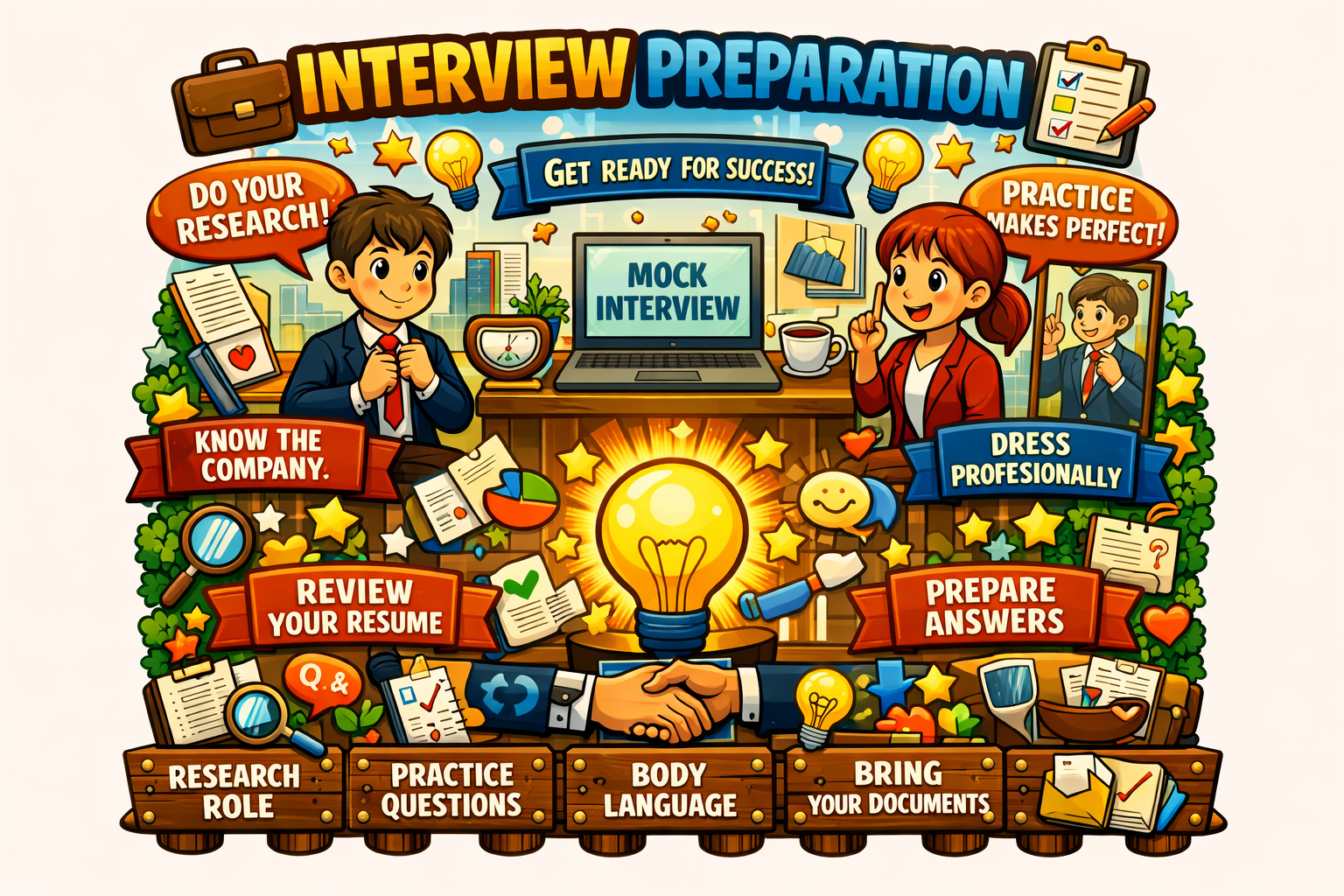
Mini Interview Preparation Strategy Bank
Tip: Practise until you sound natural, not memorised.
Before the Interview: Preparation Checklist
Use this checklist one or two days before the interview to avoid last-minute stress.
| Checklist Item | What to Do | Why it Helps |
|---|---|---|
| Read the Job Description | Understand responsibilities, required skills, and expectations. | Helps answer role-related questions. |
| Research the Organisation | Learn about services, products, values, location, and recent work. | Shows interest and preparation. |
| Review Resume | Read each point and prepare explanations. | Prevents confusion during resume-based questions. |
| Prepare Self-Introduction | Practise a 45–60 second introduction. | Creates a confident beginning. |
| Prepare Examples | Keep examples for teamwork, leadership, challenge, learning, and achievement. | Strengthens answers with proof. |
| Arrange Documents | Keep resume, certificates, ID proof, and portfolio ready. | Shows organisation and professionalism. |
| Plan Dress and Travel | Choose neat dress and confirm route, time, or online link. | Avoids last-minute delay and panic. |
| Sleep and Rest | Get proper rest before the interview day. | Improves alertness and confidence. |
Common Interview Questions and Preparation Focus
| Question | Preparation Focus | Better Approach |
|---|---|---|
| Tell me about yourself. | Self-introduction, education, skills, project, goal. | Keep it short, relevant, and confident. |
| Why do you want this role? | Role understanding and career interest. | Connect your skills and goals with the opportunity. |
| What are your strengths? | Relevant strengths with examples. | Mention strengths useful for the role. |
| What is your weakness? | Honesty and improvement mindset. | Choose a manageable weakness and show improvement action. |
| Explain your project. | Problem, your role, tools, method, result, learning. | Focus on your actual contribution. |
| Describe a challenge you faced. | Situation, task, action, result. | Use STAR method. |
| Why should we select you? | Suitability, skill match, attitude, learning ability. | Show how you can contribute to the role. |
| Do you have any questions? | Interest and seriousness. | Ask about role expectations, training, team, or next steps. |
Note: Answers should be honest, structured, and supported with examples whenever possible.
Use STAR Method for Example-Based Answers
The STAR method helps you answer behavioural questions clearly. It is useful for questions about teamwork, leadership, mistakes, conflict, and problem solving.
| STAR Element | Meaning | Example Cue |
|---|---|---|
| S - Situation | Explain the background briefly. | During our final-year project... |
| T - Task | Explain your responsibility or challenge. | I was responsible for preparing the report... |
| A - Action | Explain what you did. | I divided the work, tracked progress, and coordinated with the team... |
| R - Result | Explain the result and learning. | We submitted on time, and I learned the importance of planning... |
Appearance, Etiquette and Body Language
| Area | Good Practice | Avoid |
|---|---|---|
| Dress | Wear neat, clean, and appropriate clothing. | Untidy or overly casual appearance. |
| Time | Reach early or join online before time. | Being late or rushing at the last minute. |
| Greeting | Greet politely with a natural smile. | Entering silently or casually. |
| Posture | Sit upright with relaxed shoulders. | Slouching, leaning too much, or appearing careless. |
| Eye Contact | Maintain natural eye contact while speaking and listening. | Staring continuously or looking down always. |
| Listening | Listen fully before answering. | Interrupting or answering before the question is complete. |
| Closing | Thank the interviewer politely. | Leaving abruptly or casually. |
Online Interview Preparation
Online interviews need the same content preparation as in-person interviews, along with proper technical setup.
| Area | Preparation | Why it Matters |
|---|---|---|
| Internet | Check internet stability and keep backup data if possible. | Prevents disconnection during interview. |
| Camera | Place camera at eye level and check framing. | Creates professional appearance. |
| Microphone | Test audio before joining. | Ensures the interviewer can hear clearly. |
| Lighting | Keep light in front of you, not behind you. | Makes your face visible clearly. |
| Background | Use a neat and quiet background. | Reduces distraction and looks professional. |
| Device | Charge laptop/mobile and keep charger ready. | Avoids battery failure. |
| Joining Link | Keep meeting link, login details, and documents ready. | Prevents last-minute confusion. |
Note: For online interviews, technical readiness is part of professional readiness.
Common Interview Preparation Mistakes
| Mistake | Impact | Better Approach |
|---|---|---|
| Preparing only one day before | Creates stress and weak answers. | Start preparation early and practise gradually. |
| Memorising full answers | Sounds artificial and may fail if question changes. | Prepare key points and speak naturally. |
| Ignoring resume details | Creates doubt when you cannot explain your own profile. | Review every resume point carefully. |
| Giving generic answers | Does not show real ability. | Use examples from projects, study, work, or activities. |
| Not practising aloud | Answers may sound unclear or nervous. | Practise speaking aloud and take feedback. |
| Ignoring logistics | Causes delay, panic, or unprofessional impression. | Plan documents, dress, travel, and online setup early. |
Note: Most interview mistakes can be reduced with early preparation, mock practice, and honest review.
Step-by-Step Interview Preparation Process
Interview preparation becomes easier when it is followed as a process.
| Step | Action | Question to Ask Yourself |
|---|---|---|
| 1. Understand | Study the role, opportunity, organisation, or institution. | What are they looking for? |
| 2. Review | Read your resume, projects, skills, and achievements. | Can I explain every point confidently? |
| 3. Prepare | Prepare introduction and common answers. | What are my key points? |
| 4. Practise | Practise aloud and take mock interviews. | Do I sound clear and natural? |
| 5. Improve | Work on weak areas such as confidence, clarity, or examples. | What feedback should I apply? |
| 6. Arrange | Keep documents, dress, travel, and online setup ready. | Is everything ready before interview day? |
| 7. Perform | Attend the interview calmly and professionally. | Am I listening and answering with clarity? |
| 8. Reflect | After interview, review what went well and what can improve. | What should I improve for the next interview? |
Practice
A) Multiple Choice Questions
-
Interview preparation means:
memorising false answers getting ready with profile, knowledge, communication, and documents avoiding practice reaching late
-
Which is the best way to prepare self-introduction?
make it very long keep it short, clear, and relevant include false achievements avoid mentioning skills
-
The STAR method is useful for:
behavioural answers random guessing avoiding questions hiding experience
-
Before an online interview, you should:
ignore camera and audio test internet, camera, microphone, and background join late sit in a noisy place
-
If you do not know an answer, the best response is:
give a false answer be honest and show willingness to learn argue with interviewer remain silent rudely
B) Situation-Based Practice
- You have an interview after one week. How will you prepare? (Hint: role research, resume review, common answers, mock practice, documents.)
- Your resume mentions a project. What details should you prepare? (Hint: purpose, your role, tools, method, result, learning.)
- You feel nervous while answering. What can you do during preparation? (Hint: practise aloud, record answers, take mock interviews.)
- The interviewer asks about your weakness. How should you prepare this answer? (Hint: honest weakness, improvement action, positive ending.)
- You are attending an online interview. What arrangements should you make? (Hint: internet, camera, audio, lighting, quiet place, documents.)
C) Match the Interview Preparation Concept with Its Use
| Concept | Use |
|---|---|
| Resume review | Helps explain your profile confidently |
| Mock interview | Improves confidence through practice |
| STAR method | Structures behavioural answers clearly |
| Role research | Helps connect your skills with the opportunity |
| Document preparation | Shows organisation and professionalism |
Interview Preparation Reminder
Interview preparation is a complete process. It includes understanding the opportunity, knowing your resume, preparing common answers, practising communication, arranging documents, maintaining professional appearance, and improving confidence through mock practice. A prepared candidate speaks honestly, clearly, and calmly.
Task: Prepare a one-week interview preparation plan with daily activities such as resume review, self-introduction, technical revision, mock practice, and document arrangement.
Show Suggested Answers
Multiple Choice
- getting ready with profile, knowledge, communication, and documents
- keep it short, clear, and relevant
- behavioural answers
- test internet, camera, microphone, and background
- be honest and show willingness to learn
Situation-Based Practice: Sample Answers
- Research the role, review the resume, prepare self-introduction, revise technical areas, practise common questions, take mock interviews, and arrange documents.
- Prepare the project purpose, your role, tools used, method followed, result achieved, difficulties faced, and learning gained.
- Practise aloud daily, record answers, take mock interviews, improve weak areas, and practise calm breathing before answering.
- Choose a real but manageable weakness, explain how you are improving it, and show that you are serious about growth.
- Check internet, camera, microphone, lighting, background, meeting link, device charging, and keep resume and documents ready.
Concept Matching
- Resume review → Helps explain your profile confidently
- Mock interview → Improves confidence through practice
- STAR method → Structures behavioural answers clearly
- Role research → Helps connect your skills with the opportunity
- Document preparation → Shows organisation and professionalism
Clue Explanation
Interview preparation combines role research, resume clarity, answer practice, technical revision, communication improvement, body language, documents, online setup, and post-interview reflection.
Practical tips
- Start preparation several days before the interview.
- Prepare your self-introduction clearly.
- Review every point in your resume.
- Revise core subject and technical basics.
- Prepare examples for skills and achievements.
- Take at least one mock interview.
- Keep documents and dress ready in advance.
- Be honest, calm, and professional during the interview.
Select a topic and chapter from the left menu.