Mock Practice & Role‑Play
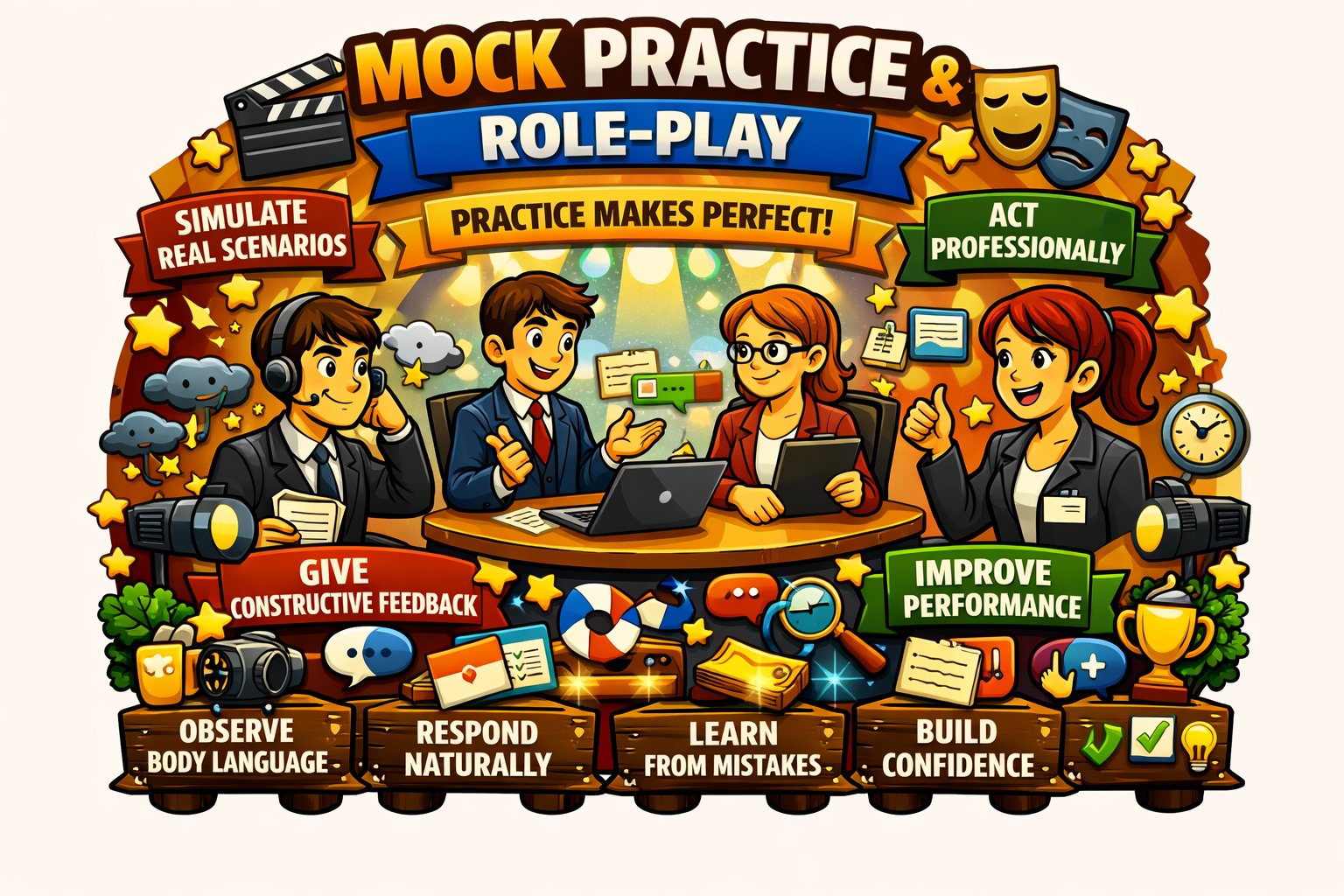
Mock Practice & Role-Play means practising interview situations in a realistic way before the actual interview. It helps candidates improve confidence, communication, body language, answer structure, and professional behaviour.
What is Mock Practice & Role-Play?
Mock practice is a simulated interview where a candidate answers questions as if they are attending a real interview. It may be conducted by a teacher, mentor, friend, trainer, or peer group.
Role-play is a practice activity where different people take roles such as interviewer, candidate, HR manager, technical panel member, or observer. It helps candidates experience real interview situations in a safe learning environment.
| Practice Type | What Happens | Benefit |
|---|---|---|
| Mock Interview | A candidate answers interview questions in a formal practice setting. | Improves confidence, fluency, and answer structure. |
| Role-Play | Participants act as interviewer, candidate, and observer. | Builds real-situation awareness and communication skill. |
| Peer Practice | Students practise questions and feedback with each other. | Encourages repeated practice and collaborative learning. |
| Recorded Practice | The candidate records answers and reviews performance. | Improves self-awareness of voice, posture, and clarity. |
“Practice does not remove all nervousness, but it gives confidence to perform despite nervousness.”
Interview Practice Tip
Key points
- Practise in a realistic interview setting.
- Prepare common, technical, HR, and behavioural questions.
- Use proper dress, posture, and greeting during practice.
- Record answers when possible.
- Take feedback from observers.
- Repeat practice after correction.
- Focus on improvement, not perfection.
Why are Mock Practice & Role-Play Important?
Mock practice and role-play help candidates move from theoretical preparation to practical performance. They reveal gaps in communication, body language, confidence, answer structure, and subject clarity.
Builds Confidence
Repeated practice reduces fear of interview situations.
- Less hesitation
- Better fluency
- Improved self-belief
- Calmer performance
Improves Communication
Practice helps candidates answer clearly and professionally.
- Better structure
- Clear examples
- Improved tone
- Reduced rambling
Reveals Weak Areas
Feedback shows what needs improvement before the real interview.
- Weak answers
- Poor eye contact
- Nervous habits
- Unclear examples
Creates Real Readiness
A realistic rehearsal prepares the candidate for actual pressure.
- Interview flow
- Question handling
- Professional etiquette
- Closing confidence
Types of Mock Practice
Different types of mock practice can be used depending on available time, resources, and interview purpose.
| Type | How It Works | Best Used For |
|---|---|---|
| Self-Practice | The candidate practises answers alone, preferably aloud. | Basic fluency and self-introduction. |
| Mirror Practice | The candidate answers while observing facial expression and posture. | Body language awareness. |
| Recorded Practice | The candidate records video/audio and reviews it. | Voice, clarity, pace, and confidence improvement. |
| Peer Mock Interview | Friends or classmates ask questions and give feedback. | Repeated practice and quick improvement. |
| Mentor Mock Interview | A teacher, senior, or trainer conducts formal practice. | Detailed correction and professional feedback. |
| Panel Mock Interview | Two or more people act as interviewers. | Campus placement, technical, and formal interviews. |
| Online Mock Interview | Practice is done through video call. | Remote interviews and digital etiquette. |
Mini Mock Practice Strategy Bank
Tip: One corrected mock interview is more useful than many careless practice sessions.
How to Conduct Interview Role-Play
Role-play works best when roles, questions, timing, feedback, and improvement steps are clearly planned.
| Role | Responsibility | Good Practice |
|---|---|---|
| Candidate | Answers questions as in a real interview. | Dress neatly, greet properly, answer clearly, and close politely. |
| Interviewer | Asks prepared and follow-up questions. | Ask realistic questions and observe answer quality. |
| Technical Panel Member | Checks subject, project, or practical knowledge. | Ask concept, application, and project-based questions. |
| HR Panel Member | Checks attitude, communication, goals, and fit. | Ask behavioural, motivation, and self-awareness questions. |
| Observer | Watches body language, tone, confidence, and structure. | Give specific and respectful feedback after the session. |
| Timekeeper | Tracks duration of answers and whole mock interview. | Ensure answers are clear but not too long. |
Mock Interview Question Bank
Use this question bank during mock practice and role-play sessions.
| Question Type | Sample Questions | Practice Focus |
|---|---|---|
| Introductory | Tell me about yourself. Walk me through your resume. | Short, structured, confident introduction. |
| Resume-Based | Explain your project. What was your role in this activity? | Clarity, honesty, and ownership. |
| Technical | Explain a core concept from your subject. How did you use this tool? | Concept, example, and application. |
| Behavioural | Tell me about a time you worked in a team. Describe a challenge you faced. | STAR method and real examples. |
| Situational | What would you do if your team misses a deadline? | Judgement, maturity, and practical action. |
| Strength / Weakness | What are your strengths? What is one weakness you are improving? | Self-awareness and improvement mindset. |
| Stress Question | Why should we select you over others? Why are your marks low? | Calmness, honesty, and confidence. |
| Closing | Do you have any questions for us? | Professional candidate questions. |
Note: Practise both prepared questions and unexpected follow-up questions.
Mock Interview Feedback Checklist
Feedback should be specific, respectful, and useful. It should tell the candidate what worked well and what needs improvement.
| Area | What to Observe | Improvement Question |
|---|---|---|
| Opening | Greeting, smile, posture, and first impression. | Did the candidate begin confidently? |
| Self-Introduction | Structure, relevance, length, and clarity. | Was the introduction focused and professional? |
| Answer Structure | Logical flow, examples, and directness. | Did the answer match the question? |
| Voice and Pace | Audibility, speed, pauses, and confidence. | Was the speech clear and easy to follow? |
| Body Language | Eye contact, posture, gestures, facial expression. | Did body language support confidence? |
| Technical Clarity | Concept explanation, project clarity, practical examples. | Were technical answers accurate and understandable? |
| Honesty | Handling unknown questions and resume claims. | Did the candidate avoid false claims? |
| Closing | Candidate questions, thank-you, and final impression. | Did the candidate close professionally? |
7-Day Mock Practice Plan
A short practice plan can help candidates improve gradually before an interview.
| Day | Practice Activity | Expected Outcome |
|---|---|---|
| Day 1 | Prepare and practise self-introduction aloud. | Clear opening answer. |
| Day 2 | Review resume and prepare project explanations. | Confidence in profile-based questions. |
| Day 3 | Practise common HR questions. | Better answer structure. |
| Day 4 | Practise technical or subject questions. | Improved concept explanation. |
| Day 5 | Record a mock interview and review it. | Self-awareness of voice and body language. |
| Day 6 | Do peer or mentor mock interview. | External feedback and correction. |
| Day 7 | Repeat mock interview after corrections. | Improved confidence and readiness. |
Common Mistakes During Mock Practice
| Mistake | Possible Impact | Better Approach |
|---|---|---|
| Practising silently | Does not improve speaking fluency. | Practise answers aloud. |
| Memorising full answers | Answers may sound artificial. | Prepare key points and speak naturally. |
| Avoiding feedback | Weak areas remain unchanged. | Ask for honest and specific feedback. |
| Ignoring body language | May reduce professional impression. | Practise posture, eye contact, and gestures. |
| Not repeating after correction | Feedback does not become improvement. | Redo the answer after applying feedback. |
| Practising only easy questions | Candidate remains weak in difficult situations. | Include stress, technical, and behavioural questions. |
Note: Mock practice should feel slightly challenging. If it is always easy, it may not prepare you enough.
Step-by-Step Mock Practice Process
Use this process to conduct a useful mock interview or role-play session.
| Step | Action | Question to Ask |
|---|---|---|
| 1. Select Role | Choose interviewer, candidate, observer, and timekeeper. | Who will perform each role? |
| 2. Set Context | Decide job role, course, internship, or interview type. | What interview are we simulating? |
| 3. Prepare Questions | Use HR, technical, behavioural, and situational questions. | Are the questions realistic? |
| 4. Conduct Practice | Run the mock interview like a real interview. | Is the candidate practising seriously? |
| 5. Observe | Note answer quality, body language, tone, and confidence. | What worked well and what needs improvement? |
| 6. Give Feedback | Share specific feedback respectfully. | What is one strength and one improvement area? |
| 7. Repeat | Practise again after applying feedback. | Did the answer improve after correction? |
Practice
A) Multiple Choice Questions
-
Mock interview means:
a simulated interview for practice avoiding all interview questions only reading silently joining interview without preparation
-
Role-play helps candidates:
experience real interview situations safely avoid communication practice ignore feedback memorise false answers
-
After receiving mock interview feedback, the candidate should:
ignore it completely practise again after correction argue with everyone stop preparing
-
Recorded practice is useful because it helps review:
voice, pace, posture, and clarity only handwriting exam marks only nothing important
-
A good feedback rule is:
one strength, one improvement area, and one action step only criticism no feedback only jokes
B) Situation-Based Practice
- You have an interview in seven days. How will you use mock practice? (Hint: self-introduction, resume, technical questions, mock session, feedback.)
- During mock practice, you realise you speak too fast. What should you do? (Hint: practise slower pace, pause, record again.)
- Your friend gives feedback that your answers are too long. How will you improve? (Hint: use structure, reduce repetition, answer directly.)
- You are asked a question you did not prepare. How should you handle it in role-play? (Hint: pause, think, answer honestly, and structure your response.)
- As an observer in role-play, what should you note? (Hint: opening, clarity, body language, examples, closing.)
C) Match the Mock Practice Element with Its Use
| Mock Practice Element | Use |
|---|---|
| Mock interview | Simulates real interview practice |
| Role-play | Assigns interview roles for realistic practice |
| Observer | Gives feedback on performance |
| Recording | Helps review voice, posture, and clarity |
| Repeat practice | Converts feedback into improvement |
Mock Practice Reminder
Mock practice and role-play help candidates become interview-ready through realistic rehearsal, feedback, and correction. They improve confidence, communication, body language, answer structure, listening, and professional etiquette. The best practice method is: prepare, practise, get feedback, correct, and repeat.
Task: Conduct one 20-minute mock interview with a friend or mentor and write three strengths, three improvement areas, and three action steps.
Show Suggested Answers
Multiple Choice
- a simulated interview for practice
- experience real interview situations safely
- practise again after correction
- voice, pace, posture, and clarity
- one strength, one improvement area, and one action step
Situation-Based Practice: Sample Answers
- Practise self-introduction, review resume, prepare technical and HR questions, take a mock interview, collect feedback, and repeat after correction.
- Record the answer again, speak slower, use short pauses, and practise with a timer.
- Use a clear structure, answer the main point first, reduce unnecessary details, and support with one relevant example.
- Pause briefly, understand the question, answer what you know honestly, and organise the response step by step.
- Observe greeting, self-introduction, answer clarity, examples, voice, posture, eye contact, confidence, and professional closing.
Mock Practice Matching
- Mock interview → Simulates real interview practice
- Role-play → Assigns interview roles for realistic practice
- Observer → Gives feedback on performance
- Recording → Helps review voice, posture, and clarity
- Repeat practice → Converts feedback into improvement
Clue Explanation
Effective mock practice requires realistic questions, active role-play, clear observation, constructive feedback, correction, and repeated practice until the candidate becomes more confident and professional.
Practical tips
- Practise answers aloud, not silently.
- Record at least one practice session.
- Use real interview questions.
- Practise greeting, introduction, answers, and closing.
- Ask for honest and specific feedback.
- Correct one weakness at a time.
- Repeat mock practice after feedback.
- Include difficult and unexpected questions.
Select a topic and chapter from the left menu.