Candidate’s Questions
Candidate’s Questions are the thoughtful questions a candidate asks the interviewer near the end of an interview to show interest, preparation, maturity, and understanding of the role.
What are Candidate’s Questions?
At the end of many interviews, the interviewer may ask: “Do you have any questions for us?” This is an opportunity for the candidate to show genuine interest in the role, organisation, team, learning opportunities, expectations, and next steps.
Good candidate questions should be professional, relevant, and thoughtful. They should not sound careless, demanding, or focused only on personal benefits.
| Interview Situation | Poor Candidate Question | Better Candidate Question |
|---|---|---|
| Job interview | How soon can I get leave? | What are the key expectations from this role in the first few months? |
| Internship interview | Will the work be easy? | What kind of projects or tasks will interns usually work on? |
| Campus placement | Do I have to work hard? | What skills should selected candidates strengthen before joining? |
| Technical role | Can I avoid coding? | Which tools or technologies are commonly used by the team? |
“The questions you ask can show how seriously you understand the opportunity.”
Interview Closing Tip
Key points
- Prepare two or three questions before the interview.
- Ask questions related to role, learning, team, or expectations.
- Keep questions polite and professional.
- Avoid questions that show lack of seriousness.
- Do not ask questions already answered clearly.
- Listen carefully to the interviewer’s response.
- End by thanking the interviewer.
Why are Candidate’s Questions Important?
Candidate’s questions are important because they help you understand the opportunity better and also show the interviewer that you are thoughtful, prepared, and career-oriented.
Shows Interest
Good questions show that you are genuinely interested in the role.
- Role curiosity
- Learning mindset
- Preparation
- Positive attitude
Clarifies Expectations
You understand what the organisation expects from the selected candidate.
- Work responsibilities
- Performance standards
- Training needs
- Joining readiness
Creates Professional Image
Thoughtful questions create a mature and professional impression.
- Confidence
- Communication
- Seriousness
- Career awareness
Supports Better Decision
You also learn whether the role is suitable for your growth.
- Role fit
- Work culture
- Learning scope
- Future path
Good Categories of Candidate’s Questions
A candidate can ask questions from different areas depending on the interview type, role, and what has already been discussed.
| Question Category | Purpose | Sample Question |
|---|---|---|
| Role Expectations | To understand what is expected from the selected candidate. | What are the key responsibilities of this role in the first few months? |
| Learning and Training | To understand growth and preparation opportunities. | Is there any training or mentoring support for new joiners? |
| Team and Work Style | To understand how the team works. | Could you tell me about the team I may be working with? |
| Skills Required | To understand which skills matter most. | Which skills should I strengthen to perform well in this role? |
| Success Measurement | To understand how performance is evaluated. | How is success usually measured for this position? |
| Next Steps | To understand the selection process professionally. | May I know what the next steps in the selection process are? |
Mini Candidate Question Strategy Bank
Tip: A good candidate question should sound curious, respectful, and career-focused.
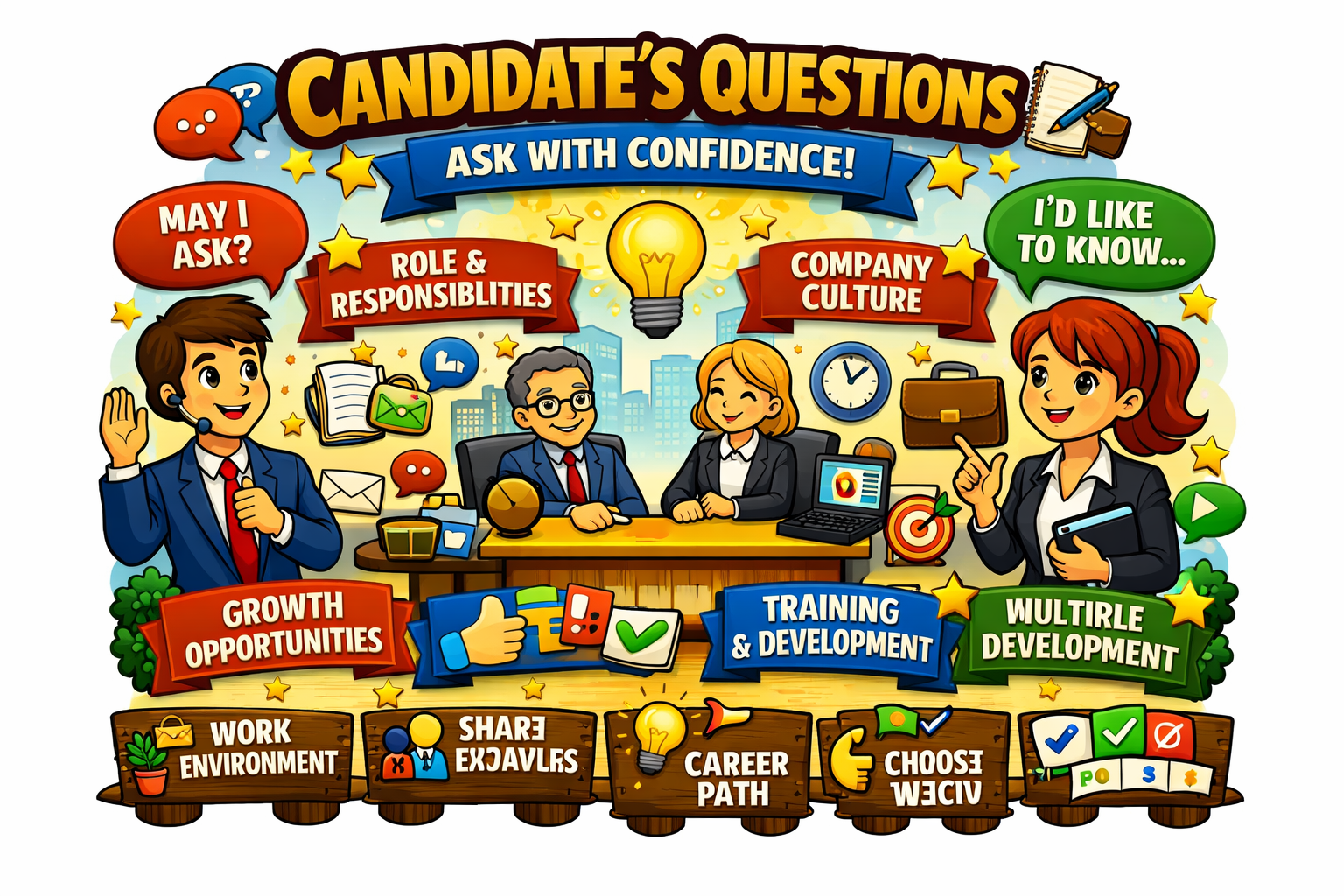
Professional Questions a Candidate Can Ask
These questions can be used in job interviews, internships, campus placements, or professional selection rounds.
| Purpose | Recommended Question | What It Shows |
|---|---|---|
| Understand role | What would be the main responsibilities of this role? | Role awareness and seriousness. |
| Understand expectations | What are the key expectations from a new candidate in the first 3 to 6 months? | Performance focus. |
| Understand learning scope | What learning or training support is usually available for new joiners? | Growth mindset. |
| Understand team | Could you please tell me about the team structure or work environment? | Teamwork interest. |
| Understand skill needs | Which skills will help a candidate succeed in this role? | Self-improvement attitude. |
| Understand success | How is performance or success usually measured in this role? | Result orientation. |
| Understand process | May I know the next steps in the selection process? | Professional closing. |
| Show preparation | I read about your work in this area. Could you share how this role contributes to it? | Research and interest. |
Questions Candidates Should Avoid Asking Too Early
Some questions may create a weak impression if asked too early or in the wrong tone. They may make the candidate appear casual, demanding, or less serious about the role.
| Avoid Asking Too Early | Why It May Create a Poor Impression | Better Approach |
|---|---|---|
| How many leaves will I get? | May suggest that leave is your first priority. | Discuss leave policy later during HR or offer stage. |
| Will the work be easy? | May suggest low commitment or fear of responsibility. | Ask about role expectations and training support. |
| How soon can I get promoted? | May seem impatient before understanding the role. | Ask about growth and learning opportunities respectfully. |
| Can I avoid certain tasks? | May show unwillingness to learn or contribute. | Ask what skills are needed to handle the role well. |
| What does your company do? | Shows lack of basic research. | Research the organisation before the interview. |
| Did I get selected? | May sound impatient or unprofessional. | Ask about the next steps in the selection process. |
Candidate’s Questions for Different Interview Situations
| Interview Type | Good Candidate Question | Why It Works |
|---|---|---|
| Fresher Job Interview | What skills should a fresher strengthen to perform well in this role? | Shows learning mindset and readiness. |
| Internship Interview | What kind of learning outcomes are expected from this internship? | Shows interest in meaningful learning. |
| Technical Interview | Which tools or technologies does the team use most frequently? | Shows practical interest in the work. |
| HR Interview | What qualities do successful candidates usually demonstrate in this organisation? | Shows maturity and cultural awareness. |
| Academic Admission Interview | What kind of learning environment and academic support does the programme offer? | Shows academic seriousness. |
| Scholarship Interview | What qualities does the selection committee value most in scholarship recipients? | Shows respect for selection criteria. |
| Promotion Interview | What additional responsibilities should I prepare for in this role? | Shows ownership and growth readiness. |
Note: The best question depends on the interview context. Match your question to the opportunity.
How to Ask Candidate’s Questions Professionally
How you ask a question is as important as what you ask. Use polite wording, clear tone, and respectful body language.
| Step | Action | Example Phrase |
|---|---|---|
| 1. Thank | Acknowledge the opportunity to ask. | Thank you. I would like to ask one question. |
| 2. Ask Clearly | Ask one question at a time. | What are the key expectations from this role? |
| 3. Listen | Listen carefully without interrupting. | Nod and maintain attentive body language. |
| 4. Acknowledge | Respond politely after the answer. | Thank you, that gives me a clear understanding. |
| 5. Close | End professionally. | Thank you for your time and for explaining this. |
Common Mistakes in Candidate’s Questions
| Mistake | Possible Impact | Better Approach |
|---|---|---|
| Saying “No questions” immediately | May show low curiosity or lack of preparation. | Prepare one thoughtful question in advance. |
| Asking only about salary first | May appear benefit-focused before contribution-focused. | Ask first about role expectations or learning; discuss salary at the right stage. |
| Asking questions already answered | Shows poor listening. | Listen during the interview and adjust your question. |
| Asking too many questions | May consume unnecessary time. | Ask one or two important questions. |
| Using casual or demanding tone | Creates unprofessional impression. | Use polite phrases such as “Could you please…” or “May I know…”. |
| Not listening to the answer | Misses useful information and appears careless. | Listen attentively and acknowledge the response. |
Note: Candidate’s questions should strengthen your interview impression, not weaken it.
Step-by-Step Process to Prepare Candidate’s Questions
Use this simple process before attending any interview.
| Step | Action | Question to Ask Yourself |
|---|---|---|
| 1. Research | Study the role, organisation, course, or opportunity. | What do I already know about this opportunity? |
| 2. Identify Gaps | Find what you still need to understand. | What information would help me understand the role better? |
| 3. Select Category | Choose question area such as role, learning, team, or next steps. | Which question area is most suitable? |
| 4. Write Questions | Prepare two or three questions in advance. | Are my questions professional and relevant? |
| 5. Listen During Interview | Remove any question already answered by the interviewer. | Has this question already been answered? |
| 6. Ask Politely | Ask one or two questions clearly and respectfully. | Am I asking in a polite and concise way? |
| 7. Close with Thanks | Thank the interviewer for answering. | Did I close the interview respectfully? |
Practice
A) Multiple Choice Questions
-
Candidate’s questions are usually asked:
only before entering the room near the end of an interview only after selection letter never in interviews
-
A good candidate question should be:
careless and demanding professional, relevant, and thoughtful unrelated to the role asked without listening
-
Which is a good candidate question?
What are the key expectations from this role? Will the work be easy? Can I avoid difficult tasks? What does your company do?
-
Asking a question already answered earlier may show:
good listening poor listening excellent preparation strong technical skill
-
After the interviewer answers your question, you should:
ignore the answer thank them politely argue unnecessarily leave without closing
B) Situation-Based Practice
- The interviewer asks, “Do you have any questions for us?” What can you ask? (Hint: role expectations, learning, team, or next steps.)
- You wanted to ask about training, but the interviewer already explained it. What should you do? (Hint: do not repeat; ask another relevant question or thank them.)
- You are attending a fresher job interview. What is one good question to ask? (Hint: ask about skills needed or first few months’ expectations.)
- You are tempted to ask first about leave and holidays. What is a better approach? (Hint: ask first about role and learning; discuss benefits at HR stage.)
- You have no question because everything was explained clearly. How can you respond professionally? (Hint: acknowledge that the explanation was clear and thank them.)
C) Match the Candidate Question Type with Its Purpose
| Question Type | Purpose |
|---|---|
| Role expectations question | Understands what the selected candidate must deliver |
| Training question | Understands learning and support for new joiners |
| Team question | Understands work environment and collaboration |
| Skill question | Understands what to strengthen for success |
| Next steps question | Understands the remaining selection process |
Candidate Question Reminder
Candidate’s questions are an important part of interview closing. A good question shows that the candidate has listened carefully, understood the opportunity, and is serious about contributing, learning, and performing well. Prepare questions in advance, ask politely, and close with thanks.
Task: Prepare three candidate questions for a job interview: one about role expectations, one about learning, and one about next steps.
Show Suggested Answers
Multiple Choice
- near the end of an interview
- professional, relevant, and thoughtful
- What are the key expectations from this role?
- poor listening
- thank them politely
Situation-Based Practice: Sample Answers
- You may ask: “What are the key expectations from this role in the first few months?”
- Do not repeat the same question. Ask another relevant question or say, “Thank you, you have already clarified my question.”
- Ask: “Which skills should a fresher strengthen to perform well in this role?”
- First ask about role expectations, learning, or team. Salary, leave, and benefits can be discussed at the appropriate HR or offer stage.
- Say: “Thank you. You have explained the role and process clearly, and I do not have any further questions at this moment.”
Question Type Matching
- Role expectations question → Understands what the selected candidate must deliver
- Training question → Understands learning and support for new joiners
- Team question → Understands work environment and collaboration
- Skill question → Understands what to strengthen for success
- Next steps question → Understands the remaining selection process
Clue Explanation
Candidate’s questions should show preparation, interest, listening, maturity, and professionalism. The strongest questions usually focus on role expectations, learning, team, performance, skills, or the next steps in the process.
Practical tips
- Prepare two or three questions before the interview.
- Ask only one or two questions at the end.
- Choose questions based on what has not been answered.
- Focus on role, learning, skills, team, or next steps.
- Use polite wording such as “May I know…” or “Could you please…”.
- Avoid asking only about salary or leave first.
- Listen carefully to the answer.
- Thank the interviewer before closing.
Select a topic and chapter from the left menu.