Time Management
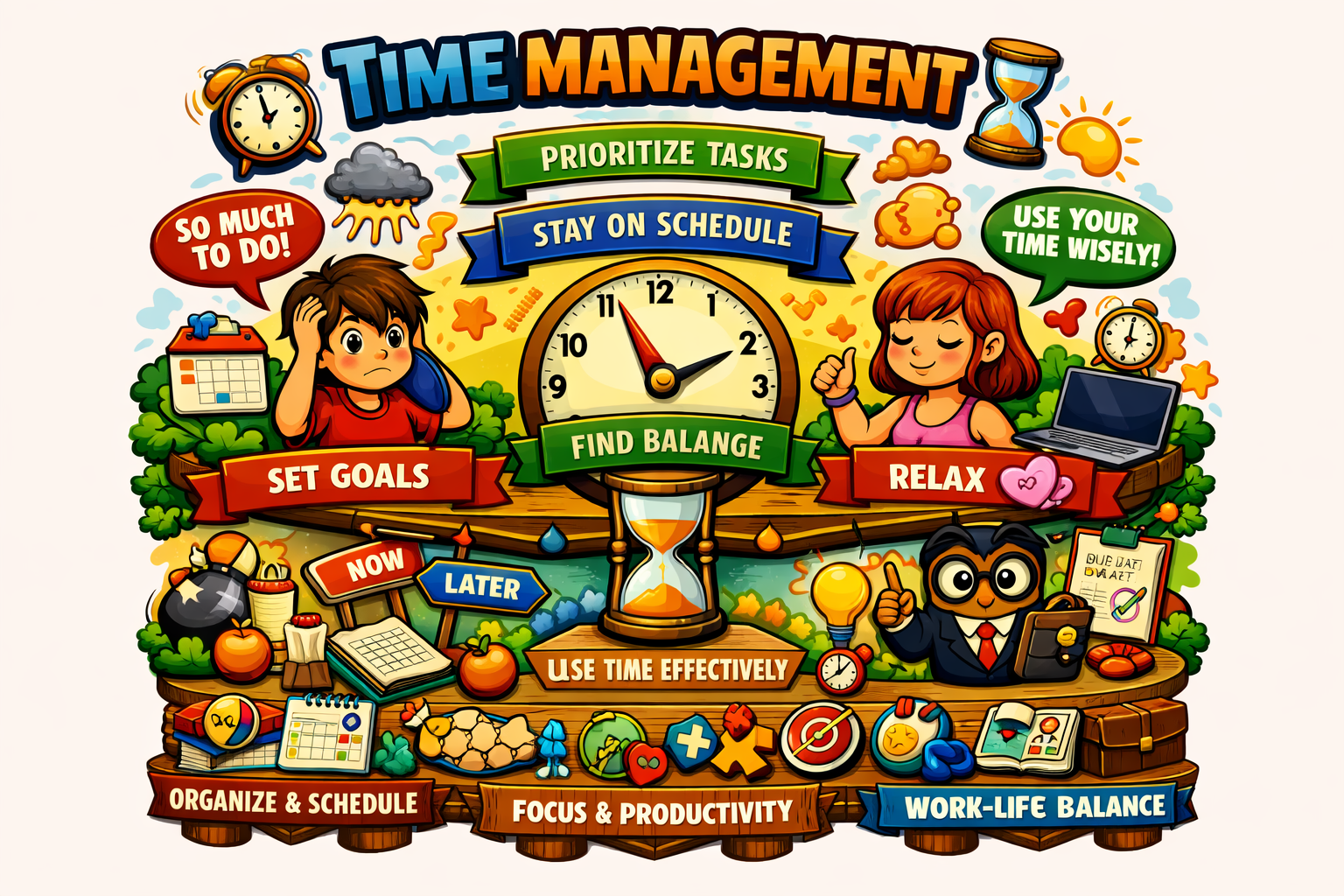
Time management refers to the practice of organizing and planning how to allocate your time effectively to accomplish tasks, goals, and activities. It involves identifying priorities, setting goals, and making conscious decisions about how to spend and prioritize your time.
Time Management is the ability to plan, prioritise, organise, and use time effectively so that important tasks are completed with less stress and better results.
What is Time Management?
Time management means using available time wisely. It involves deciding what is important, planning tasks, avoiding unnecessary delay, reducing distractions, and completing work within deadlines.
Good time management is useful for students, job seekers, professionals, entrepreneurs, and anyone who wants to balance study, work, family, health, and personal goals.
| Situation | Poor Time Management | Better Time Management |
|---|---|---|
| Exam preparation | Studying randomly at the last minute. | Preparing a timetable and revising important topics first. |
| Project deadline | Starting only one day before submission. | Breaking the project into smaller tasks with daily targets. |
| Daily routine | Spending too much time on distractions. | Fixing time blocks for study, work, rest, and personal activities. |
| Multiple tasks | Trying to do everything at once. | Prioritising urgent and important tasks first. |
“Time management is not about having more time; it is about using available time wisely.”
Productivity Tip
Key points
- Set clear goals.
- Plan tasks before starting.
- Prioritise important work.
- Avoid procrastination.
- Reduce distractions.
- Use deadlines wisely.
- Review progress regularly.
Why is Time Management Important?
Time management improves performance, reduces stress, increases confidence, and helps people achieve personal, academic, and professional goals.
Better Productivity
You complete more meaningful work in less wasted time.
- Clear task list
- Focused work periods
- Less confusion
- Faster completion
Reduced Stress
Planning reduces last-minute pressure and panic.
- Early preparation
- Realistic deadlines
- Clear priorities
- Controlled workload
Improved Discipline
You build consistent habits and self-control.
- Regular routine
- Reduced delay
- Better focus
- Stronger commitment
Better Work-Life Balance
You give time to study/work, health, family, and rest.
- Time for priorities
- Time for recovery
- Less burnout
- Balanced routine
Mini Time Management Strategy Bank
Tip: Time management becomes easier when you plan the next day before going to sleep.
Practical Time Management Techniques
| Technique | How to Use It | Why it Helps |
|---|---|---|
| To-Do List | Write all tasks clearly before starting the day. | Removes confusion and gives direction. |
| Priority Matrix | Classify tasks as urgent-important, important-not urgent, urgent-not important, or low priority. | Helps decide what to do first. |
| Time Blocking | Assign fixed time slots for specific activities. | Improves focus and reduces multitasking. |
| Pomodoro Method | Work for 25 minutes and take a short 5-minute break. | Maintains energy and concentration. |
| Two-Minute Rule | If a task takes less than two minutes, do it immediately. | Prevents small tasks from piling up. |
| Deadline Buffer | Finish important tasks before the actual deadline. | Reduces last-minute pressure and errors. |
| Single-Tasking | Focus on one important task at a time. | Improves quality and reduces mental fatigue. |
| Weekly Review | Review completed work, pending tasks, and next week’s priorities. | Improves planning and long-term consistency. |
Note: The best technique is the one you can practise consistently. Simple methods used daily are better than complex plans ignored later.
Priority Matrix for Better Decisions
The priority matrix helps you decide which tasks deserve immediate attention and which tasks can be scheduled, delegated, or reduced.
| Category | Meaning | Action | Example |
|---|---|---|---|
| Urgent and Important | Tasks needing immediate attention. | Do now | Submission due today, medical emergency, urgent client work. |
| Important but Not Urgent | Tasks important for long-term success. | Schedule | Exam preparation, skill development, exercise, project planning. |
| Urgent but Not Important | Tasks demanding attention but not always valuable. | Delegate or limit | Some calls, interruptions, routine requests. |
| Not Urgent and Not Important | Low-value distractions. | Reduce or avoid | Mindless scrolling, unnecessary gossip, random browsing. |
Common Time Management Mistakes and Better Approaches
| Common Mistake | Impact | Better Approach |
|---|---|---|
| No daily plan | Tasks become confusing and scattered. | Prepare a short task list every morning or previous night. |
| Procrastination | Work piles up and creates stress. | Start with a small 10-minute action. |
| Multitasking | Reduces quality and increases mental fatigue. | Focus on one task at a time. |
| Ignoring breaks | Energy and concentration drop. | Use short planned breaks between focused work sessions. |
| Unclear priorities | Low-value tasks consume important time. | Mark tasks as urgent, important, or low priority. |
| Too many commitments | Leads to overload and poor performance. | Learn to say no politely or negotiate deadlines. |
Note: Poor time management often comes from unclear priorities, weak planning, distractions, and delayed action.
Step-by-Step Time Management Process
Time management becomes practical when it is followed as a simple daily process.
| Step | Action | Question to Ask |
|---|---|---|
| 1. List | Write all tasks that need attention. | What all needs to be done? |
| 2. Prioritise | Mark tasks by urgency and importance. | Which task matters most? |
| 3. Schedule | Assign time blocks for important tasks. | When will I do this task? |
| 4. Focus | Work on one task without unnecessary distractions. | What should I focus on now? |
| 5. Track | Check whether work is moving as planned. | Am I on schedule? |
| 6. Adjust | Modify the plan if priorities change. | What needs to be changed? |
| 7. Review | Evaluate what worked and what did not. | How can I improve tomorrow? |
Practice
A) Multiple Choice Questions
-
Time management means:
doing all tasks randomly using time wisely to complete important tasks avoiding all responsibilities working without breaks
-
Which task should be handled first?
urgent and important not urgent and not important random entertainment unnecessary browsing
-
The Pomodoro Method usually means:
work with no rest 25 minutes work and short break only sleeping doing tasks without planning
-
Procrastination means:
starting early delaying important work reviewing progress planning properly
-
Time blocking helps because it:
creates focused time for tasks increases confusion removes all responsibilities encourages multitasking
B) Situation-Based Practice
- You have five chapters to revise and only three days left. What should you do? (Hint: prioritise important chapters and prepare a schedule.)
- You keep delaying a difficult task. What is the first step to overcome it? (Hint: start with a small 10-minute action.)
- Your phone distracts you during study time. What can you do? (Hint: keep phone away and use focused time blocks.)
- You have many tasks and do not know where to start. What should you do first? (Hint: list and prioritise tasks.)
- You completed less work than planned today. What should you do at night? (Hint: review and adjust tomorrow’s plan.)
C) Match the Time Management Technique with Its Use
| Technique | Use |
|---|---|
| To-do list | Helps remember and organise tasks |
| Priority matrix | Helps decide what to do first |
| Time blocking | Creates focused time for specific work |
| Pomodoro method | Maintains focus with short work-break cycles |
| Weekly review | Improves planning and consistency |
Productivity Reminder
Time management is a life skill that improves learning, work performance, confidence, and discipline. A person who manages time well does not depend only on motivation. They use planning, priorities, focus, review, and consistent habits to complete important work.
Task: Prepare tomorrow’s time plan with three important tasks, two time blocks, one break, and one review point.
Show Suggested Answers
Multiple Choice
- using time wisely to complete important tasks
- urgent and important
- 25 minutes work and short break
- delaying important work
- creates focused time for tasks
Situation-Based Practice: Sample Answers
- List all chapters, identify the most important ones, divide them across three days, and keep time for revision.
- Start with a small 10-minute action so that the task becomes less frightening.
- Keep the phone away, turn off unnecessary notifications, and study in fixed time blocks.
- Write all tasks, mark urgent and important tasks, and begin with the highest priority task.
- Review what went wrong, move pending work to tomorrow, and make a more realistic plan.
Technique Matching
- To-do list → Helps remember and organise tasks
- Priority matrix → Helps decide what to do first
- Time blocking → Creates focused time for specific work
- Pomodoro method → Maintains focus with short work-break cycles
- Weekly review → Improves planning and consistency
Clue Explanation
Effective time management combines planning, prioritisation, focused work, breaks, review, and adjustment. It reduces stress and helps people complete important tasks with better quality.
Practical tips
- Plan your day before it begins.
- Do the most important task early.
- Break large tasks into smaller steps.
- Use time blocks for focused work.
- Keep distractions away during important work.
- Take short breaks to maintain energy.
- Review your progress daily and weekly.
Select a topic and chapter from the left menu.