Conflict Management
Conflict management is the process of handling disputes and disagreements between two or multiple parties. The goal of this system is to minimize the negative factors that are influencing the conflict and encourage all participants to come to an agreement. Successful conflict management results in a mutually beneficial outcome that is agreed upon by each party.
Conflict Management is the ability to handle disagreements, differences, and difficult situations in a calm, respectful, and solution-focused manner.
What is Conflict Management?
Conflict occurs when two or more people have different opinions, needs, expectations, goals, or communication styles. Conflict itself is not always negative. If handled well, it can lead to better understanding, improved teamwork, and stronger relationships.
Conflict management means identifying the cause of disagreement, listening to all sides, controlling emotions, discussing the issue respectfully, and finding a practical solution.
| Situation | Poor Response | Better Conflict Management Response |
|---|---|---|
| Team member misses a deadline | You never do your work properly. | Let us understand what caused the delay and how we can complete it now. |
| Two people disagree in a meeting | One person dominates the discussion. | Let both views be heard before we decide. |
| Someone criticises your work | You become defensive or angry. | Thank you for the feedback. Can you point out which part needs improvement? |
| Misunderstanding occurs | People assume negative intentions. | Let us clarify what was meant before reacting. |
“Conflict handled with respect becomes a path to understanding.”
Communication Tip
Key points
- Stay calm before responding.
- Listen to understand, not just to reply.
- Focus on the issue, not the person.
- Avoid blaming language.
- Look for common goals.
- Find a practical solution.
Common Types of Conflict
Conflicts may arise for different reasons. Identifying the type of conflict helps in choosing the right response.
Task Conflict
Disagreement about what should be done.
- Different priorities
- Different methods
- Different deadlines
- Different quality expectations
Relationship Conflict
Conflict caused by personal tension or behaviour.
- Personality differences
- Lack of respect
- Emotional reactions
- Past misunderstandings
Communication Conflict
Conflict caused by unclear or poor communication.
- Incomplete information
- Wrong assumptions
- Poor listening
- Misinterpreted tone
Value Conflict
Conflict caused by different beliefs, values, or principles.
- Different priorities
- Different ethical views
- Different cultural backgrounds
- Different expectations
Conflict Management Styles
People handle conflict in different ways. The best style depends on the situation, urgency, relationship, and importance of the issue.
| Style | Meaning | Useful When | Risk |
|---|---|---|---|
| Avoiding | Delaying or staying away from the conflict. | The issue is minor or emotions are too high. | Problem may remain unresolved. |
| Accommodating | Giving importance to the other person’s need. | The relationship is more important than the issue. | Your own needs may be ignored. |
| Competing | Strongly pushing one’s own position. | Quick decision is needed in a serious situation. | May damage trust if overused. |
| Compromising | Both sides give up something to reach agreement. | Time is limited and both sides need a workable solution. | May not fully satisfy either side. |
| Collaborating | Both sides work together to find the best solution. | The issue is important and relationship matters. | Takes more time and effort. |
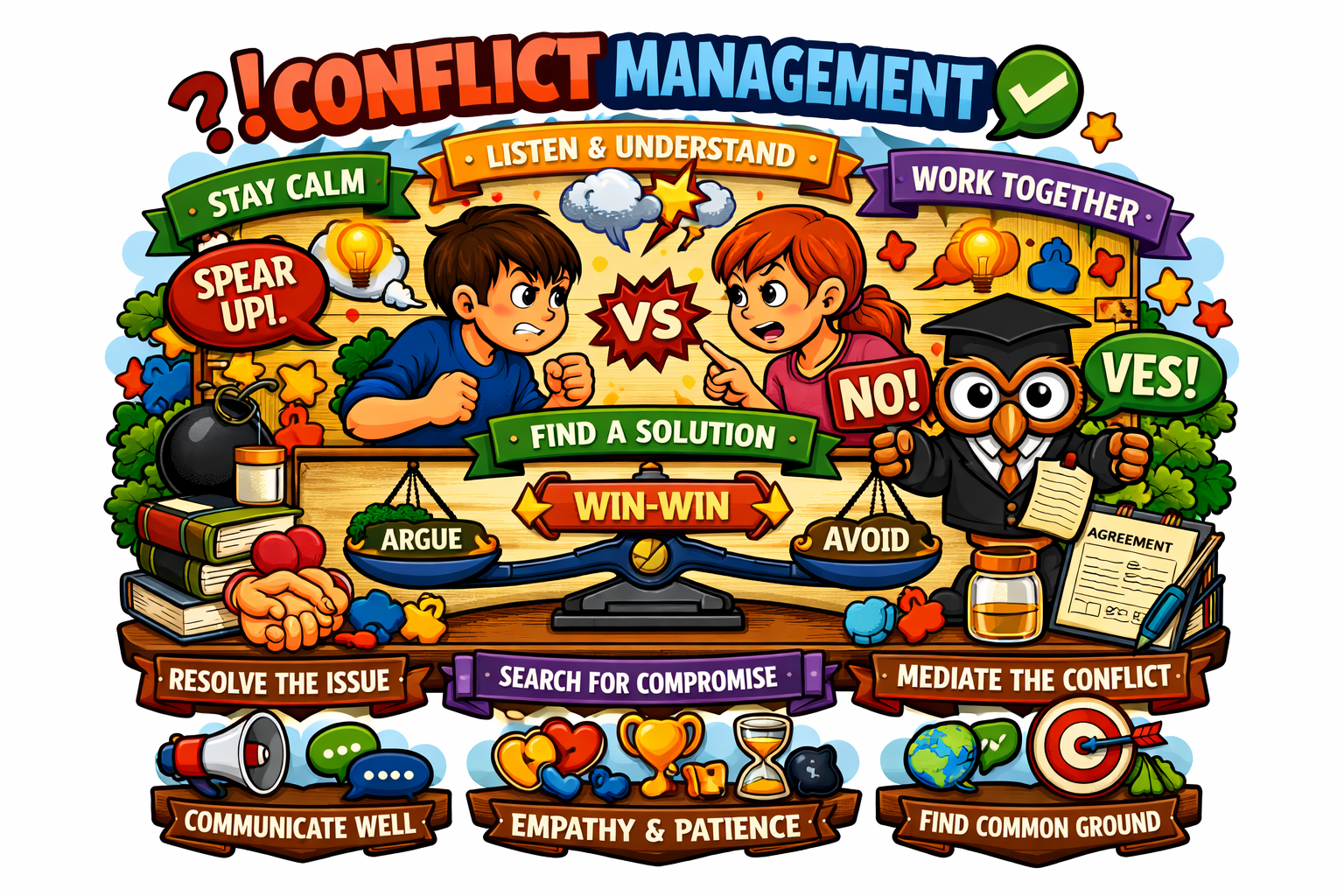
Mini Conflict Management Strategy Bank
Tip: Conflict becomes easier to solve when both people feel heard and respected.
Step-by-Step Conflict Resolution Process
| Step | Action | Example Phrase |
|---|---|---|
| 1 | Stay calm and avoid emotional reaction. | Let us discuss this calmly. |
| 2 | Clarify the actual issue. | Can we first identify what exactly went wrong? |
| 3 | Listen to both sides. | I would like to understand your perspective. |
| 4 | Focus on facts, not blame. | The report was delayed by two days, so the review was affected. |
| 5 | Find common interests. | We both want the project to be completed properly. |
| 6 | Agree on solution and responsibility. | Let us divide the remaining work and set a new deadline. |
| 7 | Follow up. | Let us review the progress tomorrow evening. |
Note: A conflict is not fully resolved until the agreed action is completed and trust begins to improve.
Useful Expressions for Conflict Management
| Purpose | Useful Expression | Why it Works |
|---|---|---|
| Calm the discussion | Let us take a moment and discuss this calmly. | Reduces emotional escalation. |
| Clarify misunderstanding | I think there may be a misunderstanding. Let us clarify it. | Prevents assumptions. |
| Show listening | What I understand from your point is... | Shows respect and active listening. |
| Disagree respectfully | I see your point, but I have a different view. | Disagrees without attacking. |
| Shift to solution | What can we do now to solve this? | Moves from blame to action. |
| Set boundary | I am willing to discuss this, but not in an angry tone. | Protects respectful communication. |
| Agree on next step | Let us decide who will do what and by when. | Creates accountability. |
| Repair relationship | I value our teamwork and would like us to move forward positively. | Restores trust and cooperation. |
Note: Useful conflict language is calm, specific, respectful, and action-oriented.
Practice
A) Multiple Choice Questions
-
The main goal of conflict management is to:
win the argument avoid all discussions solve the problem respectfully blame the other person
-
Which is the best first step during a conflict?
shout immediately stay calm and listen leave without explanation accuse the other person
-
Which conflict style focuses on finding the best solution together?
avoiding competing collaborating ignoring
-
Which sentence is most suitable in a conflict?
You always create problems. Let us understand the issue and find a solution. I will never work with you. Only my decision matters.
-
A conflict caused by unclear information is usually a:
communication conflict calendar conflict physical conflict financial rule
B) Rewrite in a Conflict-Management Style
- Poor response: You are always late and irresponsible. (Rewrite by focusing on the issue, not the person.)
- Poor response: I do not care what you think. (Rewrite by acknowledging the other person’s view.)
- Poor response: This is your fault. (Rewrite using neutral language.)
- Poor response: Stop talking. I will decide. (Rewrite by allowing discussion.)
- Poor response: Nothing can be done now. (Rewrite by moving towards a solution.)
C) Identify the Conflict Management Skill
| Statement / Action | Skill Used |
|---|---|
| Let me first understand your concern fully. | Active listening |
| The report was delayed by two days, so the review was affected. | Focusing on facts |
| We both want the project to succeed. | Finding common goal |
| Let us divide the remaining work and set a deadline. | Solution planning |
| I am willing to discuss this, but only respectfully. | Setting boundaries |
Communication Reminder
Conflict management is a practical life skill. It helps people handle disagreement without damaging relationships. A person who manages conflict well listens carefully, controls emotions, speaks respectfully, focuses on facts, and works towards a solution.
Task: Think of one conflict situation and write three possible responses: passive, aggressive, and constructive.
Show Suggested Answers
Multiple Choice
- solve the problem respectfully
- stay calm and listen
- collaborating
- Let us understand the issue and find a solution.
- communication conflict
Rewrite in a Conflict-Management Style: Sample Answers
- The delay affected the schedule. Can we discuss how to avoid this next time?
- I would like to hear your view before we decide.
- There seems to be a problem in the process. Let us identify what went wrong.
- Let us both share our points and then decide the best way forward.
- Let us see what options are still available and choose the best one.
Conflict Management Skill
- Understanding concern → Active listening
- Report delay statement → Focusing on facts
- Project success statement → Finding common goal
- Dividing work and deadline → Solution planning
- Respectful discussion condition → Setting boundaries
Clue Explanation
Effective conflict management avoids blame and focuses on facts, feelings, needs, and solutions. The best responses are calm, respectful, specific, and action-oriented.
Practical tips
- Do not react immediately when emotions are high.
- Listen before giving your response.
- Separate the person from the problem.
- Use “I” statements and neutral language.
- Look for common goals.
- Agree on specific next steps.
- Follow up after the solution is decided.
Select a topic and chapter from the left menu.