Body Language
Body language is the way your body communicates without the use of words. It includes hand gestures, posture, facial expressions, and movements that send messages of their own. Body language can happen consciously and unconsciously.
Body Language is the use of facial expressions, gestures, posture, eye contact, hand movements, personal space, and tone-related physical behaviour to communicate without words.
What is Body Language?
Body language is a form of non-verbal communication. It shows confidence, interest, respect, nervousness, disagreement, openness, or discomfort even before a person speaks.
In interviews, group discussions, presentations, classrooms, workplaces, customer interactions, and leadership situations, body language plays an important role in creating a positive impression.
| Situation | Poor Body Language | Positive Body Language |
|---|---|---|
| Interview | Looking down, slouching, fidgeting. | Sitting upright, natural eye contact, calm facial expression. |
| Presentation | Standing stiff, reading continuously, avoiding audience. | Open posture, controlled gestures, audience connection. |
| Listening | Checking phone, looking away, interrupting. | Nodding, facing the speaker, attentive expression. |
| Team discussion | Crossed arms, impatient expressions, dominating gestures. | Relaxed posture, respectful gestures, open expression. |
“Body language should support your words, not contradict them.”
Communication Tip
Key points
- Maintain natural eye contact.
- Keep an upright but relaxed posture.
- Use controlled hand gestures.
- Avoid fidgeting and restless movements.
- Smile appropriately.
- Respect personal space.
- Match facial expression with the message.
Major Elements of Body Language
Body language is made up of different visible behaviours. Each element can strengthen or weaken communication.
Facial Expression
The face shows emotion and attitude.
- Smile shows warmth
- Frown shows concern
- Blank face may seem uninterested
- Expression should match the situation
Eye Contact
Eye contact shows attention and confidence.
- Too little may show nervousness
- Too much may seem aggressive
- Natural eye contact is best
- Look at the speaker while listening
Posture
Posture reflects confidence and readiness.
- Sit upright
- Avoid slouching
- Keep shoulders relaxed
- Face the person speaking
Gestures
Hand and body movements support spoken words.
- Use open gestures
- Avoid pointing aggressively
- Avoid excessive hand movement
- Use gestures naturally
Mini Body Language Strategy Bank
Tip: Practise in front of a mirror or record yourself while speaking to observe your body language.
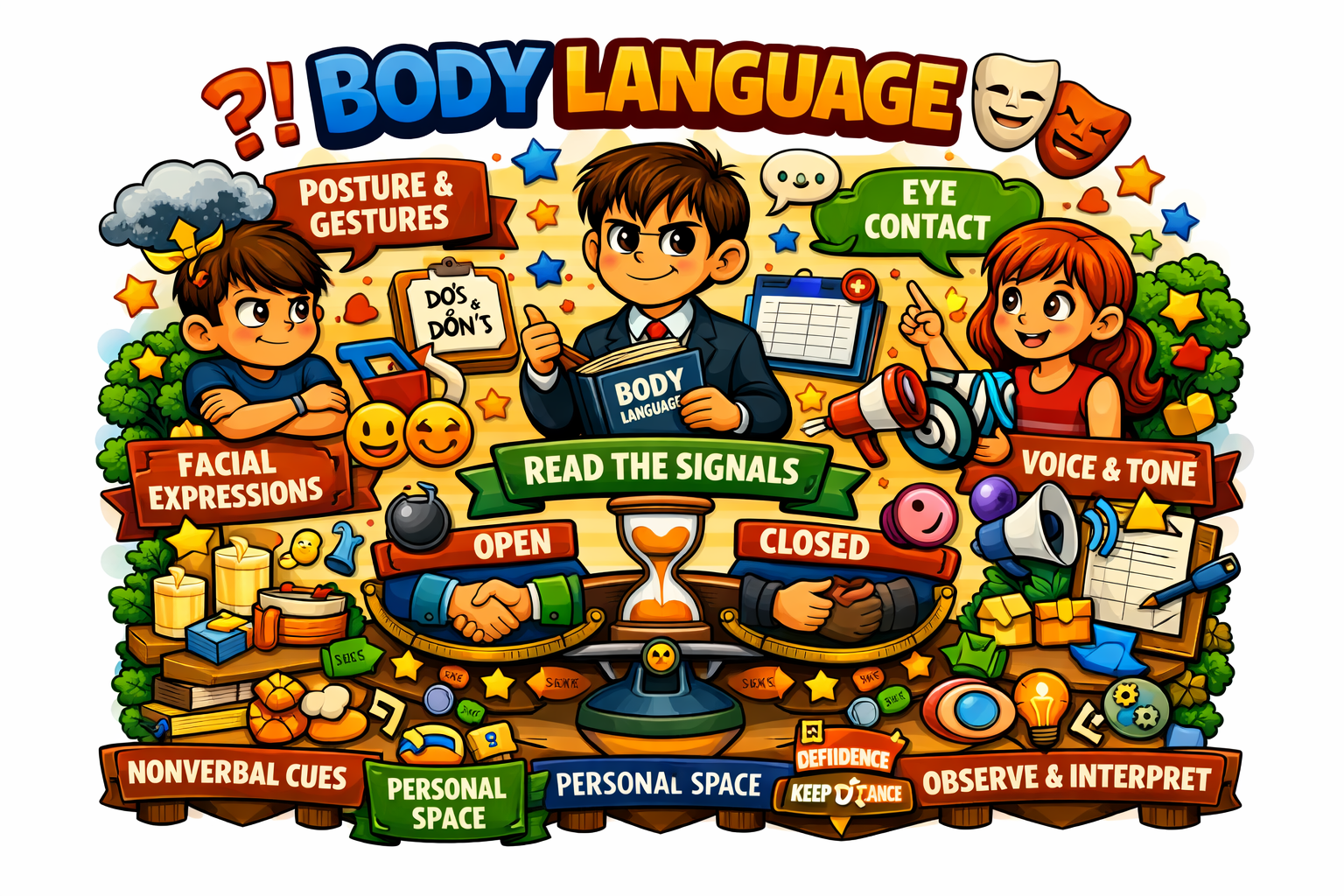
Positive and Negative Body Language
| Area | Positive Body Language | Negative Body Language | Message Created |
|---|---|---|---|
| Posture | Upright and relaxed. | Slouching or leaning away. | Confidence vs lack of interest. |
| Eye Contact | Natural and attentive. | Avoiding eye contact or staring. | Respect vs nervousness or aggression. |
| Hands | Open and controlled gestures. | Pointing, restless tapping, crossed arms. | Openness vs defensiveness or impatience. |
| Face | Appropriate smile and expression. | Blank, irritated, or mocking expression. | Warmth vs disinterest or disrespect. |
| Listening | Nodding and facing speaker. | Looking at phone or interrupting. | Attention vs carelessness. |
| Movement | Purposeful and calm movement. | Excessive movement or fidgeting. | Control vs nervousness. |
Note: Body language should be interpreted with context. A single gesture may not always mean the same thing in every situation.
Body Language in Professional Situations
| Situation | Recommended Body Language | Avoid |
|---|---|---|
| Job Interview | Sit upright, smile politely, maintain natural eye contact, listen carefully. | Slouching, looking down always, fidgeting, interrupting. |
| Group Discussion | Face the group, nod while listening, use open hand gestures. | Pointing aggressively, laughing at others, dominating physically. |
| Presentation | Stand confidently, move purposefully, use gestures to explain points. | Reading continuously, hiding behind podium, turning back to audience. |
| Customer Interaction | Use attentive posture, calm expression, and respectful distance. | Ignoring, impatience, crossed arms, careless facial expression. |
| Team Meeting | Lean slightly forward, listen actively, respond calmly. | Checking phone, showing boredom, interrupting frequently. |
Common Body Language Mistakes and Better Approaches
| Common Mistake | Possible Impression | Better Approach |
|---|---|---|
| Avoiding eye contact completely | Nervousness, lack of confidence, or lack of interest. | Use natural eye contact while speaking and listening. |
| Crossing arms tightly | Defensive or closed attitude. | Keep arms relaxed and use open gestures. |
| Fidgeting repeatedly | Nervousness or lack of preparation. | Keep hands steady and breathe calmly. |
| Checking phone while someone speaks | Disrespect or lack of attention. | Keep phone away during important conversations. |
| Speaking with a blank expression | Low energy or disinterest. | Use suitable facial expression and vocal energy. |
| Standing too close | Discomfort or pressure. | Respect personal space based on context. |
Note: Body language should be confident but not overdone. Too much movement or forced expression can look artificial.
Step-by-Step Body Language Improvement Process
Body language can be improved through awareness, practice, feedback, and conscious correction.
| Step | Action | Practice Question |
|---|---|---|
| 1. Observe | Notice your natural posture, eye contact, and gestures. | How do I usually sit, stand, and listen? |
| 2. Record | Record a short speech or mock interview. | Do I look confident and attentive? |
| 3. Correct | Identify one habit to improve at a time. | Should I reduce fidgeting or improve eye contact? |
| 4. Practise | Practise speaking with open posture and controlled gestures. | Are my gestures supporting my message? |
| 5. Get Feedback | Ask a trusted person to observe your communication. | What impression does my body language create? |
| 6. Apply | Use improved body language in real conversations. | Can I remain calm and confident in actual situations? |
Practice
A) Multiple Choice Questions
-
Body language is a form of:
written communication non-verbal communication mathematical calculation grammar rule
-
Which body language shows confidence in an interview?
slouching fidgeting continuously upright posture and natural eye contact looking at the floor always
-
Which action shows active listening?
checking phone facing the speaker and nodding interrupting repeatedly looking away throughout
-
Excessive fidgeting may create an impression of:
calm confidence nervousness perfect focus strong discipline
-
Professional body language should communicate:
disinterest attention, confidence, and respect anger and dominance carelessness
B) Situation-Based Practice
- You are attending a job interview. What body language should you maintain? (Hint: posture, eye contact, facial expression, listening.)
- You are giving a presentation and feel nervous. What should you do physically? (Hint: breathe, stand upright, use controlled gestures.)
- A friend is explaining a problem. How can you show active listening through body language? (Hint: face the person, nod, avoid phone.)
- During a group discussion, another person is speaking. What should you avoid? (Hint: interrupting, laughing, showing impatience.)
- You notice that you fidget while speaking. What can you do to improve? (Hint: keep hands steady, practise, record yourself.)
C) Match the Body Language Element with Its Meaning
| Body Language Element | Possible Meaning / Use |
|---|---|
| Natural eye contact | Shows attention and confidence |
| Upright posture | Shows alertness and self-confidence |
| Nodding while listening | Shows understanding and attention |
| Open hand gestures | Shows openness and clarity |
| Repeated fidgeting | May show nervousness or restlessness |
Communication Reminder
Body language is a powerful part of communication. It affects first impressions, interviews, teamwork, presentations, and everyday conversations. Good body language should be natural, respectful, confident, and suitable for the situation.
Task: Record a one-minute self-introduction and observe your posture, eye contact, gestures, and facial expression.
Show Suggested Answers
Multiple Choice
- non-verbal communication
- upright posture and natural eye contact
- facing the speaker and nodding
- nervousness
- attention, confidence, and respect
Situation-Based Practice: Sample Answers
- Sit upright, keep shoulders relaxed, maintain natural eye contact, smile politely, and listen carefully before answering.
- Take a slow breath, stand upright, keep hands steady, use controlled gestures, and look at the audience naturally.
- Face the person, nod when appropriate, maintain attentive eye contact, and avoid checking the phone.
- Avoid interrupting, showing irritation, laughing at others, pointing aggressively, or checking your phone.
- Practise with hands relaxed, record yourself, reduce unnecessary movements, and focus on speaking slowly and calmly.
Element Matching
- Natural eye contact → Shows attention and confidence
- Upright posture → Shows alertness and self-confidence
- Nodding while listening → Shows understanding and attention
- Open hand gestures → Shows openness and clarity
- Repeated fidgeting → May show nervousness or restlessness
Clue Explanation
Effective body language combines posture, eye contact, facial expression, gestures, movement, listening behaviour, and personal space. It should support the spoken message and create trust.
Practical tips
- Keep your posture upright but relaxed.
- Use natural eye contact, not staring.
- Smile appropriately in friendly situations.
- Avoid repeated fidgeting or restless movements.
- Use open and controlled gestures.
- Face the speaker while listening.
- Respect personal space.
- Practise through mock interviews and presentations.
Select a topic and chapter from the left menu.