Creative Thinking
Creative thinking is the ability to come up with new and innovative ideas. It is a skill that can be used in many different areas of life, including work, school, and personal relationships.
Creative Thinking is the ability to look at situations in new ways, generate fresh ideas, solve problems differently, and improve existing methods, products, or processes.
What is Creative Thinking?
Creative thinking means using imagination, curiosity, observation, and logic to create new ideas or improve existing ideas. It is not limited to art, music, or design. Creative thinking is useful in studies, business, technology, communication, problem solving, leadership, and daily life.
A creative thinker does not stop at the first answer. They ask questions, explore alternatives, combine ideas, test possibilities, and search for better solutions.
| Situation | Ordinary Response | Creative Thinking Response |
|---|---|---|
| Low marks in a subject | Study the same way again. | Try mind maps, practice tests, peer discussion, and error analysis. |
| Team project is delayed | Blame the team members. | Reorganise tasks, reduce non-essential work, and use shared progress tracking. |
| Presentation feels boring | Read slides word by word. | Add examples, visuals, questions, and a short activity. |
| Limited resources | Stop the work. | Find alternatives, reuse available materials, or simplify the solution. |
“Creative thinking begins when we ask: Is there another way?”
Innovation Tip
Key points
- Ask new and useful questions.
- Look at problems from different angles.
- Generate many ideas before choosing one.
- Combine existing ideas in new ways.
- Do not fear mistakes during idea generation.
- Test ideas practically.
- Improve ideas through feedback.
Why is Creative Thinking Important?
Creative thinking helps people adapt, improve, solve problems, communicate better, and find opportunities even in difficult situations.
Better Problem Solving
Creative thinkers explore multiple solutions instead of depending on one fixed method.
- Find alternatives
- Reduce limitations
- Use available resources
- Improve results
Innovation
New ideas can improve products, services, learning, and work processes.
- New methods
- New designs
- New tools
- Improved systems
Adaptability
Creative thinking helps people adjust when situations change.
- Handle uncertainty
- Respond to change
- Learn new approaches
- Stay flexible
Confidence
Generating and testing ideas builds confidence and independent thinking.
- Express ideas
- Take initiative
- Learn from mistakes
- Improve continuously
Types of Creative Thinking
Creativity works in different ways. Some thinking methods generate many ideas, while others refine ideas into useful solutions.
| Type | Meaning | Example |
|---|---|---|
| Divergent Thinking | Generating many possible ideas or solutions. | Listing 20 ways to improve classroom learning. |
| Convergent Thinking | Selecting the best idea from available options. | Choosing the most practical idea from the list. |
| Lateral Thinking | Solving problems through indirect or unusual approaches. | Reducing queue time by changing the process instead of adding counters. |
| Associative Thinking | Connecting two different ideas to create something useful. | Combining flashcards and games to make vocabulary learning fun. |
| Design Thinking | Solving problems by understanding user needs and testing solutions. | Designing a student app after studying student difficulties. |
Mini Creative Thinking Strategy Bank
Tip: Carry a small notebook or digital note app to record ideas immediately before they are forgotten.
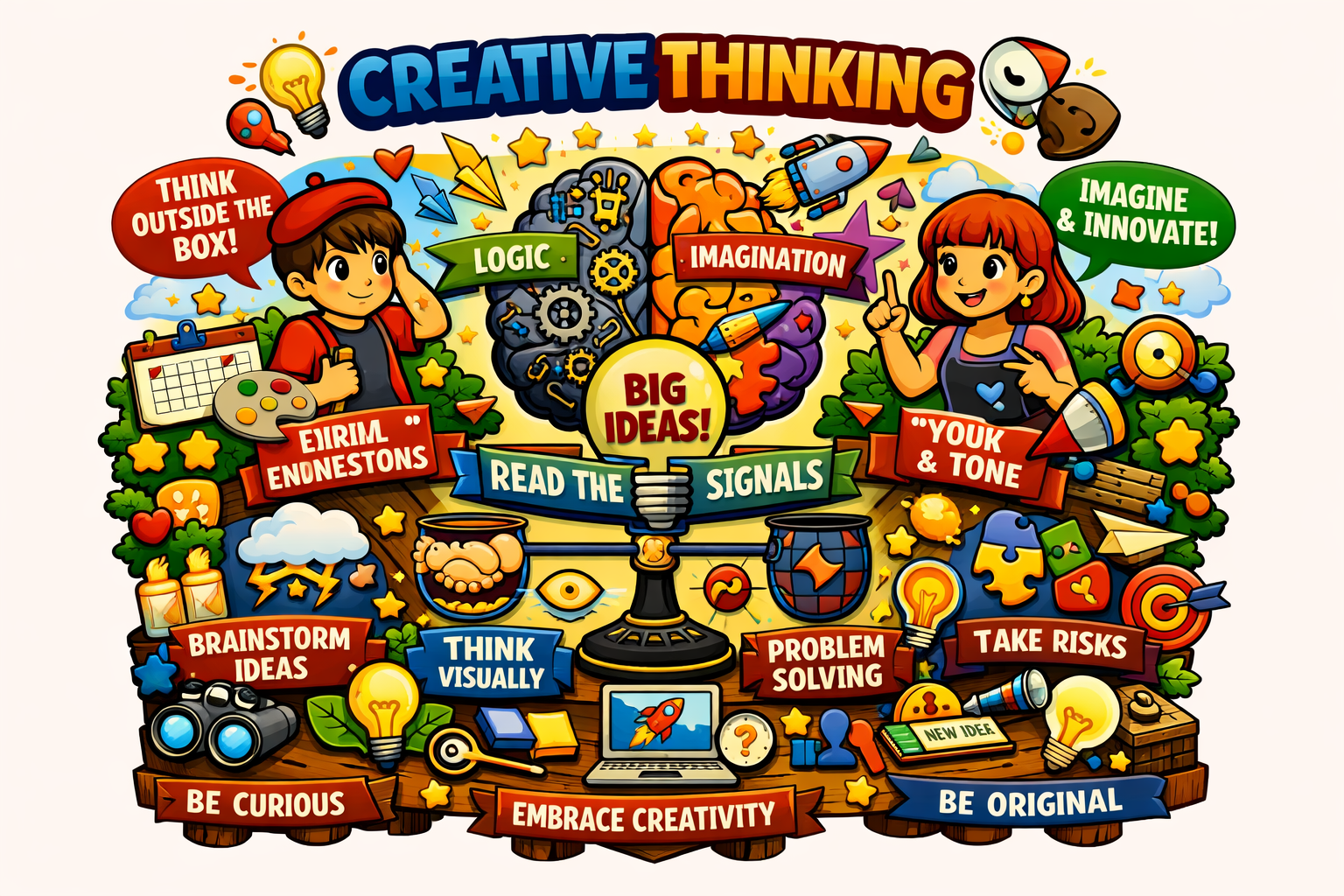
Practical Creative Thinking Techniques
| Technique | How to Use It | Why it Helps |
|---|---|---|
| Brainstorming | Write as many ideas as possible without judging them initially. | Encourages free flow of ideas. |
| Mind Mapping | Write the main idea in the centre and connect related ideas around it. | Shows connections visually. |
| SCAMPER | Substitute, Combine, Adapt, Modify, Put to another use, Eliminate, Reverse. | Helps improve or redesign existing ideas. |
| Reverse Thinking | Ask the opposite question, such as “How can we make this worse?” and then reverse the answers. | Reveals hidden causes and better solutions. |
| Role Thinking | Think from another person’s point of view. | Improves empathy and user-focused solutions. |
| Question Storming | Generate many questions before searching for answers. | Improves problem understanding. |
| Constraint Challenge | Ask how to solve the problem with fewer resources, less time, or simpler tools. | Encourages practical innovation. |
| Prototype and Feedback | Create a small trial version and get feedback. | Turns ideas into testable solutions. |
Note: Creative thinking improves when ideas are written, discussed, tested, and refined.
SCAMPER Method for Creative Improvement
SCAMPER is a useful method for improving an existing product, process, idea, or solution.
| Letter | Meaning | Question to Ask | Example |
|---|---|---|---|
| S | Substitute | What can be replaced? | Replace printed notes with interactive digital flashcards. |
| C | Combine | What can be joined together? | Combine quiz practice with leaderboard-based motivation. |
| A | Adapt | What can be adapted from another field? | Use game levels to structure learning progress. |
| M | Modify | What can be changed, enlarged, reduced, or improved? | Convert a long lesson into short micro-learning cards. |
| P | Put to another use | How else can this be used? | Use quiz results to create a personalised revision plan. |
| E | Eliminate | What can be removed? | Remove unnecessary steps from a registration process. |
| R | Reverse | What can be reversed or rearranged? | Let learners attempt questions first, then read the explanation. |
Barriers to Creative Thinking and How to Overcome Them
| Barrier | How it Affects Creativity | Better Approach |
|---|---|---|
| Fear of mistakes | Stops people from sharing new ideas. | Treat mistakes as learning during early idea generation. |
| Fixed thinking | Makes people repeat the same method even when it does not work. | Ask, “What are three other ways to solve this?” |
| Too much criticism too early | Kills ideas before they develop. | Separate idea generation from idea evaluation. |
| Lack of observation | Prevents understanding of real problems. | Observe users, situations, and repeated difficulties carefully. |
| Overdependence on routine | Limits experimentation and improvement. | Try small changes and compare results. |
| Low confidence | People hesitate to express ideas. | Start by sharing small ideas in safe settings. |
Note: Creativity improves when the environment allows questioning, experimentation, feedback, and improvement.
Step-by-Step Creative Thinking Process
Creative thinking becomes practical when ideas move through a clear process from problem understanding to improvement.
| Step | Action | Question to Ask |
|---|---|---|
| 1. Observe | Understand the problem, user, situation, or need. | What exactly is happening? |
| 2. Define | State the real problem clearly. | What problem are we trying to solve? |
| 3. Generate | Create many possible ideas without early criticism. | What are all possible solutions? |
| 4. Select | Choose the most useful and practical idea. | Which idea gives the best result with available resources? |
| 5. Test | Try the idea on a small scale. | Does this idea work in real conditions? |
| 6. Improve | Collect feedback and refine the idea. | What should be changed to make it better? |
| 7. Apply | Use the improved solution fully. | How can this idea be implemented properly? |
Practice
A) Multiple Choice Questions
-
Creative thinking means:
copying the same method always finding new and useful ways to think or solve problems avoiding all questions rejecting every idea immediately
-
Divergent thinking means:
generating many ideas choosing only one answer immediately avoiding imagination following routine blindly
-
Which technique uses Substitute, Combine, Adapt, Modify, Put to another use, Eliminate, and Reverse?
Pomodoro SCAMPER Grammar rule Calendar method
-
Which is a barrier to creative thinking?
curiosity fear of mistakes idea generation experimentation
-
A creative idea becomes valuable when it is:
hidden forever tested, improved, and applied criticised before understanding ignored completely
B) Situation-Based Practice
- Your study method is not giving good results. How can you apply creative thinking? (Hint: try new methods such as mind maps, quizzes, and revision cards.)
- Your team has limited money for an event. How can creativity help? (Hint: use available resources, sponsorship, reuse, and simple design.)
- A process has too many unnecessary steps. Which SCAMPER action can help? (Hint: eliminate or simplify unnecessary steps.)
- You need many ideas for improving classroom learning. What thinking method will you use? (Hint: brainstorming or divergent thinking.)
- You have selected one idea. What should you do before full implementation? (Hint: test it on a small scale and collect feedback.)
C) Match the Creative Thinking Technique with Its Use
| Technique | Use |
|---|---|
| Brainstorming | Generating many ideas without judging them first |
| Mind mapping | Showing idea connections visually |
| SCAMPER | Improving an existing idea through guided questions |
| Reverse thinking | Solving a problem by exploring the opposite direction |
| Prototype and feedback | Testing an idea and improving it before full use |
Innovation Reminder
Creative thinking is a practical skill that can be developed through curiosity, observation, questioning, experimentation, and feedback. It helps students learn better, professionals solve problems better, and teams improve the way they work. A creative thinker does not merely ask “What is the answer?” but also asks “What else is possible?”
Task: Choose one daily problem and generate ten possible solutions before selecting the best one.
Show Suggested Answers
Multiple Choice
- finding new and useful ways to think or solve problems
- generating many ideas
- SCAMPER
- fear of mistakes
- tested, improved, and applied
Situation-Based Practice: Sample Answers
- Try mind maps, flashcards, practice tests, group discussion, and error analysis instead of only reading repeatedly.
- Use low-cost decoration, reuse materials, involve volunteers, seek sponsorship, and simplify the event plan.
- Use the SCAMPER action “Eliminate” to remove unnecessary steps.
- Use brainstorming or divergent thinking to generate many ideas first.
- Create a small prototype or trial version, test it, collect feedback, and improve it.
Technique Matching
- Brainstorming → Generating many ideas without judging them first
- Mind mapping → Showing idea connections visually
- SCAMPER → Improving an existing idea through guided questions
- Reverse thinking → Solving a problem by exploring the opposite direction
- Prototype and feedback → Testing an idea and improving it before full use
Clue Explanation
Creative thinking includes observation, questioning, idea generation, experimentation, feedback, and improvement. It becomes powerful when imagination is combined with practical usefulness.
Practical tips
- Ask more “why”, “what if”, and “how else” questions.
- Write ideas before judging them.
- Read, observe, and learn from different fields.
- Use brainstorming for idea generation.
- Use SCAMPER to improve existing ideas.
- Test ideas on a small scale before full use.
- Accept feedback and improve the idea.
- Do not fear mistakes during early creative thinking.
Select a topic and chapter from the left menu.