Interpersonal Skills
Interpersonal skills, also known as people skills or social skills, refer to the abilities and behaviors that enable effective interaction and communication with others. These skills are essential for building and maintaining relationships, collaborating with others, resolving conflicts, and navigating social situations.
Interpersonal Skills are the abilities that help people interact, communicate, cooperate, build trust, and maintain positive relationships with others.
What are Interpersonal Skills?
Interpersonal skills are the skills used when dealing with people. They include communication, listening, empathy, respect, teamwork, cooperation, conflict handling, emotional control, and relationship building.
These skills are important in classrooms, interviews, workplaces, group discussions, leadership situations, customer interactions, friendships, and family life. A person with strong interpersonal skills can work well with others and create a positive impression.
| Situation | Poor Interpersonal Skill | Better Interpersonal Skill |
|---|---|---|
| Team discussion | Interrupting others and forcing your opinion. | Listening first, then sharing your view respectfully. |
| Friend is upset | Ignoring their feelings or giving careless advice. | Listening with empathy and offering support. |
| Workplace conflict | Blaming the other person immediately. | Discussing the issue calmly and focusing on a solution. |
| Group project | Doing only your part without coordination. | Coordinating with others and helping the team achieve the goal. |
“Good interpersonal skills help people feel respected, understood, and valued.”
Communication Tip
Key points
- Communicate clearly and respectfully.
- Listen actively before responding.
- Show empathy and understanding.
- Respect differences in opinion.
- Cooperate in teams.
- Handle conflict calmly.
- Build trust through responsible behaviour.
Why are Interpersonal Skills Important?
Interpersonal skills improve communication, teamwork, leadership, emotional maturity, conflict management, and professional success.
Better Relationships
Good interpersonal skills help build trust and respect.
- Shows care
- Builds understanding
- Reduces misunderstanding
- Improves cooperation
Effective Teamwork
Teams work better when members communicate and cooperate.
- Shared responsibility
- Clear coordination
- Mutual support
- Better results
Conflict Reduction
Respectful communication prevents small issues from becoming major conflicts.
- Calm discussion
- Active listening
- Solution focus
- Emotional control
Career Growth
Employers value people who work well with others.
- Professional behaviour
- Customer handling
- Leadership readiness
- Positive workplace image
Core Interpersonal Skills
Interpersonal skills include several related abilities. Together, they help people interact smoothly, professionally, and respectfully.
| Skill | Meaning | Example | Good Practice |
|---|---|---|---|
| Communication | Sharing ideas clearly and respectfully. | Explaining your point in a meeting. | Use simple words and confirm understanding. |
| Active Listening | Listening fully to understand the speaker. | Nodding and asking clarifying questions. | Do not interrupt unnecessarily. |
| Empathy | Understanding another person’s feelings or situation. | Saying, “I understand this is difficult for you.” | Respond with care, not judgement. |
| Teamwork | Working with others towards a common goal. | Sharing tasks in a group project. | Support others and complete your responsibility. |
| Respect | Valuing others’ opinions, time, and dignity. | Allowing others to speak in discussion. | Disagree politely without insulting. |
| Conflict Management | Handling disagreements calmly and constructively. | Finding a solution instead of blaming. | Focus on the issue, not the person. |
| Trustworthiness | Being reliable, honest, and responsible. | Completing promised work on time. | Do what you say you will do. |
| Emotional Control | Managing emotions during difficult interactions. | Staying calm during criticism. | Pause before reacting. |
Note: Interpersonal skills improve through practice, feedback, observation, and self-awareness.
Mini Interpersonal Skills Strategy Bank
Tip: In every interaction, ask yourself: “Am I making the other person feel heard and respected?”
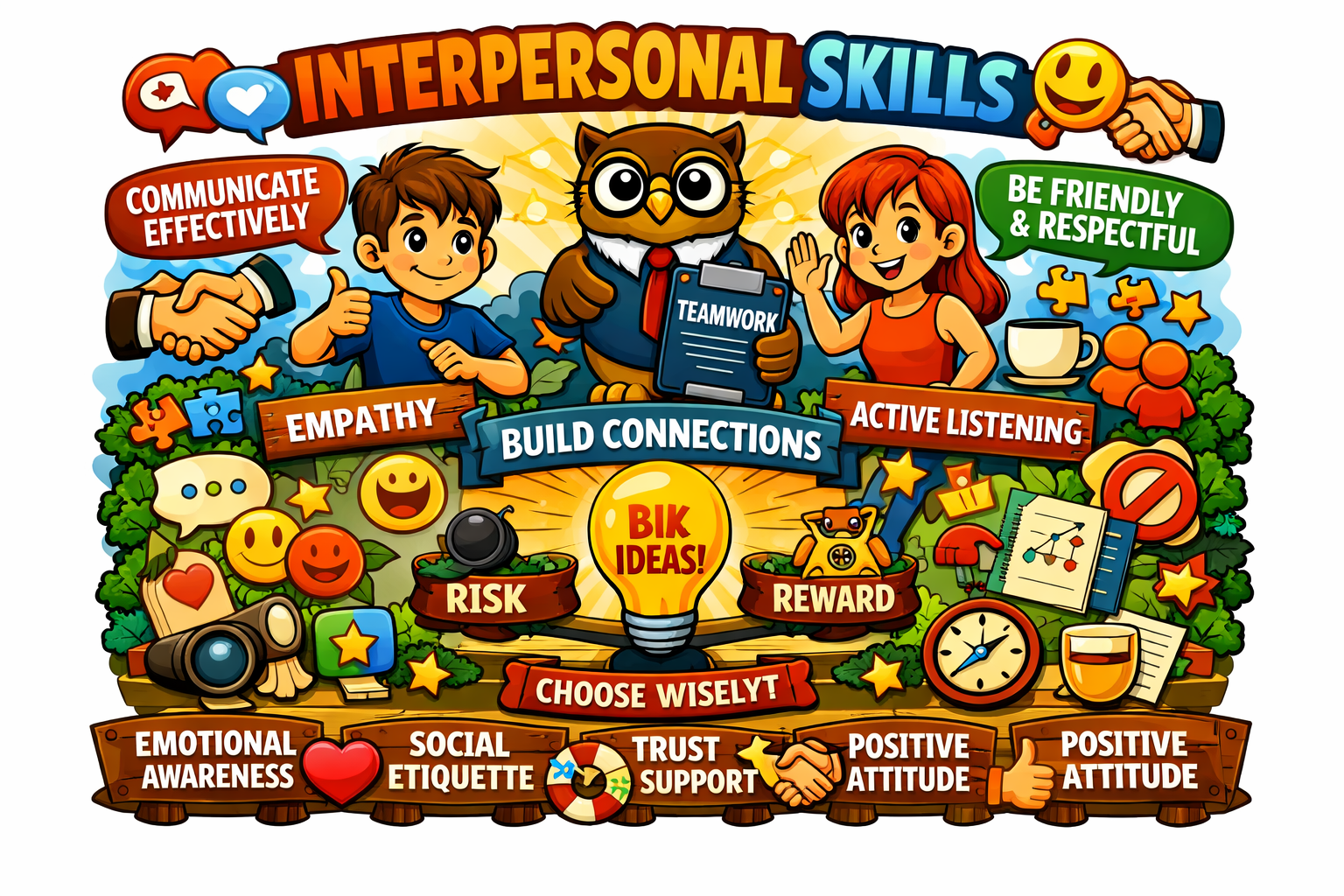
Positive and Poor Interpersonal Behaviour
| Area | Positive Behaviour | Poor Behaviour | Impact |
|---|---|---|---|
| Listening | Listening patiently and asking questions. | Interrupting or ignoring. | Builds trust or causes frustration. |
| Speaking | Clear, polite, and respectful communication. | Rude, confusing, or blaming speech. | Improves understanding or creates conflict. |
| Teamwork | Sharing responsibility and supporting others. | Working selfishly or avoiding responsibility. | Improves group success or weakens the team. |
| Feedback | Giving constructive and specific feedback. | Criticising harshly or personally. | Encourages improvement or lowers confidence. |
| Conflict | Discussing the issue calmly. | Blaming, shouting, or avoiding completely. | Solves problems or increases tension. |
| Reliability | Keeping promises and meeting deadlines. | Making excuses repeatedly. | Builds or damages trust. |
Note: Interpersonal behaviour is judged not only by what you say, but also by consistency, tone, timing, and respect.
Interpersonal Skills in Professional Situations
| Situation | Recommended Behaviour | Avoid |
|---|---|---|
| Job Interview | Greet politely, listen carefully, answer clearly, and show respect. | Interrupting, arguing rudely, or giving careless answers. |
| Group Discussion | Allow others to speak, build on ideas, disagree respectfully. | Dominating, mocking, or ignoring others. |
| Team Project | Clarify roles, support team members, and complete your responsibility. | Blaming others or avoiding your task. |
| Customer Interaction | Be patient, listen to the concern, and respond politely. | Showing irritation or dismissing the customer’s issue. |
| Workplace Feedback | Accept useful feedback and ask how to improve. | Becoming defensive or taking everything personally. |
| Leadership Role | Guide, support, communicate clearly, and appreciate effort. | Using authority without listening or empathy. |
Step-by-Step Interpersonal Skills Development Process
Interpersonal skills can be developed through self-awareness, practice, feedback, and reflection.
| Step | Action | Practice Question |
|---|---|---|
| 1. Observe | Notice how you speak, listen, and respond to people. | Do I interrupt or listen patiently? |
| 2. Identify | Find one interpersonal habit to improve. | Should I improve listening, tone, empathy, or teamwork? |
| 3. Practise | Use one improved behaviour in daily interactions. | Can I ask one thoughtful question before giving advice? |
| 4. Seek Feedback | Ask a trusted person how your communication appears. | Do I sound respectful and clear? |
| 5. Reflect | Review what went well and what needs improvement. | What did I learn from this interaction? |
| 6. Improve | Adjust behaviour and practise consistently. | How can I respond better next time? |
Common Interpersonal Mistakes and Better Approaches
| Common Mistake | Possible Impact | Better Approach |
|---|---|---|
| Interrupting often | Others may feel disrespected. | Allow the person to complete their point. |
| Not listening fully | Misunderstanding and wrong response. | Listen, summarise, and then respond. |
| Using blaming words | Creates defensiveness and conflict. | Use neutral language and focus on the issue. |
| Ignoring others’ feelings | Weakens trust and emotional connection. | Show empathy and acknowledge feelings. |
| Not keeping promises | Damages reliability and credibility. | Commit realistically and complete promised work. |
| Avoiding feedback | Limits growth and improvement. | Accept feedback calmly and use it constructively. |
Note: Strong interpersonal skills are built through trust, respect, consistency, and emotional awareness.
Practice
A) Multiple Choice Questions
-
Interpersonal skills are mainly used for:
solving only mathematics problems interacting and working well with people avoiding all communication working without relationships
-
Which is an example of active listening?
interrupting repeatedly checking phone while listening listening fully and asking clarifying questions ignoring the speaker
-
Empathy means:
understanding another person’s feelings mocking others forcing your opinion avoiding teamwork
-
Which behaviour builds trust?
making false promises completing promised work on time blaming others always avoiding responsibility
-
In conflict, good interpersonal skill means:
shouting louder focusing on solution calmly insulting the other person refusing to listen
B) Situation-Based Practice
- A team member is speaking slowly and you already understand the point. What should you do? (Hint: listen patiently and respond respectfully.)
- Your friend is upset after a poor exam result. How can you show empathy? (Hint: acknowledge feelings and offer support.)
- Two classmates disagree during a project. How can interpersonal skills help? (Hint: listen to both, focus on task, find common solution.)
- You promised to send a report but cannot complete it on time. What should you do? (Hint: inform early, apologise, and give realistic timeline.)
- Someone gives you feedback about your communication style. How should you respond? (Hint: listen calmly and identify what can improve.)
C) Match the Interpersonal Skill with Its Use
| Skill | Use |
|---|---|
| Active listening | Understanding the speaker before responding |
| Empathy | Understanding and respecting another person’s feelings |
| Teamwork | Working with others towards a common goal |
| Conflict management | Handling disagreement calmly and constructively |
| Trustworthiness | Being reliable, honest, and consistent |
Relationship Reminder
Interpersonal skills are essential for success in personal, academic, and professional life. They help people communicate clearly, listen carefully, understand emotions, build trust, cooperate in teams, resolve conflicts, and maintain healthy relationships.
Task: Think of one recent interaction and identify one interpersonal skill you used well and one skill you can improve.
Show Suggested Answers
Multiple Choice
- interacting and working well with people
- listening fully and asking clarifying questions
- understanding another person’s feelings
- completing promised work on time
- focusing on solution calmly
Situation-Based Practice: Sample Answers
- Listen patiently without interrupting, then respond respectfully after the person completes the point.
- Say, “I understand you are disappointed. Let us see what can be improved for the next exam.”
- Listen to both classmates, identify the task requirement, and help them agree on a practical solution.
- Inform the person early, apologise for the delay, explain briefly, and give a realistic new timeline.
- Listen calmly, thank the person for feedback, and choose one specific behaviour to improve.
Skill Matching
- Active listening → Understanding the speaker before responding
- Empathy → Understanding and respecting another person’s feelings
- Teamwork → Working with others towards a common goal
- Conflict management → Handling disagreement calmly and constructively
- Trustworthiness → Being reliable, honest, and consistent
Clue Explanation
Interpersonal skills combine communication, listening, empathy, respect, teamwork, emotional control, reliability, and conflict management. They help people build positive and productive relationships.
Practical tips
- Listen carefully before giving your opinion.
- Use polite and respectful language.
- Show empathy when others are upset.
- Keep promises and meet deadlines.
- Give feedback constructively.
- Accept feedback calmly.
- Resolve conflicts by focusing on solutions.
- Build trust through consistent behaviour.
Select a topic and chapter from the left menu.