Decision Making
Decision making refers to the cognitive process of selecting a course of action or choosing from available alternatives based on a set of criteria or preferences. It is a fundamental aspect of human thinking and problem-solving.
Decision Making is the ability to choose the best possible option after understanding the situation, comparing alternatives, considering consequences, and taking responsible action.
What is Decision Making?
Decision making means selecting one course of action from two or more available choices. Every person makes decisions daily, such as how to use time, what to study, how to solve a problem, how to respond to people, or which opportunity to accept.
A good decision is not always the easiest decision. It is the decision that is suitable for the goal, practical in the situation, based on relevant information, and responsible in its consequences.
| Situation | Poor Decision Making | Better Decision Making |
|---|---|---|
| Choosing a course | Selecting only because a friend selected it. | Comparing interest, ability, career scope, cost, and future goals. |
| Solving a team problem | Blaming one person immediately. | Finding the cause, discussing options, and choosing a workable solution. |
| Managing time | Doing easy tasks first while urgent work is pending. | Prioritising urgent and important tasks before low-value activities. |
| Handling pressure | Reacting emotionally without thinking. | Pausing, reviewing facts, and responding calmly. |
“A strong decision is made after thinking clearly, not after reacting quickly.”
Life Skill Tip
Key points
- Understand the problem clearly.
- Collect relevant information.
- Identify possible options.
- Compare benefits and risks.
- Consider short-term and long-term effects.
- Choose responsibly.
- Review the result and learn from it.
Why is Decision Making Important?
Decision making affects academic success, career growth, personal discipline, relationships, leadership, problem solving, and overall confidence.
Better Problem Solving
Good decisions help solve problems instead of increasing confusion.
- Identifies real issue
- Compares alternatives
- Chooses practical action
- Reduces repeated mistakes
Confidence
Making thoughtful choices builds self-confidence.
- Reduces hesitation
- Improves responsibility
- Builds independent thinking
- Supports personal growth
Leadership
Leaders must make timely and responsible decisions.
- Gives direction
- Reduces uncertainty
- Creates accountability
- Improves team trust
Time and Resource Use
Good decisions help use time, money, energy, and people wisely.
- Avoids waste
- Improves planning
- Supports priorities
- Increases efficiency
Types of Decisions
Different situations require different types of decisions. Some are simple and routine, while others need deeper analysis and responsibility.
| Type | Meaning | Example |
|---|---|---|
| Routine Decision | A regular decision made in everyday situations. | Choosing a daily study schedule. |
| Strategic Decision | A long-term decision that affects future direction. | Choosing a career path or business plan. |
| Personal Decision | A decision related to personal habits, values, or lifestyle. | Deciding to reduce screen time and sleep earlier. |
| Group Decision | A decision made after discussion with others. | Team deciding roles for a project. |
| Ethical Decision | A decision based on right conduct, fairness, and values. | Refusing to copy in an exam even when others do it. |
| Crisis Decision | A quick decision made under pressure. | Responding to an urgent safety or deadline issue. |
Mini Decision Making Strategy Bank
Tip: For important decisions, write the options on paper. Written comparison improves clarity.
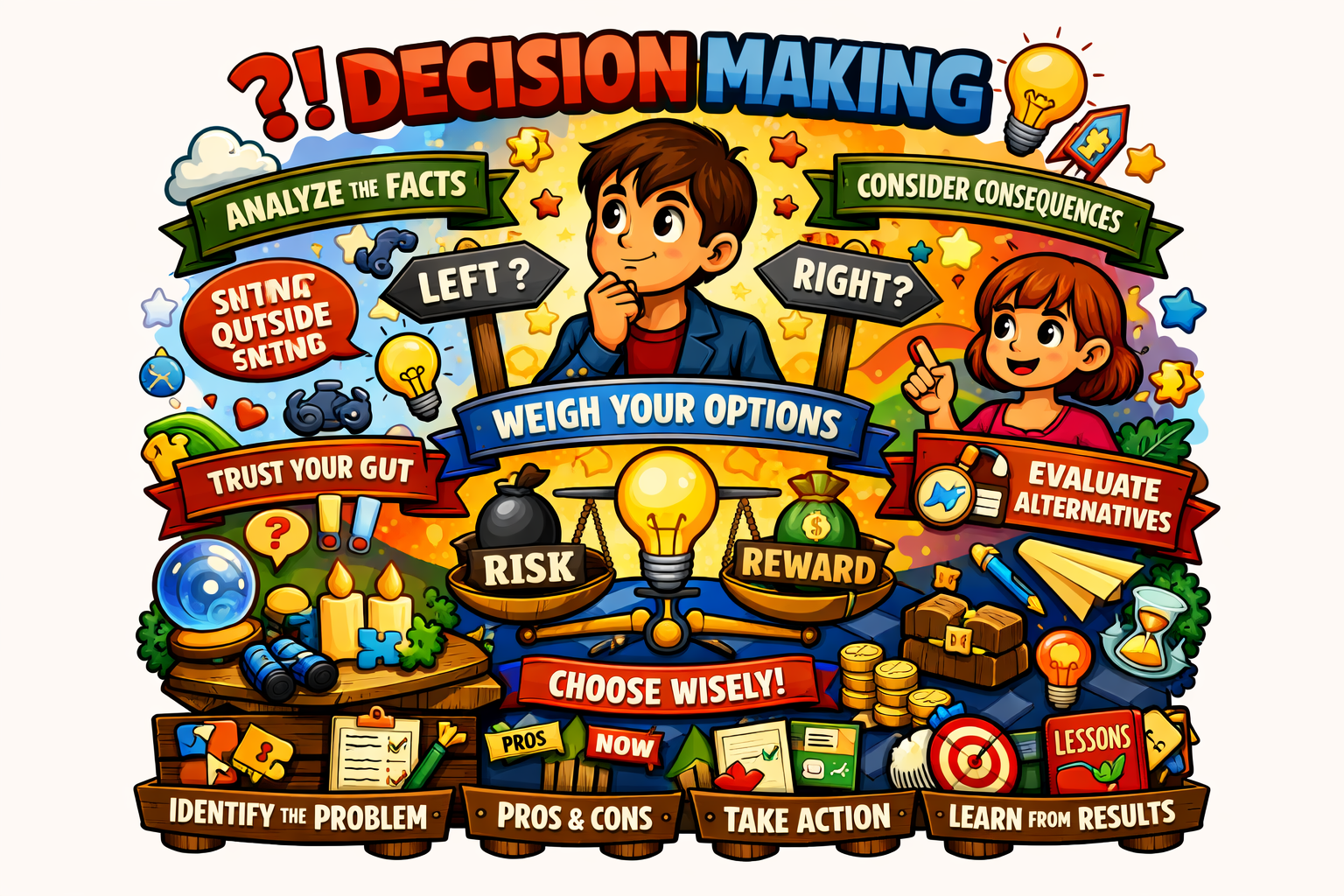
Step-by-Step Decision Making Process
Decision making becomes easier when it follows a clear process from problem identification to review.
| Step | Action | Question to Ask |
|---|---|---|
| 1. Identify | Understand the real problem or choice. | What decision needs to be made? |
| 2. Gather Information | Collect relevant facts, data, opinions, and constraints. | What information do I need? |
| 3. List Options | Identify possible choices or solutions. | What are my available options? |
| 4. Evaluate | Compare benefits, risks, cost, effort, and consequences. | What are the pros and cons of each option? |
| 5. Choose | Select the most suitable and responsible option. | Which option best serves the goal? |
| 6. Act | Implement the decision with clear steps. | What action should I take first? |
| 7. Review | Check the result and learn from the outcome. | What worked, what failed, and what can improve? |
Useful Decision Making Tools
| Tool | How to Use It | Best Used For |
|---|---|---|
| Pros and Cons List | Write advantages and disadvantages of each option. | Simple personal or academic decisions. |
| Priority Matrix | Classify tasks as urgent-important, important-not urgent, etc. | Time and task decisions. |
| Cost-Benefit Analysis | Compare the expected value with cost, effort, and risk. | Financial, career, and project decisions. |
| Risk Analysis | Identify what can go wrong and how serious it may be. | Important or uncertain decisions. |
| Decision Matrix | Rate each option against criteria such as cost, time, quality, and impact. | Comparing multiple options logically. |
| Consultation | Ask experienced people for guidance without blindly following them. | Career, team, or complex decisions. |
Note: Decision tools help organise thinking, but the final decision should also consider values, timing, responsibility, and practical reality.
Barriers to Good Decision Making
| Barrier | How it Affects Decisions | Better Approach |
|---|---|---|
| Emotional Reaction | Leads to quick decisions without checking facts. | Pause, calm down, and review the situation. |
| Fear of Failure | Creates hesitation and avoids necessary action. | Accept calculated risk and learn from outcomes. |
| Overthinking | Delays action even when enough information is available. | Set a decision deadline and act responsibly. |
| Peer Pressure | Pushes a person to choose what others want. | Check whether the decision matches your goal and values. |
| Incomplete Information | Creates wrong assumptions and poor judgement. | Collect relevant facts before deciding. |
| Bias | Favours one option unfairly without proper comparison. | Compare options using clear criteria. |
Note: A decision becomes stronger when it is not controlled by fear, pressure, bias, or incomplete information.
Ethical and Responsible Decision Making
A decision may be smart, but it should also be ethical. Responsible decisions protect fairness, honesty, respect, and long-term trust.
| Question | Why it Matters | Example |
|---|---|---|
| Is it honest? | Dishonest choices may give short-term gain but damage trust. | Not copying in an exam even if others are copying. |
| Is it fair? | Fair decisions protect people from unnecessary harm or bias. | Giving equal chance to team members during group work. |
| Who will be affected? | Good decisions consider impact on others. | Checking how a schedule change affects the whole team. |
| What are the long-term effects? | Short-term benefit may create long-term problems. | Choosing learning over shortcuts for future growth. |
| Can I explain this decision openly? | A responsible decision can usually be justified transparently. | Explaining why a particular project option was selected. |
Practice
A) Multiple Choice Questions
-
Decision making means:
choosing randomly selecting the best option after thinking avoiding all choices following others blindly
-
What should be done before making an important decision?
ignore facts collect relevant information act in anger copy others
-
Which tool helps compare advantages and disadvantages?
pros and cons list random guessing ignoring options emotional reaction
-
Which is a barrier to good decision making?
clear thinking peer pressure relevant information responsibility
-
Responsible decision making should consider:
only short-term gain fairness, honesty, and consequences only personal comfort only speed
B) Situation-Based Practice
- You need to choose between two courses. What factors should you compare? (Hint: interest, ability, cost, career scope, and future goal.)
- Your friends are pressuring you to make a choice you are not comfortable with. What should you do? (Hint: check your values and make an independent decision.)
- Your team has two possible solutions for a project problem. How should the team decide? (Hint: compare cost, time, quality, risk, and expected result.)
- You are angry and need to respond to an important message. What is the better decision? (Hint: pause first and reply after calming down.)
- You made a decision that did not work well. What should you do next? (Hint: review the outcome and learn from it.)
C) Match the Decision Making Tool with Its Use
| Tool / Concept | Use |
|---|---|
| Pros and cons list | Compares advantages and disadvantages |
| Risk analysis | Checks what can go wrong |
| Decision matrix | Compares options using fixed criteria |
| Consultation | Uses guidance from experienced people |
| Review | Checks the result and learns for future decisions |
Decision Making Reminder
Decision making is a practical skill that improves with awareness, experience, and reflection. A good decision maker does not rush blindly or delay endlessly. They understand the situation, compare options, consider consequences, choose responsibly, act clearly, and learn from the outcome.
Task: Think of one important decision you need to make. Write the problem, three options, benefits, risks, and your final choice.
Show Suggested Answers
Multiple Choice
- selecting the best option after thinking
- collect relevant information
- pros and cons list
- peer pressure
- fairness, honesty, and consequences
Situation-Based Practice: Sample Answers
- Compare your interest, ability, course quality, cost, career opportunities, and long-term goal.
- Pause, think independently, check your values, and choose what is right for you.
- Compare both solutions using criteria such as cost, time, quality, risk, and expected result.
- Do not reply immediately. Calm down, review the facts, and then respond respectfully.
- Review why the decision did not work, learn from the result, and improve future decisions.
Tool Matching
- Pros and cons list → Compares advantages and disadvantages
- Risk analysis → Checks what can go wrong
- Decision matrix → Compares options using fixed criteria
- Consultation → Uses guidance from experienced people
- Review → Checks the result and learns for future decisions
Clue Explanation
Effective decision making includes problem identification, information gathering, option comparison, risk analysis, ethical thinking, action, and review. A good decision is practical, responsible, and aligned with goals.
Practical tips
- Do not decide only under emotional pressure.
- Understand the real problem before choosing.
- Write possible options clearly.
- Compare benefits, risks, cost, time, and effort.
- Take advice, but do not blindly follow others.
- Check whether the decision is ethical and fair.
- Act after deciding and review the result later.
Select a topic and chapter from the left menu.