Problem Solving Skills
Problem-solving skills refer to the abilities and competencies that enable individuals to identify, analyze, and resolve problems effectively. These skills involve a combination of cognitive, analytical, creative, and practical capabilities that are applied to overcome obstacles, find solutions, and make informed decisions.
Problem Solving Skills are the abilities used to understand a difficulty, identify its cause, explore possible solutions, choose the best option, and take effective action.
What are Problem Solving Skills?
Problem solving means finding a practical and effective way to overcome a difficulty. A problem may be academic, personal, technical, professional, financial, or social.
A good problem solver does not panic, blame others, or jump to conclusions. Instead, they understand the problem clearly, collect facts, analyse causes, generate options, compare solutions, act carefully, and review the result.
| Situation | Poor Response | Problem-Solving Response |
|---|---|---|
| Low marks in a subject | I am weak. I cannot improve. | Analyse mistakes, identify weak topics, and create a revision plan. |
| Project delay | Blame team members immediately. | Find the cause of delay, reprioritise tasks, and set a new timeline. |
| Technical error | Keep trying randomly without understanding. | Read the error, check recent changes, test step by step, and isolate the issue. |
| Conflict in a team | Avoid discussion or argue emotionally. | Listen to both sides, identify the issue, and agree on a workable solution. |
“A problem well understood is already half solved.”
Problem Solving Tip
Key points
- Stay calm before reacting.
- Define the real problem clearly.
- Collect relevant facts.
- Identify root causes.
- Generate possible solutions.
- Compare options carefully.
- Act, review, and improve.
Why are Problem Solving Skills Important?
Problem solving skills help people handle challenges in studies, work, relationships, projects, leadership, business, and everyday life.
Better Decisions
Good problem solving improves judgement and decision making.
- Compares options
- Reduces confusion
- Checks consequences
- Improves accuracy
Higher Confidence
Solving problems builds self-belief and independence.
- Reduces fear
- Builds initiative
- Improves resilience
- Encourages learning
Workplace Success
Employers value people who can solve practical problems.
- Handles challenges
- Improves processes
- Supports teamwork
- Saves time and resources
Continuous Improvement
Problems reveal gaps and opportunities for improvement.
- Finds root causes
- Improves systems
- Prevents repetition
- Builds better habits
Types of Problems
Different problems need different approaches. Some require logic, some require creativity, and some require communication or emotional control.
| Problem Type | Meaning | Example | Best Approach |
|---|---|---|---|
| Technical Problem | A problem related to tools, systems, machines, or software. | Application error or network issue. | Diagnose step by step and test changes. |
| Academic Problem | A difficulty related to learning, marks, or performance. | Weakness in mathematics or grammar. | Identify weak areas and practise systematically. |
| People Problem | A problem caused by communication gaps or disagreement. | Team conflict or misunderstanding. | Listen, clarify, and find common ground. |
| Resource Problem | A problem caused by limited time, money, people, or materials. | Event planning with low budget. | Prioritise, simplify, and use alternatives. |
| Decision Problem | A problem where one option must be chosen from many. | Choosing a course, job, or project method. | Compare benefits, risks, cost, and goals. |
| Repeated Problem | A problem that keeps returning because the root cause is not fixed. | Repeated delay in submissions. | Use root cause analysis and prevention. |
Mini Problem Solving Strategy Bank
Tip: When stuck, explain the problem aloud or write it down. Clear expression often reveals the solution path.
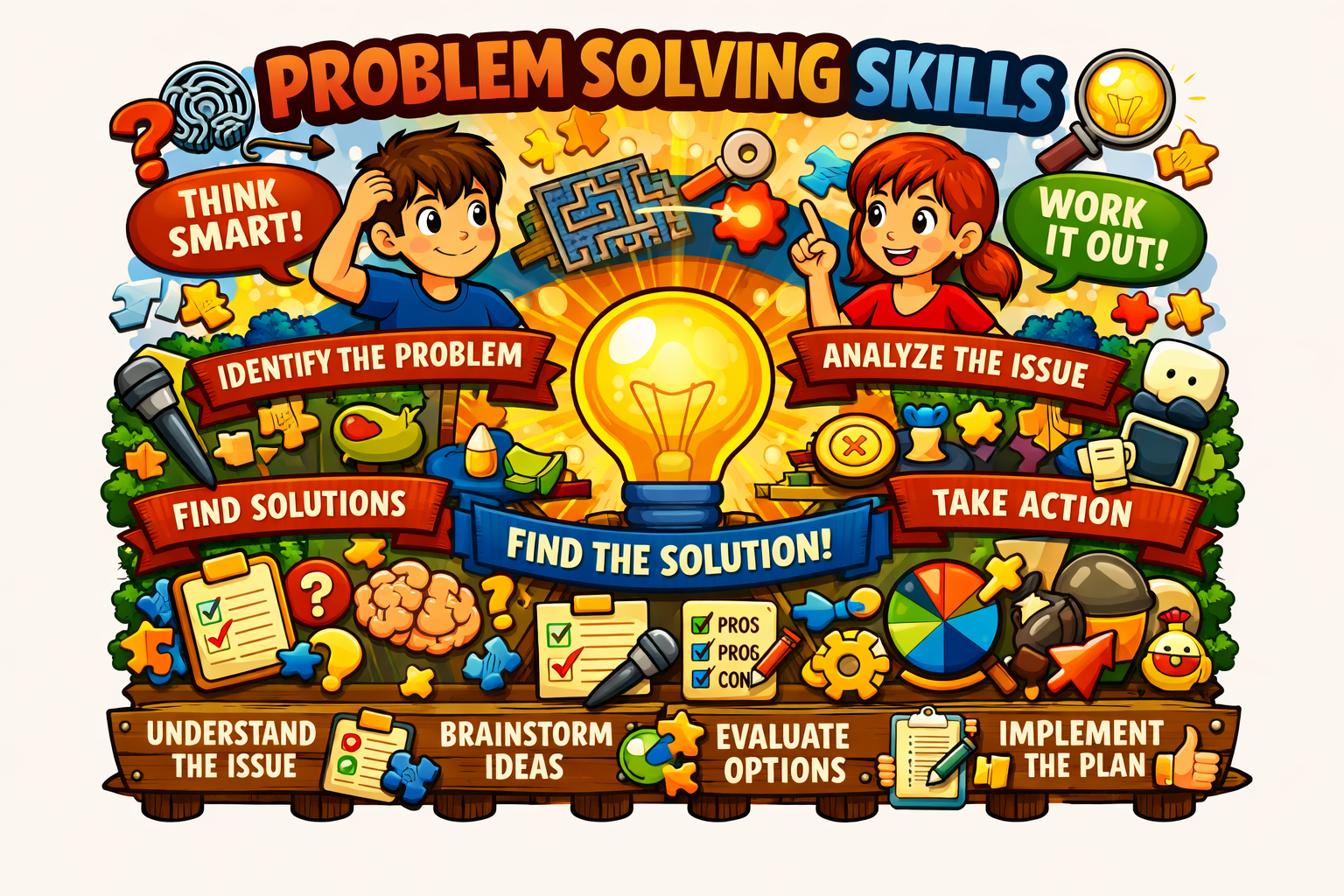
Step-by-Step Problem Solving Process
Problem solving becomes more effective when it follows a clear and disciplined process.
| Step | Action | Question to Ask |
|---|---|---|
| 1. Notice | Recognise that there is a problem. | What is not working as expected? |
| 2. Define | State the problem clearly and specifically. | What exactly is the problem? |
| 3. Analyse | Collect facts and identify possible causes. | Why is this problem happening? |
| 4. Generate | Create possible solutions. | What are the possible ways to solve it? |
| 5. Evaluate | Compare benefits, risks, time, cost, and effort. | Which solution is most practical? |
| 6. Implement | Apply the selected solution. | What action should be taken first? |
| 7. Review | Check whether the solution worked. | Did the problem reduce or get solved? |
| 8. Prevent | Take steps to avoid the same problem again. | How can this be prevented in future? |
Useful Problem Solving Tools
| Tool / Method | How to Use It | Best Used For |
|---|---|---|
| 5 Whys Method | Ask “Why?” repeatedly to reach the root cause. | Repeated or unclear problems. |
| Root Cause Analysis | Find the main cause instead of treating only symptoms. | Process errors and recurring issues. |
| Brainstorming | Generate many possible solutions before judging them. | Creative and team-based problems. |
| Pros and Cons List | Write advantages and disadvantages of each option. | Simple decision problems. |
| Decision Matrix | Rate solutions using criteria like cost, time, quality, and impact. | Comparing multiple solutions logically. |
| Pilot Test | Try the solution on a small scale before full use. | New ideas, systems, or process changes. |
| Feedback Review | Collect feedback after implementation. | Improving the solution after action. |
Note: The best tool depends on the problem. A technical issue may need testing, while a team issue may need listening and communication.
5 Whys Method: Example
The 5 Whys Method helps identify the root cause by repeatedly asking why the problem happened.
| Stage | Question | Answer |
|---|---|---|
| Problem | What happened? | The assignment was submitted late. |
| Why 1 | Why was it submitted late? | The work was completed late. |
| Why 2 | Why was the work completed late? | The student started only one day before the deadline. |
| Why 3 | Why did the student start late? | There was no proper study or task schedule. |
| Why 4 | Why was there no schedule? | The student underestimated the time required. |
| Why 5 | Why was the time underestimated? | The student did not break the assignment into smaller tasks. |
| Root Cause | What is the main cause? | Poor planning and no task breakdown. |
| Solution | What should be done? | Break assignments into smaller parts and set mini-deadlines. |
Barriers to Effective Problem Solving
| Barrier | How it Affects Problem Solving | Better Approach |
|---|---|---|
| Panic | Reduces clear thinking and leads to poor decisions. | Pause, breathe, and define the problem calmly. |
| Jumping to Conclusions | Leads to solving the wrong problem. | Collect facts before deciding. |
| Blame Mindset | Creates conflict and avoids responsibility. | Focus on causes, solutions, and prevention. |
| Fixed Thinking | Prevents creative alternatives. | Ask, “What else can be tried?” |
| Incomplete Information | Creates incorrect assumptions. | Gather relevant data and check facts. |
| No Review | The same mistake may repeat. | Review results and improve the process. |
Note: Effective problem solving needs patience, facts, analysis, creativity, action, and review.
Practice
A) Multiple Choice Questions
-
Problem solving means:
ignoring difficulties understanding a problem and finding an effective solution blaming others immediately acting without thinking
-
What is the first step in effective problem solving?
jump to a solution define the problem clearly ignore facts panic
-
The 5 Whys method is mainly used to:
decorate a presentation find the root cause avoid the problem create confusion
-
Which is a barrier to problem solving?
clear analysis jumping to conclusions collecting facts reviewing results
-
A good solution should:
only hide the problem temporarily solve the issue and reduce repetition ignore root cause increase confusion
B) Situation-Based Practice
- Your exam marks are low despite studying. How will you solve the problem? (Hint: analyse mistakes, identify weak topics, change study method.)
- A team project is delayed. What steps should the team take? (Hint: identify cause, divide pending tasks, set new deadlines.)
- Your computer shows an error after a recent change. How should you troubleshoot? (Hint: read error, check recent change, test step by step.)
- A problem keeps repeating every week. What method can help? (Hint: use root cause analysis or 5 Whys.)
- You have three possible solutions. How will you choose the best one? (Hint: compare cost, time, risk, benefit, and impact.)
C) Match the Problem Solving Tool with Its Use
| Tool / Concept | Use |
|---|---|
| 5 Whys Method | Finds the root cause by asking why repeatedly |
| Brainstorming | Generates many possible solutions |
| Pros and cons list | Compares advantages and disadvantages |
| Decision matrix | Compares options using fixed criteria |
| Pilot test | Tests a solution on a small scale before full use |
Problem Solving Reminder
Problem solving is a practical skill that improves with observation, analysis, creativity, decision making, and review. A strong problem solver remains calm, defines the issue clearly, looks for root causes, considers multiple solutions, acts responsibly, and learns from the result.
Task: Choose one current problem and write: the problem, possible causes, three solutions, best solution, and one prevention step.
Show Suggested Answers
Multiple Choice
- understanding a problem and finding an effective solution
- define the problem clearly
- find the root cause
- jumping to conclusions
- solve the issue and reduce repetition
Situation-Based Practice: Sample Answers
- Review answer sheets, identify repeated mistakes, list weak topics, practise targeted questions, and revise using a new method.
- Identify why the delay happened, divide pending work, assign responsibility, set mini-deadlines, and review progress daily.
- Read the error carefully, check the recent change, reverse or isolate the change, test step by step, and document the fix.
- Use the 5 Whys method or root cause analysis to identify why the issue keeps repeating.
- Compare each solution using criteria such as cost, time, risk, benefit, effort, and long-term impact.
Tool Matching
- 5 Whys Method → Finds the root cause by asking why repeatedly
- Brainstorming → Generates many possible solutions
- Pros and cons list → Compares advantages and disadvantages
- Decision matrix → Compares options using fixed criteria
- Pilot test → Tests a solution on a small scale before full use
Clue Explanation
Effective problem solving includes problem definition, root cause analysis, solution generation, decision making, implementation, review, and prevention. The best solutions are practical, sustainable, and focused on the real cause.
Practical tips
- Do not panic when a problem appears.
- Write the problem clearly in one sentence.
- Separate symptoms from root causes.
- Collect facts before deciding.
- Generate more than one solution.
- Compare solutions before choosing.
- Test important solutions on a small scale when possible.
- Review the result and prevent repetition.
Select a topic and chapter from the left menu.