Assertiveness
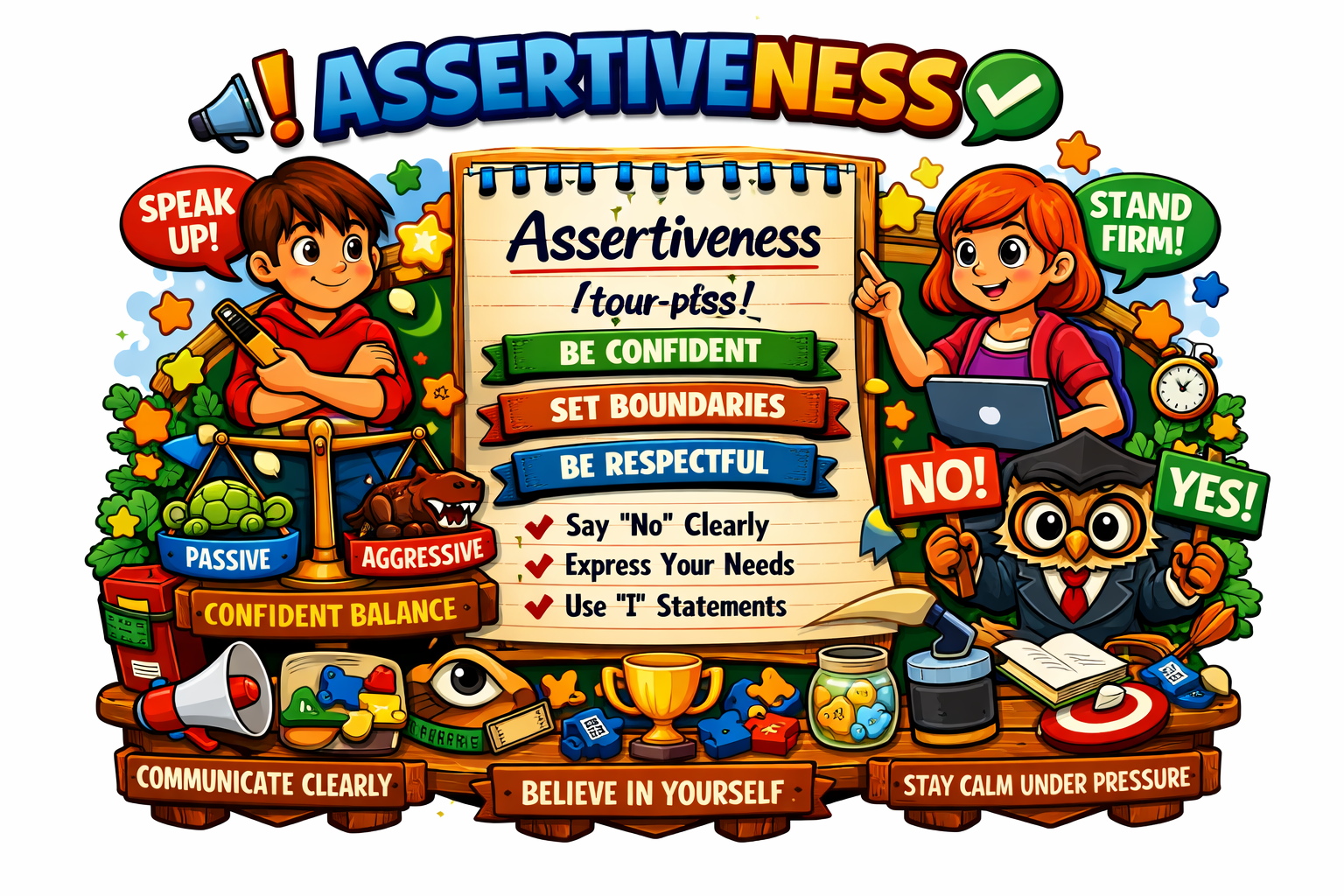
Assertiveness refers to the ability to express one's thoughts, feelings, needs, and opinions in a confident and respectful manner while maintaining personal boundaries. It involves effectively communicating and standing up for oneself without being overly aggressive or passive.
Assertiveness is the ability to express your thoughts, feelings, needs, and opinions clearly and respectfully without being aggressive or passive.
What is Assertiveness?
Assertiveness means communicating with confidence while respecting the rights, feelings, and opinions of others. An assertive person neither keeps silent out of fear nor forces others to accept their views.
Assertiveness is especially useful in interviews, group discussions, workplace communication, classroom participation, leadership situations, conflict handling, and everyday conversations.
| Situation | Non-Assertive Response | Assertive Response |
|---|---|---|
| You disagree in a meeting | I don’t know... maybe you are right. | I see your point, but I have a different view. |
| You need more time | I will somehow do it, even if I cannot. | I can complete it well if I get one more day. |
| Someone interrupts you | Stops speaking silently. | Please allow me to complete my point. |
| You cannot accept extra work | Yes, I will do it, even when overloaded. | I am currently working on urgent tasks, so I may not be able to take this up today. |
“Assertiveness is the courage to speak clearly with the discipline to remain respectful.”
Communication Tip
Key points
- Speak clearly and respectfully.
- Express your needs without fear.
- Respect others while expressing yourself.
- Use “I” statements instead of blaming language.
- Say no politely when needed.
- Maintain calm body language.
Passive, Aggressive and Assertive Communication
Assertiveness is best understood by comparing it with passive and aggressive communication styles.
Passive Communication
The person avoids expressing their own needs or opinions.
- Afraid to say no
- Avoids disagreement
- Allows others to decide everything
- May feel ignored later
Aggressive Communication
The person expresses views forcefully without respecting others.
- Blames or attacks
- Uses harsh tone
- Interrupts frequently
- Creates fear or conflict
Assertive Communication
The person expresses views clearly and respectfully.
- Speaks with confidence
- Uses polite but firm words
- Listens to others
- Maintains self-respect and respect for others
Passive-Aggressive Style
The person hides anger but shows it indirectly.
- Uses sarcasm
- Avoids direct discussion
- Shows silent resistance
- Creates confusion
Mini Assertiveness Strategy Bank
Tip: Assertiveness improves with practice. Start with simple situations before handling difficult conversations.
Common Assertive Expressions
| Purpose | Assertive Expression | Why it Works |
|---|---|---|
| Disagree politely | I understand your point, but I see it differently. | Shows respect while expressing disagreement. |
| Ask for clarification | Could you please explain what you mean by that? | Avoids confusion and keeps the tone polite. |
| Say no | I am sorry, but I will not be able to take this up today. | Sets a boundary without sounding rude. |
| Request time | I need some time to think before I respond. | Prevents impulsive or unclear answers. |
| Handle interruption | Please let me complete my point, and then I will listen to your view. | Maintains control without attacking the other person. |
| Give feedback | I appreciate your effort, but this part needs more clarity. | Balances appreciation with constructive feedback. |
| Ask for support | I need help with this section so that I can complete it properly. | Clearly states the need and the reason. |
| Express discomfort | I am not comfortable with this approach. Can we discuss another option? | Expresses concern without blaming. |
Note: Assertive communication is clear, direct, respectful, and solution-oriented.
Assertive Body Language
Assertiveness is not only about words. Your body language, facial expression, voice, and listening style also communicate confidence.
| Element | Assertive Behaviour | Avoid |
|---|---|---|
| Eye Contact | Maintain natural eye contact. | Staring aggressively or looking down constantly. |
| Voice | Use a calm, clear, steady voice. | Shouting, mumbling, or speaking too fast. |
| Posture | Sit or stand upright and relaxed. | Slouching, fidgeting, or appearing tense. |
| Facial Expression | Keep expression composed and appropriate. | Smirking, glaring, or showing irritation. |
| Listening | Listen fully before responding. | Interrupting or assuming the other person’s meaning. |
Practice
A) Multiple Choice Questions
-
Assertiveness means:
speaking rudely remaining silent always expressing oneself clearly and respectfully forcing others to agree
-
Which sentence is most assertive?
You never listen to me. I would like to complete my point. Forget it, I will say nothing. Do as I say.
-
Which communication style avoids expressing needs?
assertive passive aggressive confident
-
Which is a good assertive phrase for disagreement?
You are completely wrong. I understand your view, but I disagree. I will never talk again. Only my opinion matters.
-
Assertive body language includes:
shouting loudly looking down always calm voice and natural eye contact interrupting frequently
B) Rewrite Assertively
- Passive: Okay, I will do all the work even though I am busy. (Rewrite by setting a polite boundary.)
- Aggressive: You are wrong. Your idea is useless. (Rewrite by disagreeing respectfully.)
- Passive: I don’t mind. Anything is fine. (Rewrite by stating a preference.)
- Aggressive: Stop talking. I know better. (Rewrite by requesting a chance to speak.)
- Passive-aggressive: Fine, do whatever you want. It does not matter. (Rewrite by expressing concern directly.)
C) Identify the Communication Style
| Statement | Style |
|---|---|
| I respect your opinion, but I would like to suggest another approach. | Assertive |
| I will not say anything. Others can decide. | Passive |
| You must listen to me because I am always right. | Aggressive |
| No problem, I will do it, though clearly nobody cares about my time. | Passive-aggressive |
| I cannot take this up today, but I can help tomorrow morning. | Assertive |
Communication Reminder
Assertiveness is a key life skill. It helps people express ideas, handle disagreement, refuse unreasonable requests, ask for support, and maintain healthy relationships. A person who is assertive communicates with confidence, clarity, and respect.
Task: Write three situations where you need to be more assertive and prepare one respectful sentence for each.
Show Suggested Answers
Multiple Choice
- expressing oneself clearly and respectfully
- I would like to complete my point.
- passive
- I understand your view, but I disagree.
- calm voice and natural eye contact
Rewrite Assertively: Sample Answers
- I am currently busy with another task, so I will not be able to take all of this work today.
- I see your point, but I think this idea may need some changes.
- I would prefer the second option because it seems more practical.
- Please allow me to share my point, and then I will listen to your view.
- I am concerned about this decision and would like to discuss it openly.
Communication Style
- Respectful disagreement → Assertive
- Avoiding expression → Passive
- Forcing others → Aggressive
- Indirect complaint → Passive-aggressive
- Polite boundary with alternative → Assertive
Clue Explanation
Assertive communication is direct but respectful. Passive communication hides needs. Aggressive communication attacks or dominates. Passive-aggressive communication avoids direct expression but shows indirect resentment.
Practical tips
- Use calm and clear language.
- Use “I” statements instead of blaming others.
- Say no politely when necessary.
- Do not confuse assertiveness with aggression.
- Listen carefully before responding.
- Practise assertive sentences in real situations.
Select a topic and chapter from the left menu.